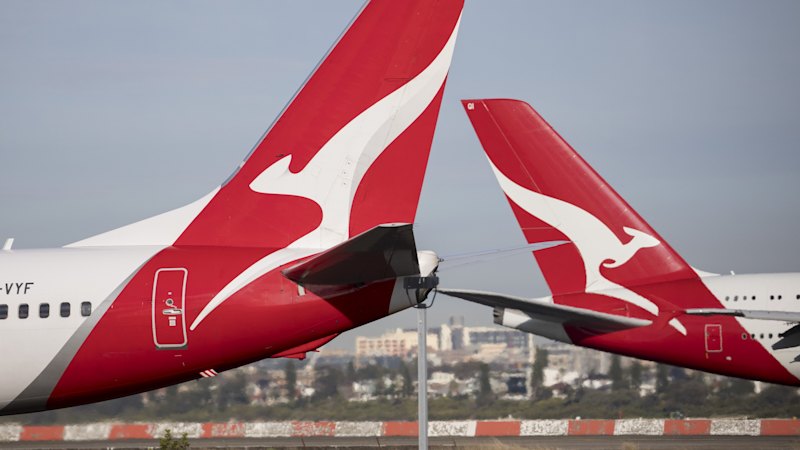

Qantas and its main union are at loggerheads over job security amid a wave of job cuts linked to the introduction of new technology at the carrier’s Sydney headquarters.
The Australian Services Union said workers were told they would be replaced by AI, but the union did not provide details of the claim, which the airline denied.
Qantas and the union will hold talks on Monday after 30 positions were made redundant at the company’s headquarters last week.
Thirty roles have been abolished as Qantas streamlines its management structure, and the consultation will decide whether staff in these roles can be redeployed to other roles and what redundancy benefits will be provided. The work was carried out at Qantas’ headquarters in Mascot, New South Wales.
ASU also wants to know whether the cuts are the first in a multi-tranche redundancy plan. The union said Qantas had a duty to consult about employment under the terms of the EBA, signed in January.
“Unless Qantas is prepared to immediately withdraw this announcement and begin full-scale consultation with the union and its members, we will have no choice but to lodge a challenge with the Fair Work Commission,” the union’s NSW Solicitor General Angus McFarland said.
Affected occupations include cargo transportation, crew support, finance, and airport services.
“Our members need to know that their jobs are safe,” McFarland said. “If a job becomes available, you need to know that your qualification will be paid for or you will be provided with training to apply for a new job.
“Just six months ago, when we negotiated a new agreement, Qantas refused to offer its members any protection against job losses due to AI. We now know why.”
Qantas denied that the job losses were related to AI, but did not dispute that other technologies were involved. The company said it continues to grow in other areas as well. It also said there should be no further job cuts as part of the restructuring plan to be announced in December 2025.
“We notified the Australian Services Union of this change last Wednesday and will meet with the Australian Services Union on Monday to discuss ways to reduce the impact on affected employees,” a company spokesperson said.
“This includes considering opportunities for redeployment into one of the new roles created by these changes, or into other roles across the group.”
The union also questioned whether the redeployment of laid-off staff was “genuine” with appropriate work, pay, responsibilities and shifts.
“Our members came to work on Wednesday and were sidelined and effectively told that their jobs would be replaced by AI and that they had four weeks to find another job,” McFarland said.
Asked for details, the union would not say what AI tools Qantas claimed it was using to fill its workforce.
The job cuts followed Qantas’ announcement on December 3 that it would reduce the size of its group management team while increasing the role of technology-focused executives.
In December, QantasLink chief executive Rachel Yangoyan was appointed chief technology officer, AI and transformation officer, overseeing the company’s “AI strategy, data and analytics, and enterprise technology-led transformation programme.”
At the time, CEO Vanessa Hudson said the company was seeking a group chief AI officer to “lead the adoption and expansion of AI across the organization,” and the search was ongoing.
Qantas is establishing a product innovation center in Adelaide to enhance its delivery of a “world-leading digital experience” to the millions of customers who fly with it each year.
Since taking over from Alan Joyce in 2023, Hudson has worked to improve morale and labor relations at the company amid intense criticism between employees and management. It was later revealed that the company illegally fired approximately 1,800 ground staff in 2020.
Mr Hudson praised the “amazing” efforts of his employees in 2024 and ordered a one-time “thank you” payment of $1,000 to 23,000 part-time employees. Last year, she went on to outline a non-executive employee share scheme that would provide employees with $1,000 worth of shares each year, linked to Qantas’ financial performance.
Despite efforts to rebuild trust between management and staff, the entire aviation industry is not immune to the impact of technology reshaping workflows and employment.
Even as airlines seek to control costs by updating their fleets with new, more efficient aircraft, the airline industry continues to innovate in ticketing, marketing, and operations, which can have a dramatic impact on costs.
Concerns about the impact of artificial intelligence are a recurring theme in a variety of industries, including education, financial services, and programming.
Qantas is scheduled to announce its first half results on February 26th.
The company performed well last year, with underlying revenue up 15% to $2.39 billion, driven by a surge in holiday travel, significant expansion at Jetstar and positive future outlook.
Our Business Briefing newsletter brings you top stories, exclusive coverage and expert opinion. Sign up to receive it every weekday morning..
 Chris Zappone is a senior aviation and business reporter. Former digital overseas editor.Connect via X, facebook or Email.