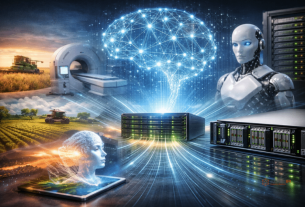
Can AI-powered holograms become university professors, presidents, and chancellors? Are we really on the path to an AI revolution that will make humans obsolete and replaceable? These questions are on people’s minds on college and university campuses everywhere, and many recent articles have noted the dramatic increase in anxiety about AI in higher education.
At a recent international healthcare conference, I had the opportunity to share a presentation with Stephen Klasko, a prominent digital health advocate. So he envisioned a return from 2035 and created a “time machine” to predict what the future of health care would be.
During our presentation, he conducted an interview with his future self, at least a three-dimensional, life-sized, AI-powered avatar of himself. Thanks to the wizardry of technology, Dr. Klasko’s life-sized avatar was able to answer prompts and coax convincing answers from language models. Avatar also responded when asked to tell an audience member a medical joke. “Why do doctors carry red pens?” in case they are asked to draw blood. This exchange caused consternation among the audience, but also raised a serious and striking question: “What does it mean to be human?”
Does AI-powered interaction with holograms mean such technology will begin to become possible? replace clinicians be patient‘s bedside?Can it serve as a substitute for telling the family and loved ones of the deceased? Or can the signs and signals we observe from a technology-obsessed culture tell us something?
human element healthcare training
We have established a culture and society obsessed with instant connections through technology. As a result, we have seen a corresponding crisis develop around loneliness, isolation, depression, and anxiety. Despite instant access to others through text messages, FaceTime, Snapchat, TikTok, and a wealth of ubiquitous technology, more and more people are suffering from a loneliness crisis.
michael avaltroni
At Fairleigh Dickinson University (FDU), we believe these signals can tell us a lot about our future direction. As humans, we are wired to connect with others. We crave conversation, human touch, contact, and relationships. My institution’s focus on health, wellness-adjacent professional programs challenges us to not only educate skilled clinicians, but also to train a generation of healthcare professionals who understand the need to harness the power of technology while being rooted in humanity.
Preparing students for the future
We fully believe in the need given the increasing use and amazing application of AI, advanced technologies, and rapid innovation in the transformation of healthcare. prepareare doing to our students use these technologyJesus By learning the three important pillars of literacy: technical literacy, data literacy, and human literacy.
Universities of the future will need to redefine higher education around the new and necessary purpose of educating for competency, connection, and human-centered design.
At its core is the integration of humanics, often described as the study, understanding, and development of key human attributes, as a new way to foster interdisciplinary collaboration in education, technology, and the human construct in an AI-driven world. This speaks to the urgency of building healthcare teams that optimize all advances in AI with humans at the center: students, clinicians, and patients.
By rethinking health care education and incorporating the humanities throughout our programs, we are working to ensure that health care students graduate with both the technical proficiency to use the tools of modern medicine and the human ability to see, hear, and care for the people in front of them. The future of healthcare will be shaped not only by our ability to innovate, but also by our ability to continue to make strong connections between people.
pillar of humanities
FDU focuses on the five pillars of the humanities: empathy, agility, cultural competency, creativity, and critical thinking. Fueling our efforts is the creation of the Humanics Living Laboratory and the Humanics Innovation Challenge Fund. This is an interdisciplinary program to develop a “human AI translator” that combines intelligence, emotion, and algorithms.
We have an opportunity to redefine higher education in the age of AI.
We are creating a future that incorporates key human-centered values that lead to care for the whole person. The goal is not to teach about AI; Educating and improving human work through AI We will embed the value of human connections at the heart of medical care.
With this foundational work, we believe we are poised not only to reimagine education, but to create the campus of the future. We envision a place for traditional path students to live and study alongside older adults in a university-based retirement community. Here, early-career medical professionals live next door to families and college students. And most importantly, whole-person health integration guides new ideas, innovative advances, and purposeful efforts to build communities that deliver on the promise of integrating the health and well-being of the whole person across all living environments.
We have an opportunity to redefine higher education in the age of AI. Rather than thinking about how to replace presidents and college presidents with AI bots, we believe the future presents an opportunity to create a new generation of learners who are preparing to become unique people in a technologically advancing world. With this goal in mind, rather than fear being replaced by technology, we must harness technology alongside our humanity and be empowered by its ability to change the world.
Michael Avaltroni,fairy dickinson universityIn New Jersey.

 michael avaltroni