
Stephen Klein, Co-Founder and CEO of Savory – February 18, 2026
For more than a decade, restaurant technology strategies have focused on creating a “single view of the guest.” Telcos are investing heavily in POS integrations, loyalty platforms, CRM platforms, CDPs, and marketing automation tools for deeper customer insights.
Most restaurant brands now have more data than ever before. But many still struggle with converting that information into actions that drive revenue in real time. The challenge is no longer data collection. It’s an intelligence activation that uses customer signals to impact discovery, conversion, and retention in the moments that matter most.
As artificial intelligence reshapes digital discovery, ordering, and engagement, the next competitive advantage won’t come from who has the most data. It depends on who can integrate and operationalize customer intelligence across the entire guest journey.
Limitations of a fragmented technology stack
Modern restaurant technology stacks are powerful but often fragmented. Guest data typically resides across point-of-sale and transaction systems, loyalty and CRM platforms, online ordering providers, third-party marketplaces, marketing and advertising tools, and brand-owned web and mobile experiences.
While integration has improved visibility, it rarely provides true real-time intelligence. Many brands still rely on batch data processing, lazy segmentation, or static personalization rules that cannot adapt to actual guest behavior. By the time insights surface, the opportunity to take action has often passed.
Meanwhile, customer expectations have changed dramatically. Guests now expect personalized recommendations, contextual offers, and a seamless digital journey, whether they’re discovering a restaurant through search, browsing menus online, or ordering through apps and marketplaces. The gap between expectations and execution continues to widen, and AI is accelerating that change.
What unified customer intelligence actually means
Unified customer intelligence means more than centralizing data in a warehouse or CDP. You need the ability to continuously analyze behavioral signals, apply predictive models in real-time, and instantly trigger personalized experiences across channels.
Most importantly, you need measurements that connect that experience to business outcomes such as revenue, margins, and customer lifetime value.
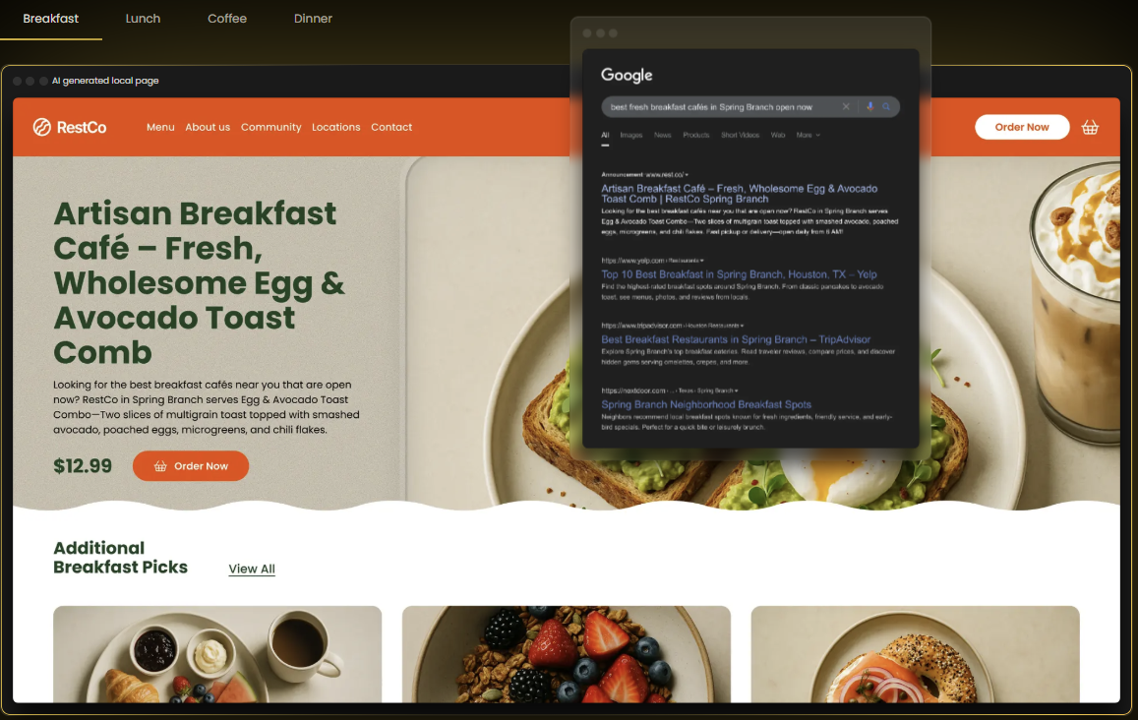
This shift is especially important as digital discovery becomes more dynamic. Search engines, marketplaces, and AI-driven assistants are increasingly shaping the way guests discover and evaluate restaurant options. In many cases, digital experiences now determine brand choices long before guests enter a physical location.
Restaurants that can adapt their digital experiences in real-time can see measurable benefits in conversion, average order value, and retention. People who cannot risk becoming invisible in an increasingly AI-driven discovery environment.
AI redefines the digital front door
AI is already impacting key elements of the restaurant customer journey, including search visibility and rankings, menu navigation, decision support, recommendation engines, marketing optimization, and loyalty engagement.
 For restaurant technology leaders, the key question is no longer whether AI will impact operations. It’s all about how quickly brands can operationalize it responsibly and effectively. Many are realizing that success depends less on adding new point solutions and more on rethinking data flows, orchestration, and ownership.
High-performing organizations are increasingly prioritizing real-time data pipelines that allow them to respond immediately to guest actions rather than delaying campaign launches. They employ a composable technology stack that allows them to deploy new AI capabilities without rebuilding their core infrastructure. And they’re investing in first-party identity strategies. Improve personalization, measurement, and long-term customer value.
Equally important is cross-functional data ownership. Marketing, operations, and technology teams must align around a common definition of success and access to insights. Without this coordination, even the most advanced tools cannot have meaningful effects.
Business impact: Not just experience, but profits
Personalization is often framed as a guest experience initiative. In fact, its greatest value is economic. Restaurants that successfully operationalize customer intelligence consistently see improvements in average order value through contextual recommendations, marketing efficiency through better targeting and reduced waste, customer lifetime value through increased retention, and improved channel mix through enhanced internal performance.
In a margin-constrained industry, these improvements compound quickly. As AI adoption accelerates, restaurant CIOs and CTOs need to focus on three fundamental areas:
- Data integration with real-time accessibility. Move beyond static data integration to systems that support real decision-making and personalization.
- A clearly defined intelligence layer strategy. Determine where predictive models reside and how they are activated across channels.
- Measurement that connects technology to financial outcomes. Shift metrics of success from engagement to impact on revenue, profit contribution, and lifetime value.
A gap in competitiveness is forming
The restaurant industry is entering an era where customer intelligence increasingly separates leaders from followers. Brands that can integrate data, responsibly deploy AI, and operationalize intelligence across the entire guest journey will reap advantages in both growth and profitability.
Companies that continue to treat data as a reporting tool rather than an operational engine risk falling behind as digital discovery and AI-driven ordering continue to evolve. The next era of restaurant growth won’t be determined by who has the most technology. It is defined by who can turn customer intelligence into real-time action.
Stephen Klein is the co-founder and CEO of Savory, an AI-powered restaurant technology company founded in Houston in 2025 by a team of restaurateurs and software innovators. The company helps restaurant brands drive discovery, conversion, and loyalty through intelligent automation and data-driven insights. Savory’s platform includes AI-powered ordering, dynamic local pages, AI app integrations, and smart marketing workflows that simplify operations while enhancing your company’s digital performance and guest engagement. Previously, he was Vice President of Strategy and Business Operations at e-commerce unicorn Cart.com, led seed funding and strategic finance at financial automation SaaS startup FinOptimal, and spent nearly a decade as a software and internet investor at PRIMECAP Management, which has $150 billion in assets under management. He began his career at Bain & Company. Stephen holds bachelor’s and master’s degrees in engineering from Stanford University and an MBA from the Stanford Graduate School of Business.
Are you an industry thought leader with a perspective on restaurant technology that you would like to share with our readers? If so, we encourage you to review our editorial guidelines and submit your article for consideration for publication.