MLIS researchers design AI-themed game for academic libraries
The library is the place to go when you have questions. People now have many questions about artificial intelligence (AI) and its place in the workforce, recreation, arts, research, commerce, and more.
But AI, primarily generative AI, is advancing so fast that many librarians are trying to catch up. Although they have made progress in learning more, they may not be comfortable using the technology themselves, let alone explaining how it works to students who want to use it in their projects.
H. Blake-Lee ’19 ’22 MA, a graduate student at UNC Greensboro, wants to move that needle. “I earned my Master of Science in Information and Library Science (MLIS) not specifically to work as a librarian, but to work with communities within libraries,” she explains. “My job focuses on bridging different perspectives, and I think it’s really important to initiate these connections within the company.”
While researching her IRB-approved magnum opus, “Understanding Generative AI in Academic Libraries,” a few statistics stood out.
Although the majority are aware of AI-related concerns, “librarians only have a level of comfort and confidence in using, teaching, and talking about AI in the 30-35% range,” she says. “About 70% want to learn about AI, but not from computers. They want to learn from interacting with other people.”
Bridging the gap between “what you want to know” and “what you know”
Blake-Lee recognized that librarians’ diverse perspectives and emotional conflicts make open discussion about AI in academic settings more difficult.
Her proposal focuses on sharing her capstone research results in lectures and conferences, as well as using hands-on gameplay to foster conversation and social connections.
First of all, how does someone without a computer science degree visualize the process, results, and long-term effects of computers communicating fast responses to humans?
Fortunately, Blake Lee’s previous studies at UNCG, where she earned a bachelor’s degree in studio art and a master’s degree in sociology, helped connect this new challenge to what people have been doing for generations.
From family photos to generative AI recognition
Have you ever looked at an old family photo? You know you’re doing more than looking back at that tiny moment you captured. Your mind cycles through positive, negative, or mixed memories and emotions related to the event or the people involved.
If you show the photo to other family members, they may have different reactions based on their own perspectives on the experience and the rest of their lives. “I fell in love with this type of research method by using visual objects and seeing how it creates a buzz,” says Blake Lee.


Blake-Lee also built on her background in game design and community-centered research. For example, she has helped develop programs focused on art and music at the McGirt-Houghton Public Library and board games for people with intellectual and developmental disabilities at the nonprofit InFocus Advocacy.
To strengthen the educational foundation of the AI-focused game, she conducted additional data collection at libraries and museums in Greensboro and around the world. Thanks to her study abroad experience at MLIS, led by Dean Lisa O’Connor, she was able to visit art spaces in London, Prague, and across Italy, observing how different works of art provoke different discussions and interpretations.
“From our experience, we thought it best to introduce visuals that align with themes, especially AI, that people might have different perspectives on. We found that card games are a really great way to bring people together,” says Blake Lee.
put all her cards on the table
She invented the card game “Caution!” She received a $2,000 scholarship from Impact Through Innovation (ITI), the School of Education’s research funding program, to begin her research and development.
The cards include 200 illustrations, some generated by AI and some provided by local artists and UNCG alumni. Players are required to think of words and ideas related to AI based on the pictures they draw.
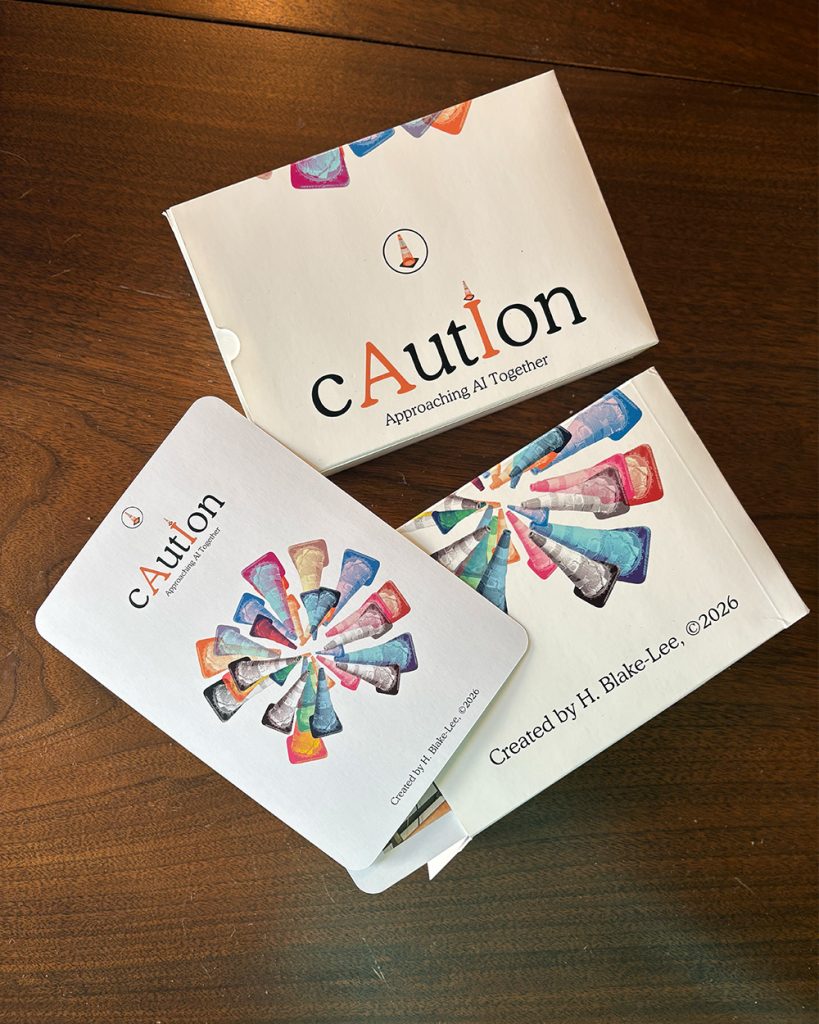
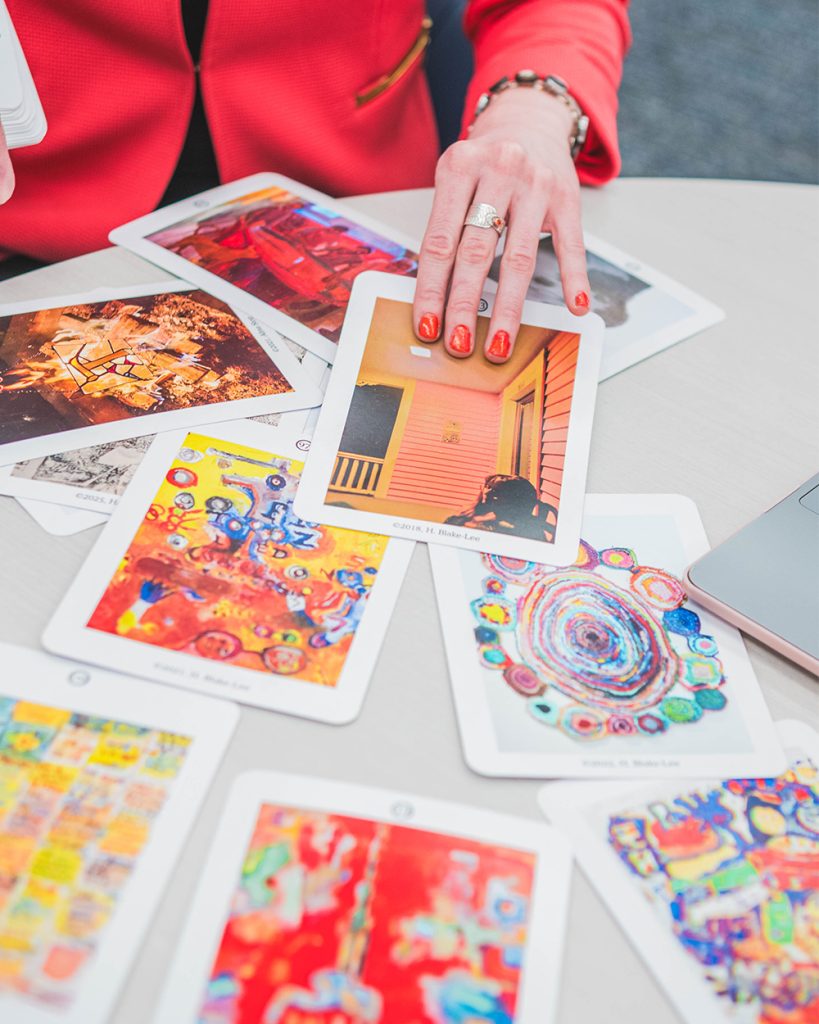
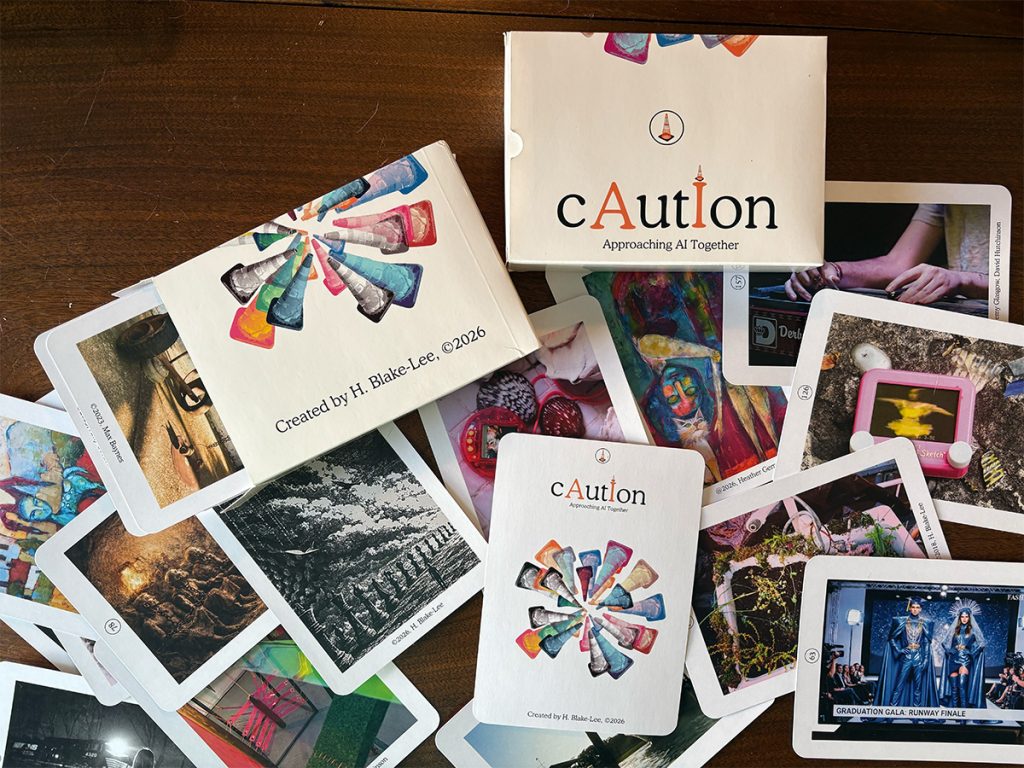
The key, Blakely said, is not to figure out what is AI, but to diversify the deck, allow librarians to absorb different types of digital art, and encourage further discussion between people with different perspectives on AI.
“During group play, everyone passes a card around and thinks of one word to describe it,” she says. “Everyone says their words out loud at the same time so they don’t affect each other’s perspective.”
From there, players search for the image they think best represents the other player’s words. You can then talk about why you associated that particular image with that word.
Each round of “Attention!” dialogue can be as long or short as needed. She says, “The key is to create a welcoming space for everyone to listen to each other, use cards to connect with others’ perspectives, and approach AI together.”
Faculty and staff have been essential in helping her create this, especially her faculty mentor, Dr. Sonia Archer Capuzzo. “Sonia is a great resource to rely on,” says Blake Lee. “I could always ask if I could meet with her for a few minutes. Her help with writing proposals and meetings led to my success in many educational endeavors.”

Learn more about AI implementation
Blake-Lee also worked closely with Steve Cramer of MLS. He is a business librarian and university library professor who studies how AI is integrated into his field. Cramer and Blake-Lee will present a webinar on new AI tools available through academic publishers.
“AI assistant in academic databases (search expansion generation)”
February 17th, noon to 1:00 p.m.
It is free to all students, faculty, and staff. Please register in advance.
The next step, expand your global footprint
With support from ITI, Blake-Lee hopes to adapt the game to different types of libraries and, one day, other professions. She collects feedback from early players about their interpretation of the visuals and the discussions the game has sparked.
“We’ve also been talking about bringing AI into counseling groups for people who become so connected to AI that they become disconnected from relationships,” she says. “Social, emotional and educational scenarios still have a lot of room to explore.”
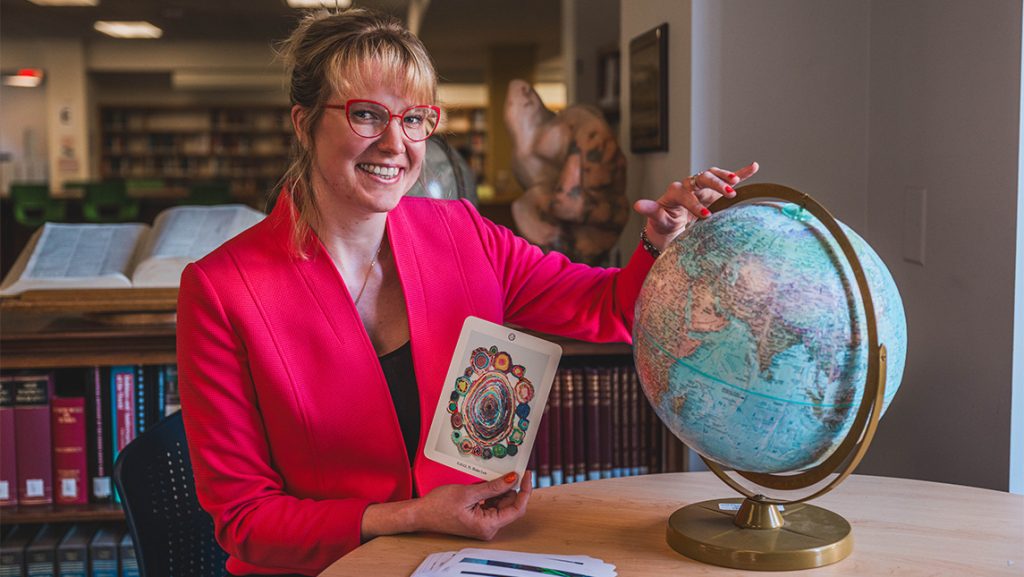
Her work has also piqued the interest of people outside of UNCG. While studying abroad, she was able to speak with staff at the National Library of Ireland. They thought her visual card game approach could be a viable art research tool and brought her back to the Atlantic side for future collaborations, and discussed using the art collection for similar games and community-centered research.
For Blake-Lee, it’s exciting to see her research become part of the global conversation about AI and ultimately help librarians feel like they understand rapidly evolving technology.
“What we’ve learned from our research is that just because everyone has different interpretations, connections, understandings, and perceptions of AI, it doesn’t mean we can’t work together to provide students with the resources they need to succeed,” she says.
Article by Janet Imrick, University Communications Department
Photo by Sean Norona, University Communications. Courtesy of H. Blake-Lee, School of Information, Libraries, and Research Sciences.
Build knowledge and knowledge centers.