
image:
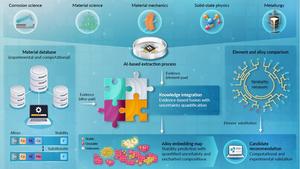
This study shows that A hybrid framework that integrates material data and AI-extracted scientific knowledge to enable uncertainty-aware discovery. Evidence for elemental substitution in alloys is collected from two independent sources. One is a materials dataset showing which elements can be replaced by pairs of alloys with matching properties, and the other is a large language model queried across five scientific disciplines. These “streams of evidence” are combined using Dempster-Schaefer theory to evaluate candidate alloys while explicitly quantifying confidence and uncertainty in predictions, guiding researchers to promising candidates while flagging areas where current knowledge is inadequate.
view more
Credit: Hieu-Chi Dam, Japan Advanced Institute of Science and Technology.
Ishikawa prefecture–High-entropy alloys are promising advanced materials for demanding applications, but the vast number of possible element combinations makes finding useful compositions difficult and expensive. Researchers have now developed a new AI-driven framework that integrates interdisciplinary expertise extracted from experimental data, computational modeling, and scientific literature. By combining these sources in an uncertainty-aware manner, their approach is able to make reliable predictions even for poorly studied alloy compositions, outperforming traditional data-driven machine learning methods that rely solely on training data.
Advances in modern technology rely on advanced materials such as alloys used in aircraft engines and parts with corrosion and heat resistance in industrial environments. In this context, high-entropy alloys (HEAs) have emerged as one of the most promising research areas in materials science. By combining several elements in approximately equal amounts, these materials can provide superior strength, stability, and durability. However, discovering useful HEAs is very difficult and expensive because each additional element dramatically increases the number of possible combinations. As the demand for sustainable energy technologies and next-generation electronics increases, it becomes increasingly urgent to accelerate the discovery of advanced materials.
Researchers around the world are turning to artificial intelligence (AI) as a powerful aid to materials research, but it has its limitations. Most machine learning models are good at interpolation. This means that you can predict material that is very similar to the material already in your training data. When researchers consider truly new configurations beyond their familiar territory, model accuracy decreases. On the other hand, decades of expertise on how elements interact and replace each other within HEAs are buried in the scientific literature, and there is no clear way to integrate that expertise into data-driven AI tools.
Against this backdrop, a research team led by Professor Hieu-Chi Dam of the Japan Advanced Institute of Science and Technology (JAIST) has developed a new AI-driven framework for HEA discovery. Their research was published in the journal digital discovery The paper, published on December 19, 2025, was co-authored by JSPS researcher Dr. Minh-Quyet Ha, JAIST doctoral student Dinh-Khiet Le, Dr. Viet-Cuong Nguyen from HPC Systems in Japan, Professor Kino Hiori from the Institute of Statistical Mathematics in Japan, and Professor Stefano Curtarolo from Duke University in the US. The team set out to combine experimental and computational material data with interdisciplinary expertise extracted directly from scientific publications to create a system specifically designed to work in data-poor and unexplored areas.
Central to this approach is a well-known idea in alloy design called elemental substitution. Under optimal conditions, chemically similar elements can be substituted for each other without significantly affecting the properties or stability of the material. The researchers first identified substitution patterns directly from a large material dataset by comparing alloys that differ in just one element. We then used state-of-the-art large-scale language models (LLMs) such as GPT-4o, GPT-.5, Claude Opus 4, and Grok3 to extract expert judgments from literature related to five major scientific fields: metallurgy, solid state physics, materials mechanics, materials science, and corrosion science.
Each source provided a piece of evidence rather than the final answer, and this information was combined using a mathematical framework known as Dempster-Shafer theory. Unlike standard probability methods, this framework can explicitly represent uncertainty and even ignorance, as Professor Damm explains.Traditional classifiers force binary “yes or no” predictions even when there is insufficient information. Our approach explicitly quantifies uncertainty and allows for “indecision” to be a valid scientific outcome.Simply put, the proposed system does not pretend to know any more than when exploring unknown territory.
When tested on several alloy datasets, the team’s framework consistently outperformed traditional machine learning models, especially when little information was available. . Most impressively, they were able to predict the behavior of alloys containing elements that were completely absent from the training data, achieving an accuracy of 86% to 92%. The researchers also validated their approach against 55 experimentally confirmed quaternary alloys from the literature and showed that it outperformed much more computationally expensive methods such as free energy models. The proposed method can go beyond individual predictions to produce compositional maps that indicate where predictions are reliable and where uncertainty remains high. This allows researchers to focus their experiments on the most promising and informative regions of compositional space.
Professor Damm said the broader significance of this research is in showing how AI can be used for scientific discovery. “Combining LLM-based extraction with formal evidence fusion can transform decades of dispersed expertise into a searchable, comparable, and quantitatively available resource. This is particularly valuable for interdisciplinary problems where relevant insights span multiple disciplines.“In particular, the same approach used in this study could accelerate drug discovery, guide battery development, and help optimize catalysts. In each case, the framework’s ability to quantify uncertainty can help research teams prioritize the most informative experiments, potentially reducing discovery timelines and costs.”
Overall, this study shows the way forward for AI in scientific discovery. This means that machine learning does not replace expert judgment, but rather systematically extracts it and combines it with experimental evidence to accelerate innovation across disciplines.
###
reference
|
About Japan Advanced Institute of Science and Technology
The Japan Advanced Institute of Science and Technology (JAIST) was established in Ishikawa Prefecture in 1990 and is the first independent national graduate university with its own campus in Japan. After 30 years of steady progress, JAIST is now one of Japan’s top universities. JAIST strives to develop talented leaders through a state-of-the-art educational system that places diversity as the key. Approximately 40% of graduates are international students. The University employs a unique graduate education style based on a carefully designed, coursework-oriented curriculum to ensure that students have a solid foundation to pursue cutting-edge research. JAIST also works closely with local communities and overseas societies, such as by promoting industry-academia joint research.
About Professor Hieu Chi Dam, Japan Advanced Institute of Science and Technology
Dr. Hieu-Chi Dam is a professor at Japan Advanced Institute of Science and Technology (JAIST) and Tohoku University International Center for Synchrotron Radiation Innovation. He received a master’s degree and a Ph.D. degrees from JAIST in 2000 and 2003, respectively. His research focuses on data science and materials informatics, integrating first-principles calculations, machine learning, and diffraction physics to study magnetic materials, superconductivity, and strongly correlated systems. He has published over 90 papers on these topics.
Funding information
This research was supported by the JST-CREST Program (Innovative Measurement and Analysis) (grant number JPMJCR2235, JSPS KAKENHI Grant Number 20K05301, JP19H05815, 20K05068, 23KJ1035, 23K03950, JP23H05403). The SC acknowledges support from the US-DoD (ONR MURI program number N00014-21-1-251). Hong Kong gratefully acknowledges the support from the ASPIRE program in the “International Collaborative Research Network for Advanced Atomic Layer Processes” project of the Japan Science and Technology Agency (JST). The authors would like to thank Dr. Juan Tran and Dr. Xiomara Campilongo for fruitful discussions.
journal
digital discovery
Article title
Beyond interpolation: Integrating data and AI-extracted knowledge for high-entropy alloy discovery
Article publication date
December 19, 2025


