
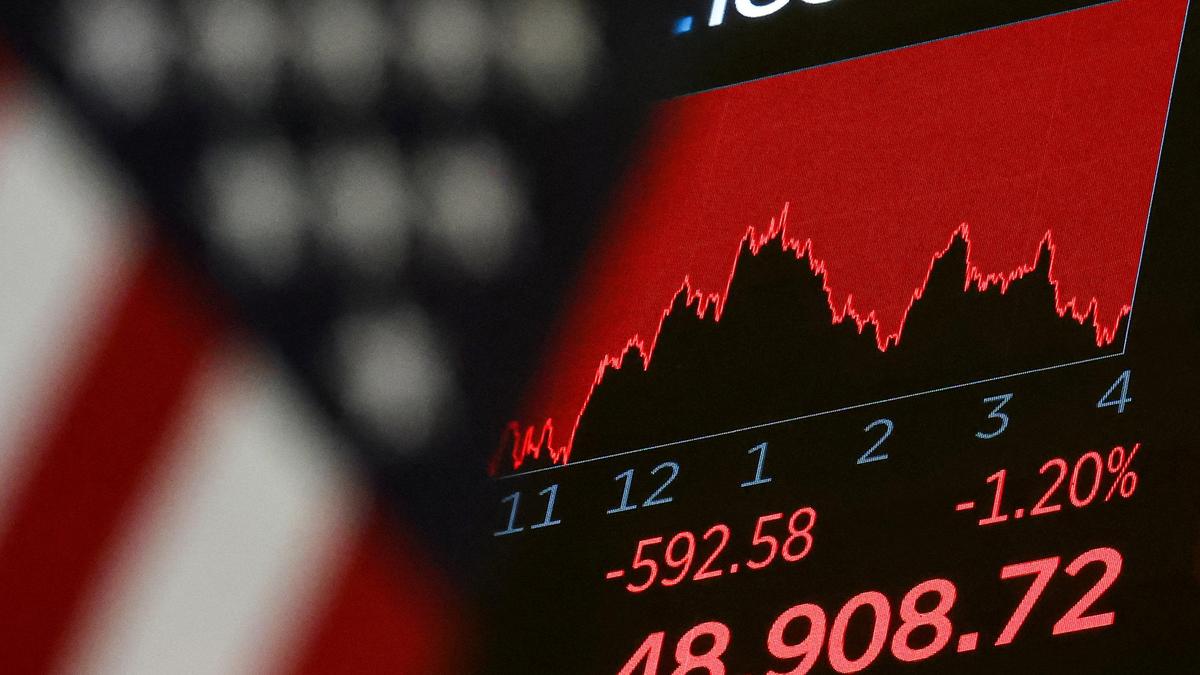
Shares of U.S. software and data services companies widened for a seventh day in Thursday trading as investors worried that rapidly advancing artificial intelligence tools could upend the sector. The S&P 500 Software and Services Index fell 4.6%, losing about $1 trillion in market capitalization since Jan. 28 in a decline dubbed “Softwaremageddon.”
Big tech companies hardest hit by the rout include ServiceNow, down 7.6%, Salesforce, down 4.7%, and Microsoft, down 5%.
“I would classify this as an all-sell mindset at this point,” said Dave Harrison-Smith, chief investment officer and head of technology investments at asset management firm Bailard.

Canada-based Thomson Reuters, which suffered a record single-day drop earlier this week after investors expressed concerns that Anthropic’s new Claude plug-in could disrupt the firm’s legal operations, fell 5.6% despite increasing its dividend and reporting fourth-quarter results that were mostly in line with expectations.
The company, which owns the Westlaw legal database and Reuters news agency, said it is seeing tangible benefits from its AI investments.
“Uncertainty surrounding the ultimate impact of AI means that short-term financial results are an important signal of business resilience, but are often insufficient to disprove longer-term downside risks,” said Ben Snyder, chief U.S. equity strategist at Goldman Sachs.
This uncertainty also deters people from buying on the spur of the moment.
“We’re not buying on the edge, but we’re at a turning point,” said Nick Giorgi, chief equity strategist at Alpine Macro.
On Thursday, the S&P 500 Software and Services Index traded about 21% below its 200-day moving average, the furthest the index has been below a key technical level since June 2022.
“We’re talking about a multi-decade washout now… In general, that actually tends to be a pretty good entry point,” Giorgi said.
Bailard’s Smith said the drop in stocks likely presented a good opportunity for stock picking, but cautioned against expecting a quick rebound.
“It is very difficult to judge the bottom price during a market crash like this,” he said.
The decline in software occurred in parallel with a broader rotation away from technology and into value-oriented sectors such as consumer staples, energy and industrials, which lagged in the bull market that began in October 2022.
“We’re generally seeing people move away from risk from technology, and we’ve been seeing that trend since the beginning of this year,” said Andrew Wells, chief investment officer at Saint-Jacques Alpha in Houston.
Reflecting the bearish mood, short interest in mid- to large-cap software companies has risen over the past three months, with cybersecurity and SaaS (software-as-a-service) companies seeing the biggest growth in such bearish bets, according to data analysis firm Ortex.
Hedge funds’ exposure to software companies has declined sharply in recent days, but the funds remain net long in the industry, according to Goldman Sachs data.
“After years of technology-driven market leadership, the balance of power is shifting as investors move toward traditional ‘old economy’ sectors,” Angelo Kourkafas, senior global investment strategist at Edward Jones, said in a note.

The sell-off also spread to sectors exposed to software companies, such as asset management companies, amid concerns that they were lending through private credit. Alternative asset manager Blue Owl, which has been on the decline for 11 consecutive quarters, said in a post-earnings conference that its total exposure to the software sector now accounts for 8% of assets under management.
Performance of foreign tech stocks was mixed. London Stock Exchange Group shares ended 5.8% higher, data analytics firm RELX rose 2.9% and Netherlands-based Wolters Kluwer rose 2%.
In contrast, India’s software exporters index, which includes stocks such as HCL Technologies and Wipro, fell 0.7%, a day after falling 6% in its worst session in nearly six years.
Market volatility has spiked across stocks, commodities and digital assets in recent weeks, which market participants believe is due to leveraged investors being forced to exit positions rapidly.
Wall Street’s most closely watched CBOE Volatility Index, which measures investor anxiety, rose 3.13 points to close at 21.77, its highest close since Nov. 21.
Precious metals gold and silver resumed their decline on Thursday after a historic selloff earlier this week, with Bitcoin down 13% to $62,890.
“This is some kind of reset happening within the market with a lot of the relative bets off, but time will tell,” John Hardy, global head of macro strategy at Saxo, said on a podcast.
issued – February 6, 2026 9:38am IST


