Despite the excitement around AI within enterprises since ChatGPT was introduced to the public, the enterprise as a whole is still in the early stages of adoption. While it is clear that AI applications across IT and business operations will continue to steadily increase in 2026, most companies are still trying to identify the value proposition of various AI use cases.
As a result, most companies consider a small number of use cases and wait for other organizations to take the plunge with most AI initiatives. We expect these efforts to center on deploying AI-powered tools and processes across a wide range of low-hanging business activities, including staffing call centers, upper echelons of business planning, and the supply chain that delivers goods and services.
As with any prediction about the future of AI, a number of speculative and not-so-speculative assumptions are required, including:
- AI service providers and enterprises will be adopting a more sustainable approach to AI development, which will require many hardware, system, and software improvements. Chip and system designers are already creating GPUs and other AI-specific processors with significantly lower power consumption. Data center designers and engineers are taking advantage of advances in co-packaged optics and other photonics to move AI data centers to optical interconnects and networks to increase performance while reducing power consumption and heat generation. Additionally, AI developers continue to explore multiple ways to reduce the computational burden of training and inference.
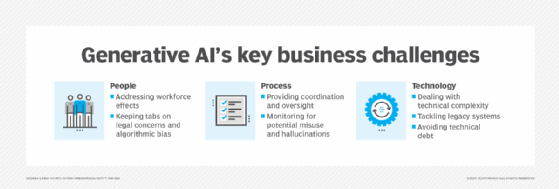
- As use cases increase, it is inevitable that small-scale problems caused by AI will continue to occur, and large-scale disasters by the end of 2030 are certainly possible. The AI catastrophe could spur highly restrictive U.S. regulations that hinder planned AI investments.
- Large-scale language models continue to suffer from hallucinatory problems due to errors or insufficient training. Safety measures are evolving, but it will take more than five years to fully resolve the issue.
- AI will continue to be plagued by security challenges, from data leaks to insider weaponization. Bad actors will use AI more extensively to automate previously manual parts of cybercrime workflows and disrupt AI deployment. For example, attackers can use voice bots to disrupt customer service call centers as a denial of service or social engineering attack.
The biggest impact AI will have on business over the next five years will be in the following key areas: Businesses are eagerly waiting for AI to become sufficiently powerful, flexible, and reliable. AI applications are speculative and not widely discussed.
contact center
Contact center chatbots have been a source of customer dissatisfaction for years. Advanced call handling is steadily improving in directing customers to problem-specific queues, providing FAQ answers, and gathering more and better information from callers to optimize the time spent by human agents after handoff. Over the past year or so, AI-driven chatbots have improved in quality, allowing call center operators to enhance their AI to become full-fledged call agents. Some contact centers have already downsized their human teams or hired fewer contract agents. Most contact centers are expected to have inexpensive AI chatbots as tier 1 support, more expensive agent AI bots as tier 2 support, and a small human staff serving as tier 3 escalation agents.
Communication with clients
One insurance company found that generative AI did a better job than most humans at communicating with insurance customers during the claims process. AI created clearer communications and was more empathetic towards customers than humans. We expect AI agents to have more autonomy when communicating with customers.
accounting and auditing
AI is automating the majority of financial audit applications, including customer expense reimbursement, telecommunications billing, accounts receivable, and other complex financial transactions. AI agents never suffer from fatigue, boredom, or distraction, and never forget the policies that guide audits. It can also discover patterns across vast amounts of transactions that humans might otherwise miss. AI is already acting as an audit assistant, allowing human auditors to focus on suspicious transactions. More companies are implementing AI for internal and external financial auditing, increasing the level of autonomy and reducing the number of people needed or needed.
Warehouse and distribution center staffing
Logistics centers and warehouses have experienced significant automation over the past few years using optimization algorithms and robots with limited functionality. This trend will accelerate and extend beyond large corporations like Amazon and Target to midsize companies and small businesses. AI will enable optimization of more types of operations at a more affordable price for a wider range of businesses. Agentic AI, packaged as a general-purpose warehouse robot, will take over all goods movement, especially container packaging, replacing the majority of human labor in medium to large logistics facilities.
delivery service
The adoption of self-driving cars in major cities is accelerating, and self-driving delivery trucks will follow. Initially, these trucks will make inter-business deliveries, such as from warehouses to stores, as they will require either humans or warehouse bots to pick up and drop off packages. Dedicated delivery bots, not necessarily general-purpose humanoid robots, could eventually enable truck-to-door deliveries to consumers. But small businesses will continue to rely on human-only deliveries until services like DoorDash and Instacart take the lead with AI-driven robotic deliveries.
Medium and long distance truck transportation
The benefits of self-driving medium- and long-haul trucks are compelling. The AI will never become drowsy while driving, take breaks, take detours, violate traffic laws, or stop for gas or non-traffic purposes. By 2027, fully and nearly self-driving trucks are expected to be a reality on some interstate highways and perhaps some state highways, such as California and Texas. By the end of 2030, large shippers will move most of their shipments through these truck-accessible corridors.
automatic cargo ship
Using agentic and physical AI technology to support self-driving vehicles and logistics robotics, autonomous cargo ships will employ a basic crew of humans who will primarily act as troubleshooters and perform tasks such as maneuvering, loading and unloading cargo. Some shippers may prefer to sail without humans, airdropping repair personnel when necessary, to avoid piracy attempts to kidnap or attack humans on board.
C-level management
The long-term trend is for more executive-level positions to be created that require greater human oversight and expertise. This trend could be reversed, especially in companies where mid-level management has been heavily automated, as AI-driven automation makes sense in certain areas of executive-level management, such as aligning the priorities and needs of different business units and direct reports. As a result, we expect AI to (re)integrate multiple C-suite positions, primarily in technologically aggressive companies.
middle management
Companies, developers, and professionals often focus on AI replacing entry-level jobs and even higher-level customer-facing jobs. Less attention has been paid to the potential for AI to replace lower- and mid-level managers in office environments. AI has the potential to organize and supervise employees more effectively than human managers when it comes to communication and reporting. AI has no egos, no career ambitions, no worries about pay. That said, higher-level managers may embrace the idea of handing over lower-level management responsibilities to AI. Technologically aggressive companies are expected to implement AI as line managers and further reduce the ranks of lower and middle management positions, even in areas where lower-level jobs are primarily occupied by humans.
project management
Most of a project manager’s responsibilities include tracking, organizing, and presenting information about the progress of a project. In large enterprises, it is expected that AI will be responsible for almost all simple project management tasks, while human project managers will be mostly focused on creating project plans. AI can help you monitor your entire project portfolio, predict resource conflicts, and troubleshoot.
John Burke is CTO and Research Analyst at Nemertes Research. Burke joined Nemertes in 2005 with nearly 20 years of technology experience. He has worked at all levels of IT including end-user support specialist, programmer, system administrator, database specialist, network administrator, network architect, and systems architect.