
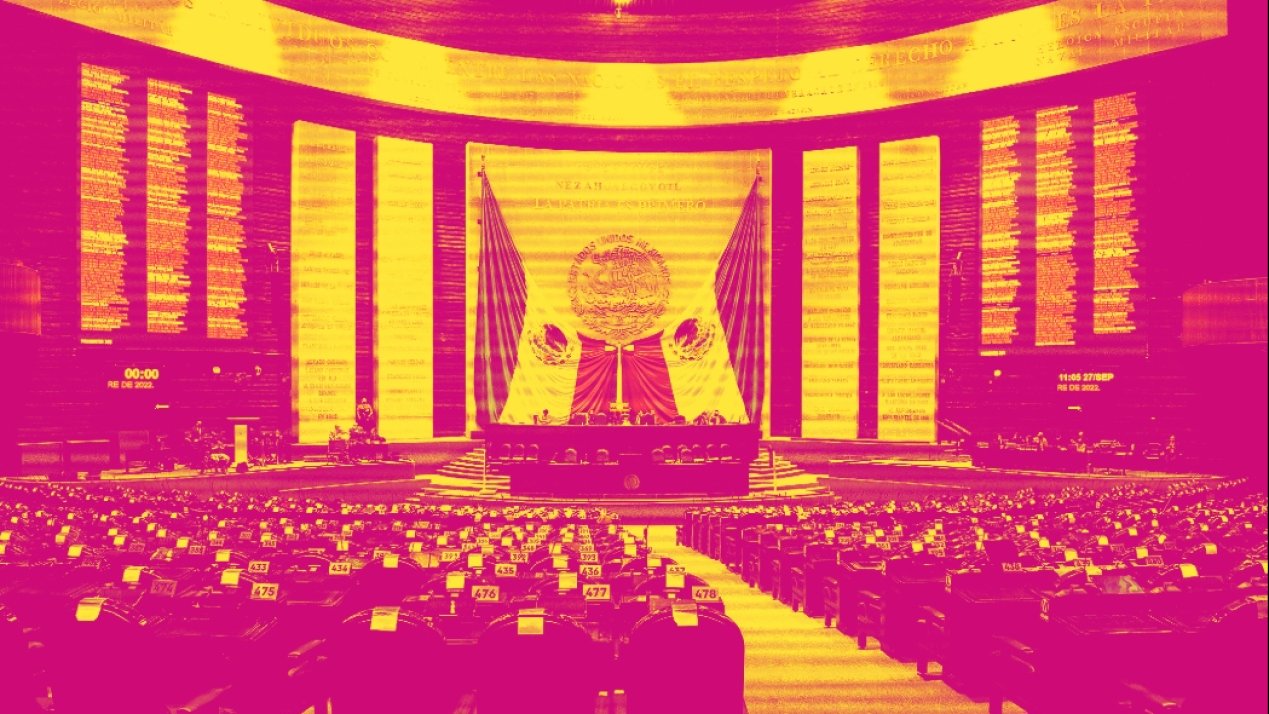
A recent study published in Nexos Magazine claims that Mexican lawmakers are increasingly using AI in speeches. Researchers have documented a 70% increase in the use of AI linguistic markers within parliamentary speeches in the Mexican Congress since September 2024, arguing that this marks a shift to a hybrid model of political expression.
The use of AI by legislators has been documented in many countries. “This is an incredible development, but it raises serious questions about autonomy, accountability, fairness, safety, morality and even ownership of creativity,” said Luke Evans, a member of the House of Commons in 2022, during the publication of the first AI-generated speech in the chamber.
Integrating large-scale language models (LLMs) into the legislative workforce is a global trend driven by operational efficiency. On June 30, 2025, PAN Senator Mario Vázquez allegedly used ChatGPT to frame a speech opposing the abolition of the Federal Commission for Economic Competition (COFECE). Then, on November 28, 2025, Vázquez was allegedly seen urging the Attorney General to make a statement regarding his resignation.
In 2024, the Inter-Parliamentary Union (IPU) issued guidelines on the use of AI in parliaments, warning that without a regulatory framework, automated debate could undermine political will and public accountability. In Mexico, where 66% of the population uses AI tools, legislators are beginning to replicate mass-market usage patterns to integrate large amounts of documents.
Methodology, statistical findings, and global benchmarks
This study, published in Nexos Magazine, provides a systematic measurement of this phenomenon. To identify AI-assisted speech, researchers developed a methodology to analyze linguistic traces in House records.
In this study, we established a controlled environment by generating an “artificial bleacher” (artificial tribune). This dataset consists of speeches created using standardized prompts in ChatGPT and Gemini. The researchers held fixed variables such as institutional register, gender, political party, and tone. To induce ideological differences, the team included each party’s principles as input. The distribution of tones included conciliatory, critical, emphatic, moderate, aggressive, reformist, technical, and emergent styles. This corpus allows the AI model to identify specific words and phrases that repeat when drafting in Spanish.
Once the catalog of traces was completed, the researchers evaluated the intervention from the LXVI Congress. The researchers analyzed 13,330 sounds expressed in approximately 7 million words from September 1, 2021 to October 28, 2025. By using Z-scores to compare monthly levels to a typical baseline for that period, we found that the AI markers increased significantly from September 2024. During this period, typical AI words appeared about 70% more than the previous year. Structural patterns also increased by 60% over the same period.
This study integrated a composite style measure that combines lexical markers, structural expressions, and argumentation sequences (e.g., “first, second, third”). The researchers said this pattern was confirmed with simultaneous increases in both the House and Senate. In September 2024, the monthly average of the AI index in the House of Representatives increased by 70%. This statistical break suggests that Congress is already operating in a hybrid mode, with the proportion of public debate structured through the aid of algorithms, the study claims.
Global use of AI
The IPU report, The Role of AI in Parliament, identifies several areas where AI can transform legislative functions beyond speechwriting. These applications provide a B2B framework for modernizing your organization.
-
Legislative research and analysis: Machine learning algorithms analyze vast amounts of documents and identify patterns and trends. These systems facilitate evidence-based policy development by integrating disparate sources of information for decision makers.
-
Automated management: Technologies such as natural language processing (NLP) and robotic process automation (RPA) automate routine tasks. This includes scheduling meetings, drafting agendas, managing documents, and more. Reducing these repetitive tasks increases the productivity of legislative research departments and other executive departments.
-
Transparency and accessibility: AI tools generate real-time transcripts of debates and create plain language summaries of complex bills. This makes information about the law more understandable to the public and increases public engagement.
-
public engagement: AI-powered chatbots provide personalized responses to voter inquiries, and sentiment analysis tools monitor social media to gauge public opinion on specific legislative topics.
In the United States, the National Conference of State Legislatures (NCSL) reports that more than 44% of legislators or their staff will use AI in their daily work by 2025, up from 20% the year before. However, in 45% of cases, these tools operate without ethics policies or internal rules.
Researchers argue that the fundamental problem is not the technology itself, but the fact that it is being incorporated without traceability or training. The absence of a regulatory framework in Mexico poses several risks to the health of the system, including:
-
algorithm hallucination: Risk that AI-generated content contains false information or non-existent jurisprudence that can be incorporated into the text of the law.
-
dilution of will: As Professor Hannah F. Pitkin of the University of California, Berkeley, argues, expression involves acting in the name of another person based on an identifiable will. AI could obfuscate this will by producing generic formulations.
-
erosion of trust: Mexico’s legislative authority already operates with low public trust. The use of private algorithms in sensitive discussions such as electoral reform could further undermine the legitimacy of the system.
To mitigate these risks, international best practices recommend maintaining a registry of prompts used by staff and ensuring that all content generated is subject to human review. Some councils have developed their own systems that utilize their own legal databases to reduce the risk of sensitive information being compromised.
In Mexico, a technology-assisted transition to parliament is a reality. The researchers argue that the frequency of AI-specific structural patterns has changed the nature of parliamentary debate. Establishing a governance framework is essential to ensure that AI acts as a tool to enhance efficiency rather than a source of opacity in the legislative process.


