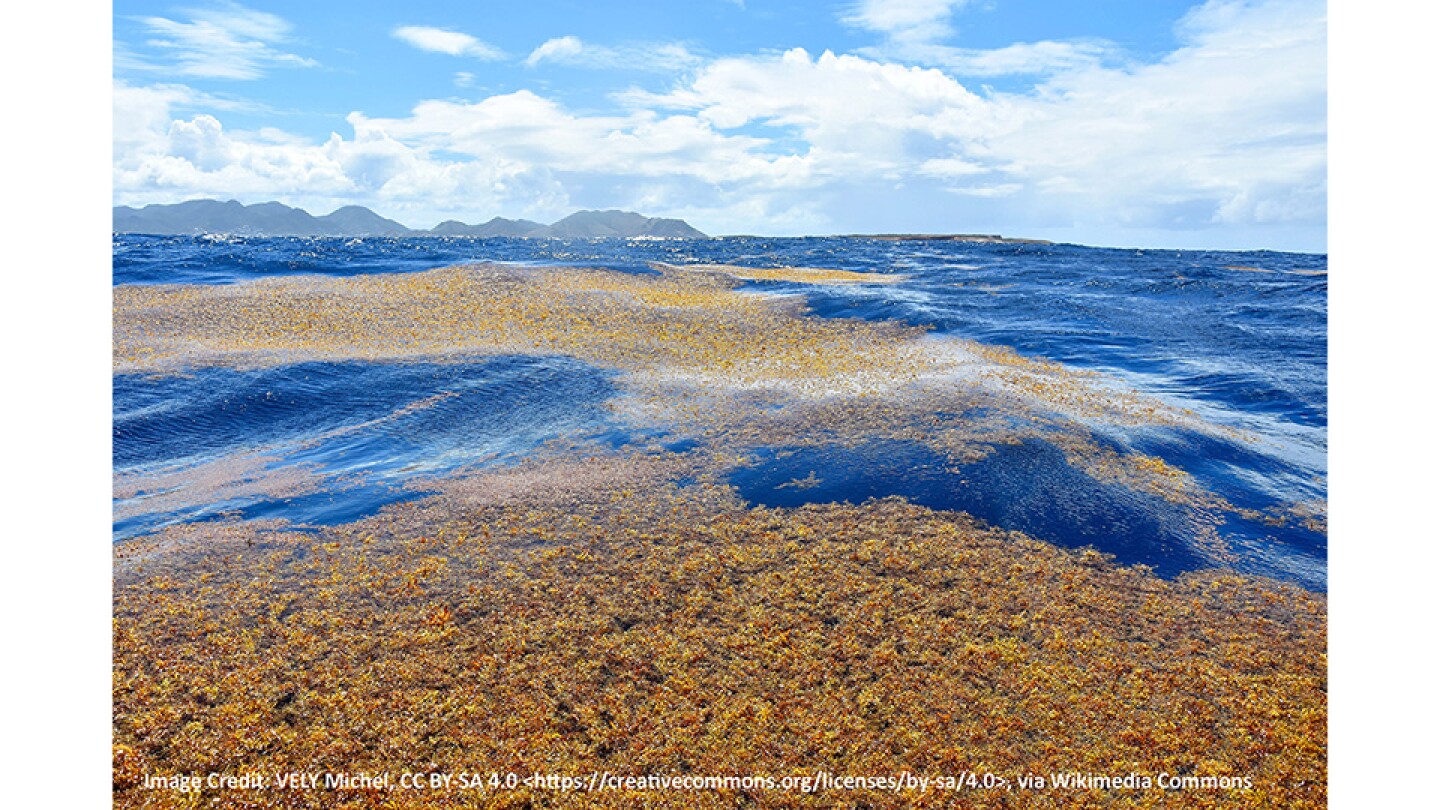
Machine learning and other modeling techniques could help predict the arrival of floating sargassum rafts clogging Caribbean ports and South American coasts.
Sargassum is a type of seaweed commonly found on large rafts floating on the ocean surface. They are so prolific that they are named after the Sargasso Sea, an area of the Atlantic Ocean. However, sargassum is not limited to these waters, and can often be found floating along ports and beaches in the Caribbean and South American coasts. There, they can disrupt transportation and damage local ecosystems.
Francisco Beron-Vera and Gage Bonner used two machine learning models to develop equations of motion for sargassum rafts directly from the data they collected. Their goal was to investigate the effectiveness of each model in inferring physical laws from data alone.
The two models investigated by the team are long short-term memory (LSTM) recurrent neural networks and the Sparse Discrimination of Nonlinear Dynamics (SINDy) algorithm.
“LSTM is a common deep learning architecture for time series. LSTM learns patterns directly from data by passing information through a set of specialized units that can ‘remember’ or ‘forget’ past signals over time,” said Veron Vera. “SINDy, on the other hand, is a data-driven modeling technique that looks for simple mathematical equations that explain observed movements.”
The group fed each model with a collection of data generated by another algorithm called eBOMB. Although eBOMB can accurately generate simulations of sargassum movement, it is too complex to provide simple equations of motion.
The authors found that both methods performed well, although each method has its own advantages. LSTM is a more lightweight model than SINDy because it uses fewer neurons and layers, but it behaves more like a “black box” and makes the results difficult to interpret. In contrast, SINDy provided explicit mathematical relationships from eBOMB data.
The authors hope that with further improvements, these lightweight models will be able to provide predictions to coastal areas in advance of sargassum invasions, giving authorities more time to prepare a response.
sauce: “Discovery of dynamics” Sargassum “The Center of Gravity of a Raft”, by F. J. Veron-Vera and G. Bonner, chaos (2026). This article can be accessed from: https://doi.org/10.1063/5.0292965 .