
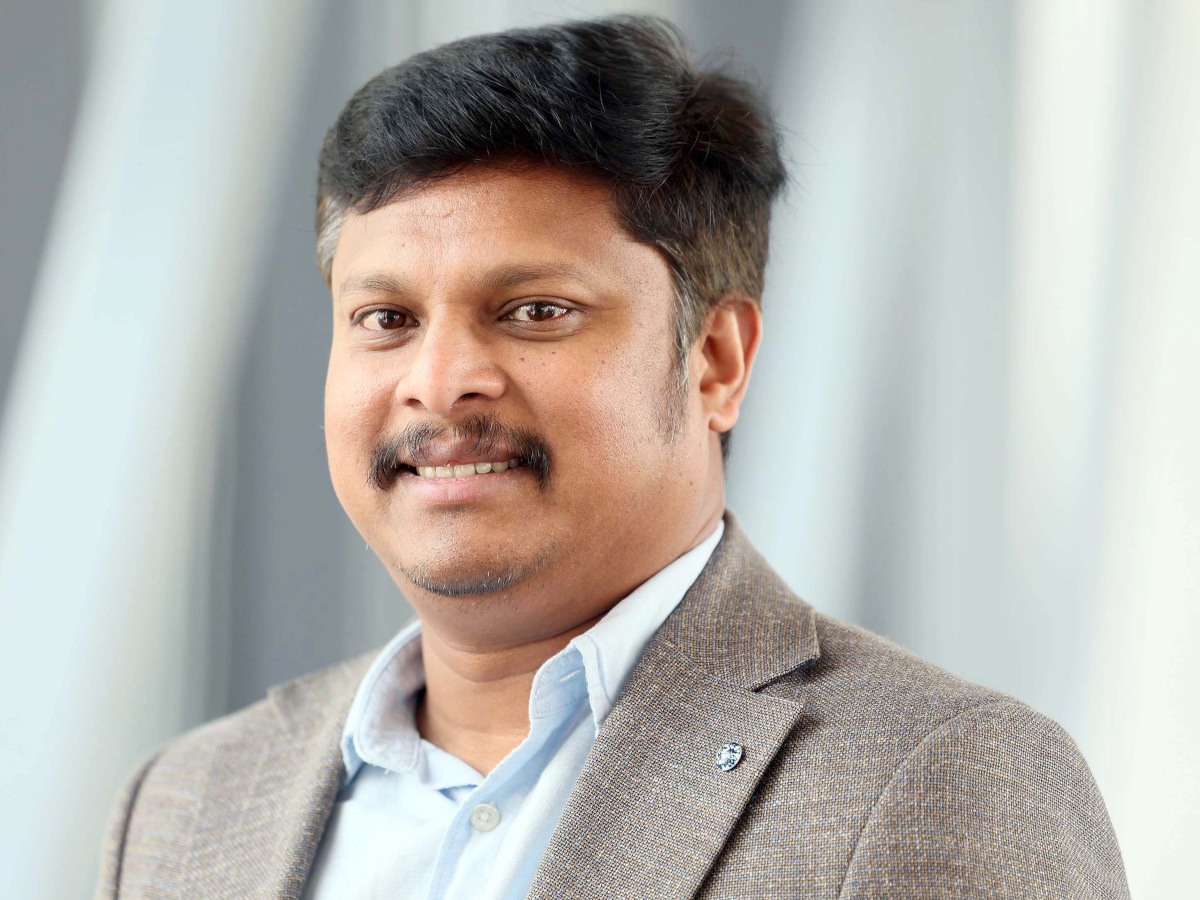
Dr Sunish Kumar Olapampala Soman from Ulster University will discuss his research focused on quantum networking and high-speed communications.
Dr. Sunish Kumar Olapampalla Soman is an Assistant Professor of Electronics and Software Engineering at the University of Ulster, Northern Ireland, and an Adjunct Professor at the Memorial University of Newfoundland, Canada.
He specializes in areas between signal processing, machine learning, and cutting-edge communications such as optical, wireless, and quantum systems. He also helps promote STEM initiatives for secondary school students in Belfast, where he lives.
“My background is in digital signal processing and machine learning for advanced communications systems. I completed my PhD working on signal processing techniques for fiber optic networks and continued with postdoctoral research focused on fiber nonlinearity compensation and deep learning,” he told SiliconRepublic.com.
“Alongside my academic role, I am an associate editor for the IEEE Open Journal of the Communications Society and IEEE Communications Surveys & Tutorials and remain actively involved in international research networks.
“My current work at Ulster University combines research leadership, teaching and public engagement, particularly with respect to emerging quantum communication systems.”
Please tell us about the research you are currently working on.
My current research integrates signal processing, machine learning and quantum technologies to support the UK’s National Quantum Strategy. Based on my PhD and postdoctoral research, I focus on three main areas:
The first is a hybrid of quantum-classical transmission over optical fiber, enabling secure quantum key distribution in parallel with traditional data traffic. The second will look at 6G-enabled sensing and communications, particularly geothermal energy monitoring using technologies such as massive MIMO and UAVs. The third investigates quantum learning algorithms that will help manage and optimize future quantum communications networks.
These projects are highly collaborative and involve postdoctoral researchers, academics, and industry partners. Together, we are working towards a secure and energy-efficient communications system that supports national priorities in quantum networking, sensing, and sustainable infrastructure.
Why do you think your research is important?
The core of my research focuses on how to communicate securely, efficiently, and sustainably in an increasingly data-driven world. Advances in signal processing and machine learning across optical, wireless, and quantum systems can build faster, more resilient, and more energy-efficient networks.
Long-term impacts include greener communications infrastructure, improved monitoring of renewable energy resources, and quantum-enabled security for critical services such as healthcare, transportation, and national infrastructure. These technologies will play a key role in delivering both economic and societal benefits as we move into the quantum era.
What made you want to become a researcher?
My interest started with a simple question. How does information move through complex systems? During my master’s studies in India, I worked on modeling signal transmission in nonlinear fiber optic networks.
I still remember the moment when the mathematical model I was developing translated directly into improving system performance. It was transformative to see theory, algorithms, and real-world engineering come together. That experience inspired me to pursue a Ph.D., and continues to fuel my curiosity about optical, wireless, and quantum communications.
What is the biggest challenge or misconception in your field?
One of the big challenges is translating advanced theory into solutions that work reliably in large-scale environments. Whether optical, wireless, or quantum systems, achieving high performance while keeping networks energy efficient, secure, and affordable is extremely challenging.
A common misconception is that communications and quantum research are abstract or separate from everyday life. In fact, these technologies are powering high-speed connectivity, emerging 6G sensing applications, and secure networks of the future. Bridging the gap between complex science and real-world impact is difficult, but it’s also one of the most rewarding parts of the job.
Do you think the public’s engagement with science has changed in recent years?
absolutely. The COVID-19 pandemic has brought science and data into everyday conversations and highlighted the direct impact of research on lives. Since then, public interest in areas such as data security, sustainable energy, and resilient infrastructure has increased.
Technologies such as quantum communications, optical networks, and 6G sensing are currently being discussed beyond academia. This places a responsibility on researchers to communicate clearly and openly in ways that connect innovation to real-world needs.
How do you encourage engagement in your work?
I strive to engage through multiple channels, from open access publications and invited talks to workshops and mentoring. You can also support the dissemination of high-quality, accessible research by working as an associate editor for an IEEE journal.
I think it is equally important to involve students and young researchers in projects that link theory to practical applications, such as quantum safety networks and climate-aware sensing. Collaborating with industry and multidisciplinary teams ensures our work delivers tangible outcomes that people can relate to and understand.
Don’t miss out on the knowledge you need to succeed. Please sign up for daily briefsSilicon Republic’s digest of science and technology news you need to know.


