
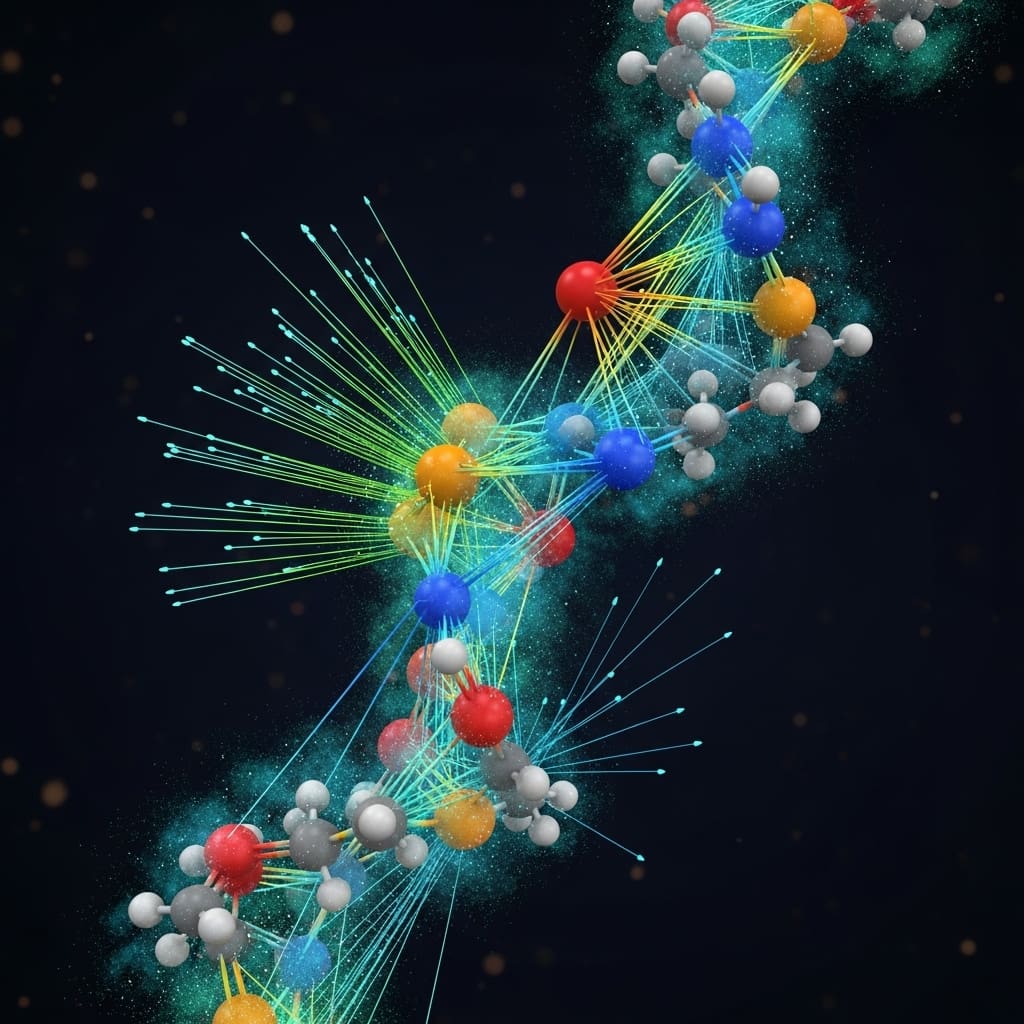
Understanding the thermodynamic and spectroscopic properties of biomolecules depends on accurately modeling their energy landscape and vibrational behavior. Sergio Suárez-Dou, Miguel Gallegos, and Kyunghoon Han, together with colleagues at the University of Luxembourg, have demonstrated a new force field, SO3LR, that can reproduce advanced density functional theory calculations with surprising accuracy. The researchers successfully validated SO3LR across a variety of biorelevant molecules and extended it far beyond the original training data to predict vibrational properties such as frequency and infrared spectra. Detailed simulations of amino acid, peptide, and protein domains in both vacuum and water environments reveal that SO3LR consistently matches the potential energy surfaces generated by density functional theory and captures important effects such as anharmonicity and environmental interactions. This study demonstrated that machine learning force fields can achieve accuracy comparable to quantum mechanical methods while significantly reducing computational costs, thereby enabling broader and more detailed studies of biomolecular systems.
Predicting the thermodynamics and spectroscopy of biomolecules requires accurate determination of the relative energy of metastable states and the curvature of the potential energy surface. Researchers demonstrated that the general-purpose SO3LR machine learning force field reproduces density functional theory calculations, specifically the PBE0+MBD method, with unprecedented accuracy across biorelevant molecules. This performance extends to systems larger and more complex than those used to train the force field, demonstrating strong ability to generalize to new scenarios. SO3LR accurately captures harmonic and anharmonic vibrational properties, including frequency, displacement patterns, and infrared spectra, for a set of 23 small molecules.
Detailed kinetic studies were then performed on the assembly of o-Phe+ amino acids, alanine-15 peptides, and p53 transactivation domains into tetramers in both vacuum and aqueous environments. Measurements confirm that SO3LR consistently agrees with results obtained using density functional theory and provides quantum-accurate images of metastable minima and vibrational properties at significantly reduced computational cost. This breakthrough provides a way to accurately model complex biomolecular systems, achieving density functional theory accuracy with the efficiency of force field calculations. This is achieved through whole-body processing of SO3LR interactions, extending up to approximately 15 Å, allowing the capture of complex structural details and environmental effects.
Achieving high-fidelity simulation with SO3LR Force Field
Scientists achieved unprecedented fidelity in biomolecular simulations by demonstrating the accuracy of the SO3LR force field for density functional theory calculations. The research team meticulously validated SO3LR across a diverse set of biorelevant molecules, going far beyond the original training data. Experiments reveal that SO3LR accurately reproduces potential energy surfaces, vibrational densities of states, and mode eigenvectors, effectively capturing important anharmonicities, polarizations, and medium-range interactions essential for understanding protein behavior. SO3LR accurately captured harmonic and anharmonic vibrational signatures, including frequency, displacement patterns, and complete infrared spectra, for a cohort of 23 small molecules.
Detailed kinetic studies were then performed on the assembly of o-Phe+ amino acids, alanine-15 peptides, and p53 transactivation domains into tetramers in both vacuum and aqueous environments. Measurements confirm that SO3LR consistently agrees with density functional theory results and provides quantum-accurate images of metastable minima and vibrational properties at significantly reduced computational cost. This breakthrough provides a way to accurately model complex biomolecular systems, achieving density functional theory accuracy with the efficiency of force field calculations. Data show that systemic processing of interactions by SO3LR (spanning up to approximately 15 angstroms) allows for the capture of complex structural details and environmental effects.
This feature is critical for modeling phenomena that are often ignored by traditional force fields, such as polarization, charge transfer, and exchange repulsion. The results demonstrate that SO3LR-based machine learning force field-driven dynamics provides a robust framework to study the stability and vibrations of biomolecules from first principles. This study demonstrated that SO3LR’s ability to account for medium-range interactions and delicate electronic effects significantly improves simulation accuracy. This advance opens new possibilities for the computational study of biomolecules and promises deeper insights into their structure, dynamics, and function.
SO3LR matches DFT accuracy for biomolecules
This study demonstrates the exceptional accuracy of the SO3LR force field in reproducing density functional theory calculations across a wide variety of biomolecules, especially using the PBE0+MBD method. Force fields accurately predict harmonic and anharmonic vibrational features, including frequency and infrared spectra, of small molecules and successfully model the dynamics of more complex systems, such as peptide and protein domains, both in vacuum and in aqueous solution. This achievement represents an important step towards accurately simulating the behavior of biomolecules using computationally efficient methods. In this study, we demonstrate that SO3LR-driven dynamics can significantly reduce computational costs while providing a level of accuracy comparable to density functional theory calculations.
This advance opens opportunities for detailed studies of the stability and vibrations of biomolecules, extending them to systems previously inaccessible due to computational limitations, such as intrinsically disordered proteins or proteins containing unnatural amino acids. The authors acknowledge the limitations inherent in the PBE0+MBD reference method, in particular the potential for overestimation of the charge transfer contribution in certain systems. Future studies may focus on extending the application of SO3LR to larger and more complex biomolecular assemblies, further honing its accuracy, and exploring its potential for predictive molecular dynamics simulations.
👉 More information
🗞 Protein stability and vibration in vacuum and water: Bridging quantum precision and force field efficiency.
🧠ArXiv: https://arxiv.org/abs/2601.09845


