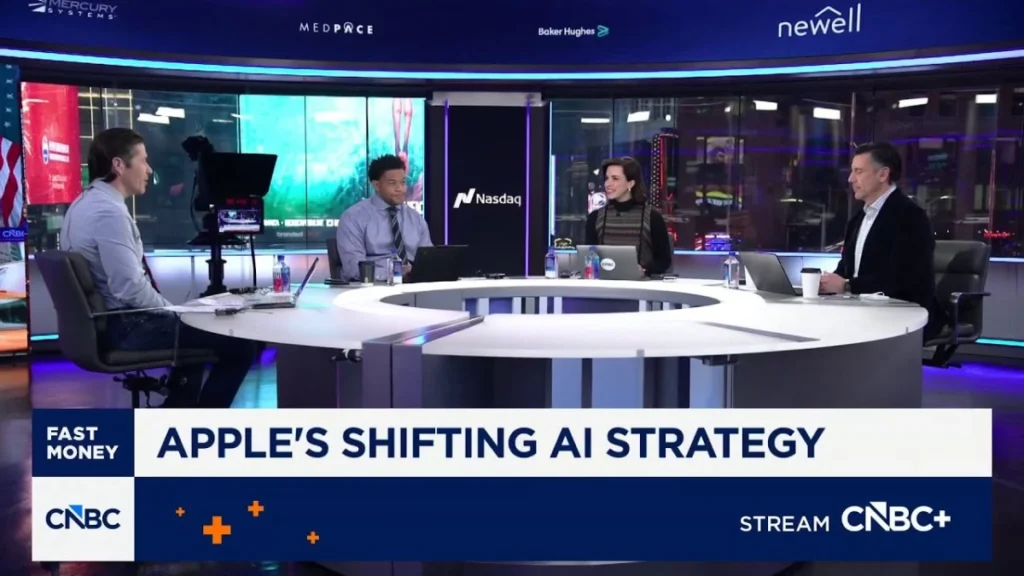
“I think we have no choice but to actually get that boat raised with the others.” This quote from Bonawin Ison, referring to Apple’s inevitable correlation with Big Tech despite its current lack of AI, encapsulates the central dilemma being discussed by CNBC Fast Money traders. The panel, which included Tim Seymour, Bonawin Ison, Steve Grasso, and Mike Ko, was convened to discuss changes in Apple’s AI strategy, especially in light of the recent poor stock performance compared to Magnificent 7. The situation at hand is clear. Apple and Meta are tied for the worst performance of this year’s Mag 7, a far cry from high flyers like Alphabet and Nvidia whose valuations have soared on excitement around generative AI.
Tim Seymour was quick to identify the core issues in the discussion. The idea is that Apple’s recent seven-week losing streak in the market is a symptom of a broader perception problem. “Apple is kind of an afterthought, and that’s kind of the problem here,” he said of what is a special week for the tech industry. Seymour argued that while Apple remains a key device for many people in the world to “live better lives with AI,” that reality “hasn’t happened yet” for investors. The market now rewards immediate and tangible AI catalysts – companies that make significant capital investments or demonstrate clear, scalable generative AI capabilities. In contrast, Apple is valued as a stable, high-quality incumbent rather than an aggressive innovator in the frontier technology field.
This valuation discrepancy is important for founders and venture capitalists evaluating where the real growth premium is being allocated. Apple’s stock performance, up just 11.95% over last year, pales dramatically in comparison to Alphabet’s 71.06% rise, but that difference is largely due to market enthusiasm for Google’s deep AI integrations and features such as the Gemini model. For Apple, the lack of a fully fleshed out generative AI product of its own means it’s been left out in the trading frenzy, even though the underlying fundamentals remain strong. Bonawin Ison reinforced this idea, saying he doesn’t expect a major turnaround in the short term until real catalysts emerge. The story for 2025 and 2026 was a rotation from AI-adjacent Big Tech names to more economically cyclical names, with Apple remaining in a holding pattern.
Apple’s strongest defense, and the reason many long-term investors are accepting the current trading slump, lies in its fundamental financial strength, particularly in its services sector. Steve Grasso emphasized that Apple’s large cash holdings (estimated at $40 billion to more than $60 billion) give the company immense operational and strategic flexibility. This cash balance allows Apple to have a “turtle mentality” when it comes to AI development, prioritizing safety and quality over speed required in the current arms race. Grasso argued that Apple will ultimately be “rewarded for not going after the AI money.”
Mike Khouw elaborated on the protective value of the service sector. Services revenue, which accounts for approximately 22% of Apple’s total business, has grown an impressive 14% with high gross margins in the 70% range. This is in sharp contrast to the hardware sector, which is growing at nearly 4%. Khouw believes this service-based monetization of its existing installed base is strong evidence of the company’s long-term stability and quality revenue, even if it doesn’t scream “AI growth spurt.” The services business provides a defensive moat and predictable revenue stream that few other tech giants can match, protecting Apple from the volatility inherent in a purely hardware or AI-driven business.
The rumored partnership with Google’s Gemini model is perhaps the most practical aspect of Apple’s current strategy. “We like the partnership with Google Gemini,” Tim Seymour said, adding that he sees it as a smart way for Apple to integrate best-in-class generative AI without spending the tens of billions of dollars required to build and train a competitive foundational model from scratch. This strategy, which focuses on seamless, user-centric integration while outsourcing the most capital-intensive parts of AI, is perfectly consistent with Apple’s historical model of leveraging external innovation (as seen in early components of Siri and other technologies). This will allow Apple to deliver an enhanced user experience while maintaining high margins and capital efficiency, rather than engaging in a potentially value-destroying race to introduce the most powerful and costly LLM.
For sophisticated investors and entrepreneurs looking into the AI space, Apple presents compelling, strategically prudent case studies. Its current valuation of 31 times forward earnings is high for a company with mid-single-digit revenue growth, but the company remains relevant due to the inherent safety of its balance sheet, the strength of its services revenue, and its leveraged partnership-driven AI deployment potential. While the market is clearly criticizing Apple for the lack of its own AI breakthroughs, the company seems content to wait until the underlying technology matures before making the transition and actually ensuring that the integration is seamless and profitable.