In a potential red flag in the artificial intelligence investment boom, shares in companies that provide cooling systems for data centers fell sharply on Tuesday after Nvidia unveiled more efficient chips.
Johnson Controls stock fell 6.2% and Modine Manufacturing stock fell more than 7.4%. Train stock fell 4%, and Carrier Global stock fell nearly 1%.
All of these companies sell industrial cooling systems to sprawling data centers that tech companies are spending tens of billions of dollars building and expanding around the world as part of a wave of AI investment.
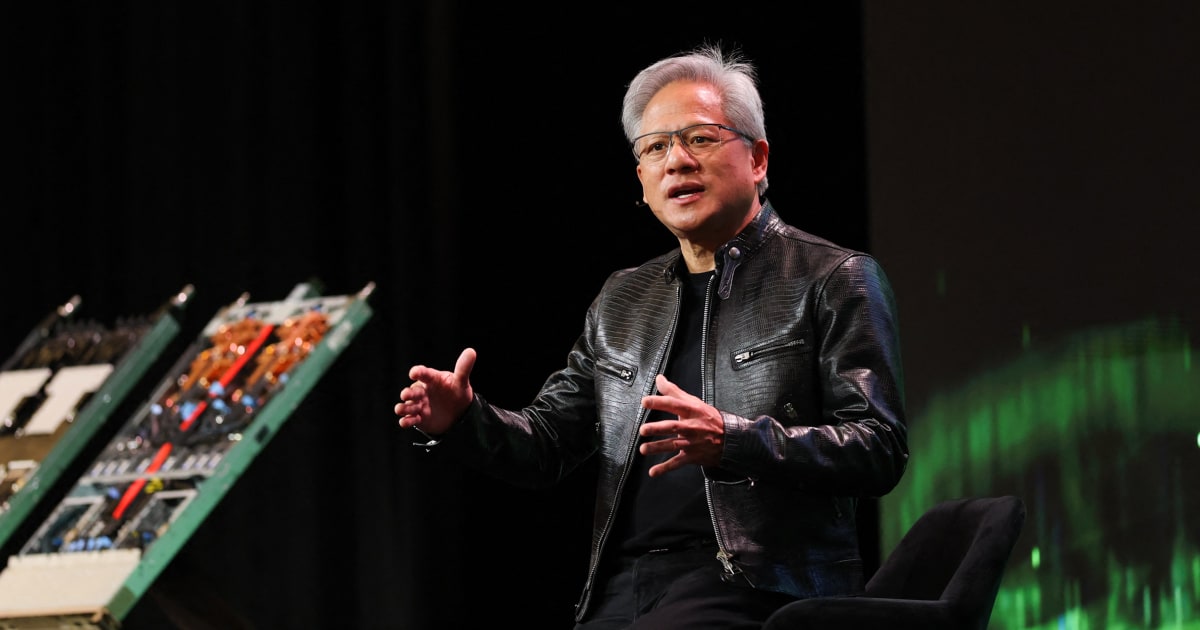
Nvidia's chips are a major driver of the AI revolution. CEO Jensen Huang told attendees at the Consumer Electronics Show in Las Vegas that the company's next-generation Vera Rubin chips won't need a cooling system to cool the water that keeps the high-performance AI chips at the proper operating temperature.
“Vera Rubin is twice as capable as Grace Blackwell,” Huang said, referring to the current Blackwell generation of Nvidia chips. “And yet, this is the miracle. The air that goes into it, the air flow is about the same, and the water that goes into it is… 45 degrees Celsius.”
At that temperature, “we don't need water chillers in the data center,” he added. “We're basically cooling this supercomputer with boiling water, and it's very efficient.” 45 degrees Celsius is equivalent to 113 degrees Fahrenheit.
New Nvidia chips can disrupt plans for expensive projects.
OpenAI, which develops ChatGPT, says it aims to build $1.4 trillion worth of computing power alone. Microsoft, one of OpenAI's most important data center partners, announced in October that it plans to increase its AI computing power by 80% over the next year and “nearly double its total data center footprint over the next two years.”
Controversial over water and electricity usage, these data centers require high-powered cooling equipment to keep the equipment inside them hot enough to keep them running.
Cooling equipment is so critical to data centers that when equipment was accidentally taken offline in November at a facility used by trading giant CME Group, temperatures inside the data center rose excessively, causing the equipment to shut down. The system, which normally processes trillions of dollars worth of trades in commodity and futures markets for investors from London to Hong Kong, was shut down for 10 hours until cooling systems were restored.
Some industry analysts see Huang's announcement as a potential concern for companies that have been involved in building data centers and the cooling systems they require.
“We believe the comments raise some questions and concerns,” analysts at investment firm Baird wrote on Tuesday.
“While we do not believe there is any significant risk to our near-term estimates, we expect the news to increase concerns about orders, particularly in the second half of 2026,” they wrote.
Nvidia announced Monday that its next-generation Vera Rubin chips are expected to be available to customers in late 2026.
“Not surprisingly, data centers are a major growth area for HVAC companies,” Baird analysts wrote. The cooling company credits data centers as “a source of strong revenue and order activity over the past 12 to 18 months, benefiting not only from strong data center demand but also from increased cooling density requirements.”
However, not everyone is convinced that this is a red flag.
“While we understand investors' concerns about end-market trends, we view HVAC divestiture activity as excessive,” Citigroup industry analyst Andrew Kaplowitz said in a letter to clients, noting that the Rubin chip's architecture “still requires liquid cooling capabilities.”
In fact, shares of data center infrastructure provider Vertiv Holdings closed slightly higher after falling more than 7%. And despite Tuesday's lower move, Johnson Controls is still up more than 45% over last year.