

Claim: The footage shows a Pakistani woman protesting being removed from the plane and demanding to know why she was removed.
Additionally, in the video, the woman claims she did nothing wrong and was not late, but was still removed from the plane.
fact: Clips are generated by AI.
recently, clip It was shared on Facebook with claims that the Pakistani “regime” was dropping off the passengers. The video, which appears to have been shot at an immigration counter at a Pakistani airport, shows a woman arguing and protesting being removed from a plane.
In the Urdu clip, she says:
“Why was I dropped off? Because I'm poor? This is justice. Why are you guys stopping me? I've done nothing wrong. I've done nothing wrong.”
Fact or fiction?
Sock Fact Check initially suspected the video was fake because the woman's mouth movements did not match what she was saying and her voice was out of sync.
Next, we looked at some indicators that the video was generated by AI. I zoomed in and shot only from the front. On the other hand, the real incident would probably have been filmed from multiple angles. The woman's cheeks and forehead are unnaturally smooth and look like they have been airbrushed.
Soch fact check We contacted Shaul Azher, a lecturer in sound design and sound recording at Karachi University and Shahid Zulfiqar Ali Bhutto University of Science and Technology (SZABIST). He also works as an audio engineer at our sister organization Soch Videos, specializing in audio mixing and mastering.
Analysis was performed on the audio of the video during fact-checking. Two audio samples were compared. Both consist of discussions between commercial airlines and passengers. Sample A is the audio from the video in the claim, and sample B is the audio from the actual video.Video of Lahore's Allama Iqbal International Airport. The report below reveals that sample A's audio is fake.
observation and discovery
- Frequency spectrum behavior
Sample A (Doctor Audio):
- The maximum variable frequency energy peaks at approximately 5,835 Hz and then
Noticeable spectral cluttering is observed.
- Despite the subject's purported screaming, the high-frequency energy decays rapidly.
III. Frequency energy levels remain unnaturally low and do not match loud vocal events
Recorded at close to medium distances.
- Such behavior is indicative of synthetic filtering, bandwidth limiting, or AI voice.
Generate rather than natural microphone capture.
Sample B (actual footage):
- Variable frequencies span the entire audible spectrum and balance energy.
distribution.
- There is slight spectral cluttering, but it is consistent with real-world environments.
noise.
III. Loud audio events exhibit the expected high-frequency excitation, consistent with natural conditions.
human screams.2. Clipping and gain behavior
Sample A:
- No audio clipping was observed, even during peak screaming moments.
- Smartphone video recording usually does not have a hard limiter. therefore,
Depending on the distance recorded, the peak should be above 0 dBFS and noticeable.
clipping.
III. Speech and screams remained at similar amplitude levels, suggesting an artificial gain
Control or post-processing.
- This behavior is highly inconsistent with the recording characteristics of real mobile devices.
Sample B:
- Slight clipping was observed during loud vocal events.
- This matches the expected behavior from a consumer smartphone's microphone if:
Exposure to sudden high SPL (sound pressure level).
III. Gain response appears natural and uncontrolled, supporting reliability.
- Dynamic range and compression analysis
Sample A:
- Clear evidence after RMS compression.
- The dynamic range appears flattened, reducing the contrast between quiet and loud sounds.
aisle.
III. This indicates post-production processing or AI rendering rather than raw capture.
Sample B:
- There is no sign of post-production compression.
- Dynamic range is uneven and unbalanced, typical of unprocessed raw fields.
recording.4. Environmental acoustics (reverberation and spatial characteristics)
Sample A:
- Hall reverb is present, but it seems artificial and exaggerated.
- The reverberation profile resembles a large empty hall, which is inconsistent with a crowded hall.
International airport environment.
III. In real airports, crowd density significantly reduces sound reverberations.
Absorption by the human body or objects.
- The acoustic response suggests synthetic spatial modeling rather than the real world.
reflection pattern.
Sample B:
- A slight reverberation is detected at the moment when the scream reaches its peak.
- Similar to crowded terminals, most interactions have little or no reverberation.
environment.
III. The acoustic behavior is consistent with the diffusion and absorption of sound that would be expected within a populated area.
airport.
conclusion
Sample A It's very likely that the audio is AI-generated or post-processed.
Sample B Matched with authentic real-world audio recorded at Jinnah International Airport.
We combed through the video to further investigate whether it had been altered. deep fake meter AI-based tools to detect manipulated and synthetic media, especially deepfakes. Use multiple detection models to analyze visual and audio cues that may indicate tampering. The results were:

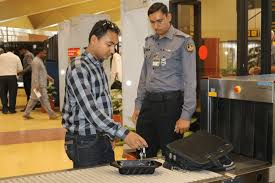

Soch fact check We then compared the keyframes of the invoice video with the real video/image found on Google search of passengers from Jinnah International Airport. A side-by-side comparison of the two images highlighted several inconsistencies in the video in question, weakening the claim that the clip was recorded at a Pakistani airport. Additionally, there appear to be no major issues in the background of the video being fact-checked airport Most of them were viewed by the Soch Fact Check team in Pakistan.
- Unified color and design
- Authentic reference images from Pakistan show immigration officers wearing light gray uniforms, which are Pakistan's official uniform and are clearly identified by cut, color, and placement of insignia.
- In contrast, the police officer standing behind the woman in the video is wearing a dark navy blue uniform, which does not match known uniform standards for Pakistani immigration officers or airport security personnel.
- Pakistani immigration official Please do not wear a dark blue uniform to work. It is especially prohibited in immigration and security areas facing passengers.
- insignia and accessories
- Airport personnel in Pakistan typically display transparent badges, epaulettes, and standardized nameplates that comply with FIA or ASF regulations.
- The police officer in the video lacks these distinguishing signs, further suggesting that he is not part of Pakistan's airport authority.
- Airport architecture and layout
- Pakistan airports usually have more features Compact immigration checkpoint, unique sign styleand locally recognizable design elements.
- The terminal seen in the video is larger, more modern, and appears to be architecturally inconsistent with the interiors of Pakistani airports, particularly in terms of ceiling design, lighting layout, and openness of space.
Visual evidence strongly suggests that the police officers and airport personnel seen in the clip are not Pakistani. This largely undermines the claim that the video was shot at an airport in Pakistan and supports the conclusion that the clip was generated by AI.
virality
This video was shared with a claim on X here.
Shared on Facebook with the same claim here.
Also shared on TikTok.
This claim was spotted on Instagram here In the same way.
Conclusion:
Research conducted by soch fact checkconcludes that this viral clip was generated by AI, based on publicly available information and open-source technology to verify visuals circulating on social media.


