Introduction: AI as the new backbone of pharmaceutical innovation
Artificial intelligence (AI) is no longer a futuristic concept in the pharmaceutical industry, but is rapidly becoming the backbone of modern drug development, clinical research, and manufacturing efficiency. As pharmaceutical companies face increasing pressure to compress development timelines, contain escalating R&D costs, and deliver more personalized treatments, AI technology is emerging as an innovative solution.
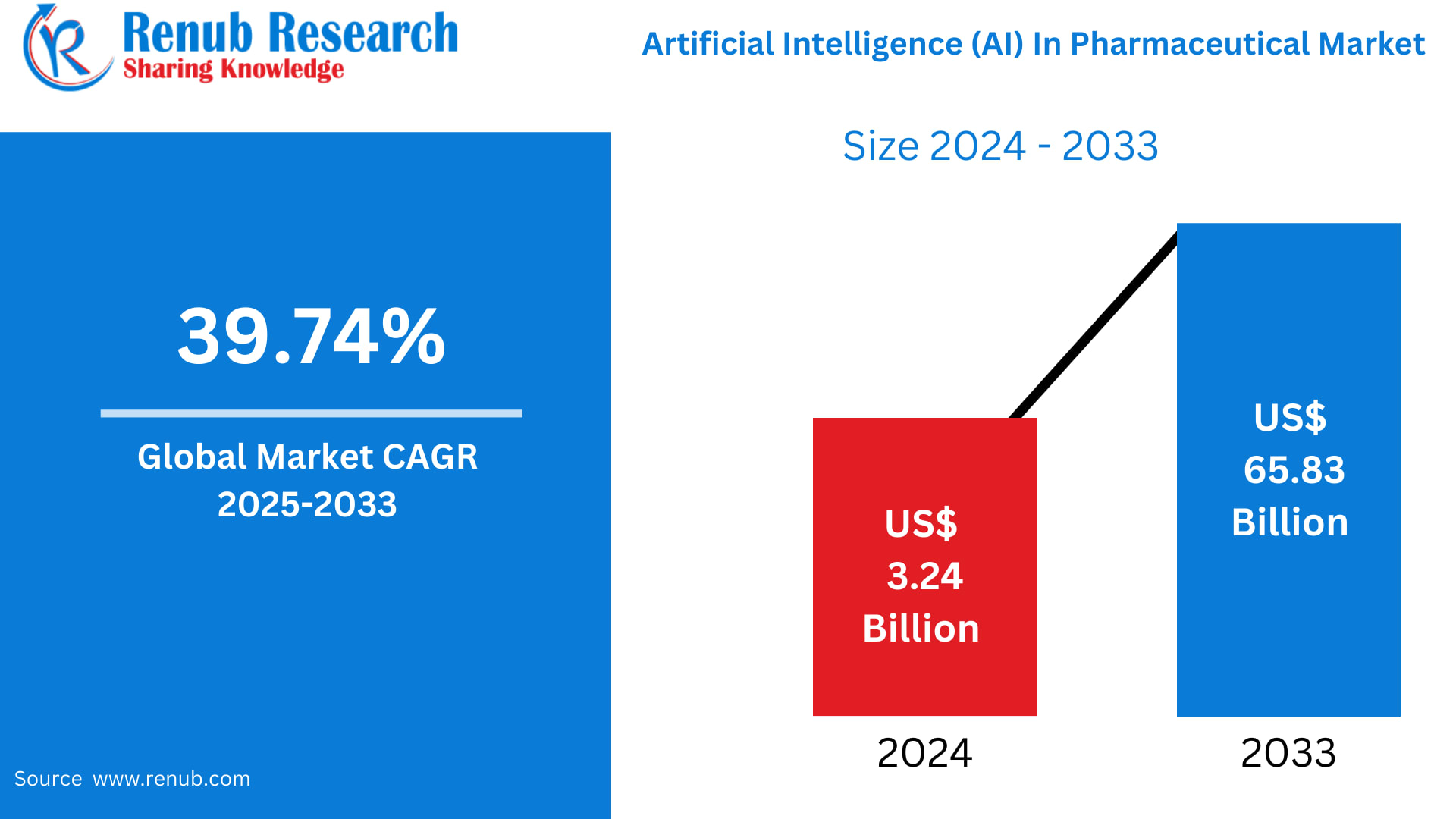
According to Renub Research, the artificial intelligence in pharmaceuticals market was valued at USD 3.24 billion in 2024 and is projected to surge to USD 65.83 billion by 2033, expanding at an impressive CAGR of 39.74% from 2025 to 2033. This rapid growth reflects the industry's accelerated reliance on machine learning, deep learning, natural language processing, and generative AI to drive efficiency across the pharmaceutical value chain.
Download free sample report
Prospects of artificial intelligence in the pharmaceutical market
Artificial intelligence in medicine refers to the application of advanced computational algorithms to analyze vast biomedical datasets, accelerate drug discovery, improve clinical trial results, and enhance patient care. By leveraging machine learning models, natural language processing tools, and predictive analytics, AI enables researchers to simulate drug interactions, identify novel compounds, and personalize treatment plans.
One of the most impactful applications of AI is drug discovery, where algorithms can analyze millions of molecular structures in a fraction of the time required by traditional methods. AI also plays a key role in optimizing clinical trials, helping pharmaceutical companies identify the right patient populations, predict trial outcomes, and reduce costly late-stage failures.
As the availability of medical data expands and digital transformation accelerates, the adoption of AI in the pharmaceutical sector is becoming not only advantageous but essential.
Key drivers of AI pharmaceutical market growth
1. Accelerate drug discovery and development
AI has dramatically shortened drug discovery timelines by enabling rapid analysis of molecular interactions and biological datasets. Machine learning algorithms can predict drug efficacy, toxicity, and stability early in the development cycle, significantly reducing failure rates.
AI helps pharmaceutical companies move promising drugs into clinical trials faster by optimizing preclinical research and accelerating candidate identification. As R&D costs continue to rise globally, AI-powered discovery platforms are becoming an essential tool to stay competitive.
2. Advances in personalized medicine
Personalized medicine is transforming healthcare, and AI is the driving force behind this transformation. By integrating genetic, clinical, and lifestyle data, AI systems can predict individual patient responses to treatment and enable more targeted and effective treatments.
This approach is particularly effective in oncology, rare diseases, and chronic diseases, where treatment outcomes vary widely across patient populations. As regulators and patients increasingly demand precision treatments, AI-powered personalization is becoming the cornerstone of pharmaceutical innovation.
3. Increased cooperation and investment
Strategic alliances between pharmaceutical companies, AI startups, and technology providers are driving rapid innovation. Global pharmaceutical leaders are investing heavily in AI platforms to power biomarker discovery, clinical trial efficiency, and real-world evidence analysis.
Venture capital funding and government-backed digital health initiatives are further strengthening the AI ecosystem. These investments are accelerating the commercialization of AI-enabled medicines and strengthening the role of AI as a long-term growth driver.
Artificial intelligence challenges in the pharmaceutical market
Data privacy and regulatory compliance
Pharmaceutical AI relies heavily on sensitive patient data, genomic information, and clinical records. Ensuring compliance with strict data protection regulations such as HIPAA and GDPR remains a major challenge.
Furthermore, the regulatory framework for AI-enabled drug development is still evolving, creating uncertainty for stakeholders. Building transparent, explainable, and ethical AI systems is essential to gaining regulatory and public trust.
High implementation costs and technical complexity
Implementing AI solutions requires significant investments in computing infrastructure, skilled human resources, and data management systems. Smaller pharmaceutical companies often struggle with these upfront costs and integration challenges, especially when using legacy systems.
Reducing the complexity of deployment and increasing accessibility is critical to increasing adoption, especially in emerging markets.
Technology trends shaping the market
Generative AI in Pharma
Generative AI is revolutionizing molecular design by simulating millions of potential compounds and identifying promising drug candidates faster than traditional approaches. It is increasingly used in protein folding, formulation optimization, and clinical trial design.
By significantly reducing discovery timelines and R&D costs, generative AI is emerging as one of the most innovative technologies in the pharmaceutical sector.
Deep learning in pharmaceutical research
Deep learning excels at processing unstructured data such as medical images, genomic sequences, and scientific literature. Applications range from drug repurposing and biomarker identification to predictive safety analysis.
As data volumes continue to increase, deep learning will continue to be a key driver of pharmaceutical innovation and early disease detection.
AI products and applications
software platform
The AI-powered software platform provides end-to-end solutions across drug discovery, clinical trials, regulatory compliance, and commercialization. These platforms improve decision-making and operational efficiency by integrating analytics, machine learning models, and real-time insights.
laboratory automation
AI-powered laboratory automation improves precision, scalability, and reproducibility in pharmaceutical research. Automated systems handle repetitive tasks such as sample processing and high-throughput screening, freeing scientists to focus on innovation.
Cloud-based AI solution
Cloud deployments are gaining attention due to their scalability, flexibility, and cost-effectiveness. Cloud-based AI platforms facilitate global collaboration, faster data processing, and seamless integration with advanced analytical tools, making them attractive to both large pharmaceutical companies and emerging biotech companies.
Regional market insights
US
The United States leads the global AI pharmaceutical market with significant R&D spending, advanced medical infrastructure, and a vibrant AI startup ecosystem. Strong support from venture capital and the development of supportive regulations continue to promote innovation.
Germany
Germany stands out as a European hub for AI-powered pharmaceutical research, supported by a robust healthcare system, research institutes and government-backed digital initiatives. The country's focus on precision medicine is further accelerating AI adoption.
India
India is one of the fastest growing markets for AI in the pharmaceutical sector. With a large healthcare ecosystem, cost-competitive R&D capabilities, and growing AI talent pool, India is emerging as a strategic destination for AI-enabled drug development and clinical research.
Saudi Arabia
Under Vision 2030, Saudi Arabia is investing heavily in digital health and AI-powered pharmaceutical research. Strategic partnerships and policy support are positioning the country as an emerging player in the global AI pharmaceutical industry.
Market segmentation overview
By technology:
Machine learning, deep learning, natural language processing, computer vision, generative AI, and other AI technologies
By providing:
Software platforms, services (AI-aaS, custom projects)
By application:
Drug discovery and preclinical development, clinical trial design and patient recruitment, manufacturing and quality control, pharmacovigilance, sales and marketing analysis, test automation
By deployment mode:
Cloud-based, on-premises/hybrid
By geography:
North America, Europe, Asia Pacific, Latin America, Middle East, Africa
competitive environment
This market is a mix of global technology leaders and specialized AI-driven pharmaceutical innovators. Companies are evaluated from five perspectives: overview, leadership, recent developments, SWOT analysis, and revenue performance.
Final Thoughts: The Future of AI in Pharma
Artificial intelligence is fundamentally reshaping the pharmaceutical industry, from discovering molecules to bringing them to market. While challenges around data privacy, regulation, and cost remain, the benefits of AI's efficiency, innovation, and personalization far outweigh the risks.
With the market expected to grow from USD 3.24 billion in 2024 to USD 65.83 billion by 2033, AI will become a permanent pillar of pharmaceutical strategies. Companies that invest early, build ethical AI frameworks, and embrace digital transformation will define the next generation of global healthcare innovation.