If two employees have conflicting goals, they can resolve them by talking to their boss, playing rock, paper, scissors, or even a friendly arm wrestling match. But when two generative AI agents come into conflict, who wins?
This will be a problem for most companies, predicts Salesforce in its 2025 MuleSoft Connectivity Benchmark Report. We found that the average company runs 897 apps. Many, if not most, software vendors are incorporating agent AI tools to automate workflows.
“There are some smaller companies that are focused on perfecting a single agent, but that's limiting,” said Mike Sziraj, senior vice president and general manager of product management at Genesys. “What is agent orchestration? [less about routing customers and] Learn more about understanding customer intent and business intent to drive results, whether it involves humans, AI, or backend systems. ”
It is currently in its early stages, with many companies deploying their first AI agents or evaluating which business processes are ready for automation. However, as agent AI becomes more prevalent, CIOs can anticipate that their environments may create software conflicts around issues such as data access and security, resource usage, and data synchronization.
Vendors know this and want to own part of the agent AI management layer where they can potentially control both their own and other users' AI agents. CX leaders can choose from a growing number of agent orchestration tools to manage agent interactions. The list includes AI Control Tower from ServiceNow, Amazon Bedrock Multi-Agent Collaboration from AWS, MuleSoft Agent Fabric from Salesforce, Watsonx Orchestrate from IBM, OpenText AI Data Platform, Pega Agentic Process Fabric from Pegasystems, and Adobe Agent Orchestrator, to name a few.
Even PwC released its own OS called Agent OS.
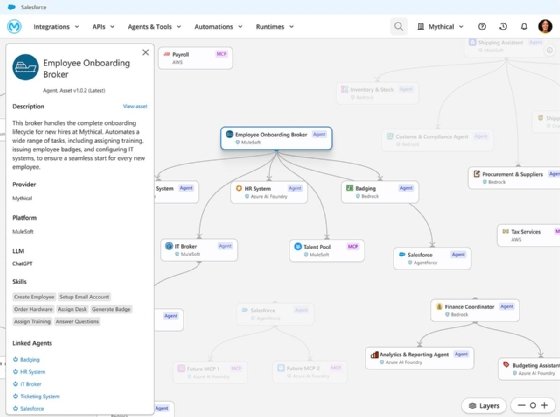
“In the enterprise space, no client uses one AI tool, one platform wall-to-wall,” said Derek Santana, U.S. Salesforce alliance leader at PwC. “We don't use Agentforce for everything. We don't use Copilot for everything, so we don't use OpenAI.”
This is a complex puzzle to solve as AI agents are given more autonomy to do their work. Tools like ServiceNow's AI Control Tower help CIOs understand how AI is being deployed across the organization and apply standards and governance to it, said Terrence Chesire, vice president of product management, CRM and industry workflows at ServiceNow.
“The challenge is to bring together strategy, processes and awareness across the organization,” Cheshir said. “This gives us the tools and capabilities to turn that into meaningful insights so that as leaders, we can really understand all the places where AI is being utilized and the goals of those use cases, even if it’s not a ServiceNow use case.”
Keith Kirkpatrick, research director at Futurum Group, said vendors are vying for control of the agent AI orchestration layer as IT spending moves away from and toward traditional seat licensing in the coming years.
“ServiceNow recognizes that the real value lies in having access to the entire technology stack,” Kirkpatrick said. “The way they're going to do it is through AI agents, or at least the way they believe they're going to do it. They're not just managing their agents, but everyone else's agents as well.”
Customers still deploying their first agent
Orchestration issues predict the future state of enterprise IT. Currently, all but a few users are still completing their first agent.
For PepsiCo, the first agency was a victory, marking a five-year data migration to the cloud for 6 million customers around the world and a simultaneous data and process harmonization effort that allows the company to use the data to analyze sales trends and costs at the neighborhood level. Agents can generate data-driven recommendations about what customers can most benefit from stocking their refrigerators.
Now that PepsiCo has laid the groundwork for agent AI, there will be more agents to come, said Dave Donarik, PepsiCo's senior vice president of technology strategy and enterprise products.
“Certainly we are in the early stages of the journey,” Donalik said. “We think there's an opportunity in terms of expanding some of the use cases of how aggressive you want to be with new product innovation, how aggressive you want to be with customer loyalty and incentives. We're testing and learning as we work on this.”
PepsiCo's agency was built on Salesforce. For now, the agents are strictly controlled by human supervision, or, in his words, “hands on the wheel.” But Dornalik expects other vendors' potential distributors to come online in the next few years. When it comes to the orchestration layer, we envision PepsiCo developing something from components from multiple different vendors, so the company isn't tied to “one big logo.”
“When we think about AI strategy, we want to control the orchestration layer,” Dohnalik said. “Everyone said, 'Oh, I can do that for you. I have a control tower, I have an orchestration layer.'” We have a huge footprint, so the way we think about it is… we want to control that control plane. ”
For most users, multi-agent orchestration may be in the realm of theory or vendor wishful thinking for now, but consultants working on the effort say it's coming.
“We are already talking about implementing Agentforce with clients who have decided to standardize on the Gemini and Google platforms,” said Chuck Tomanek, Director of Solution Delivery at Perficient. “So introducing Agentforce and allowing our agents to communicate with agents built on Gemini and other platforms, whether through Gemini, through APIs, or hopefully in the not-too-distant future, is a very real possibility. [such as] Agent 2 Agent. ”
Some vendors are helping accelerate adoption of agent AI by embedding employees into customers' IT organizations. Salesforce does this with what we call “forward deployment engineering.”
Salesforce wants to be a single agent AI vendor for its customers, but understands that that's not always practical and that some use cases require agents outside of the Salesforce platform, said Jennifer Kramer, senior vice president of AI product forward deployment engineering and customer success at Salesforce.
“We want to be a single agent solution, but they have a point agent solution. [from other companies]“We want to be the layer that ties it all together,” Kramer said. “I don't think a multi-agent situation is that far in our future, if it doesn't already exist. Things happen very quickly in this space, and things are happening that we never thought possible this time last year.”
Don Fluckinger is a senior news writer at Informa TechTarget. He is responsible for customer experience, digital experience management, and end-user computing. Any tips? send him an email.