
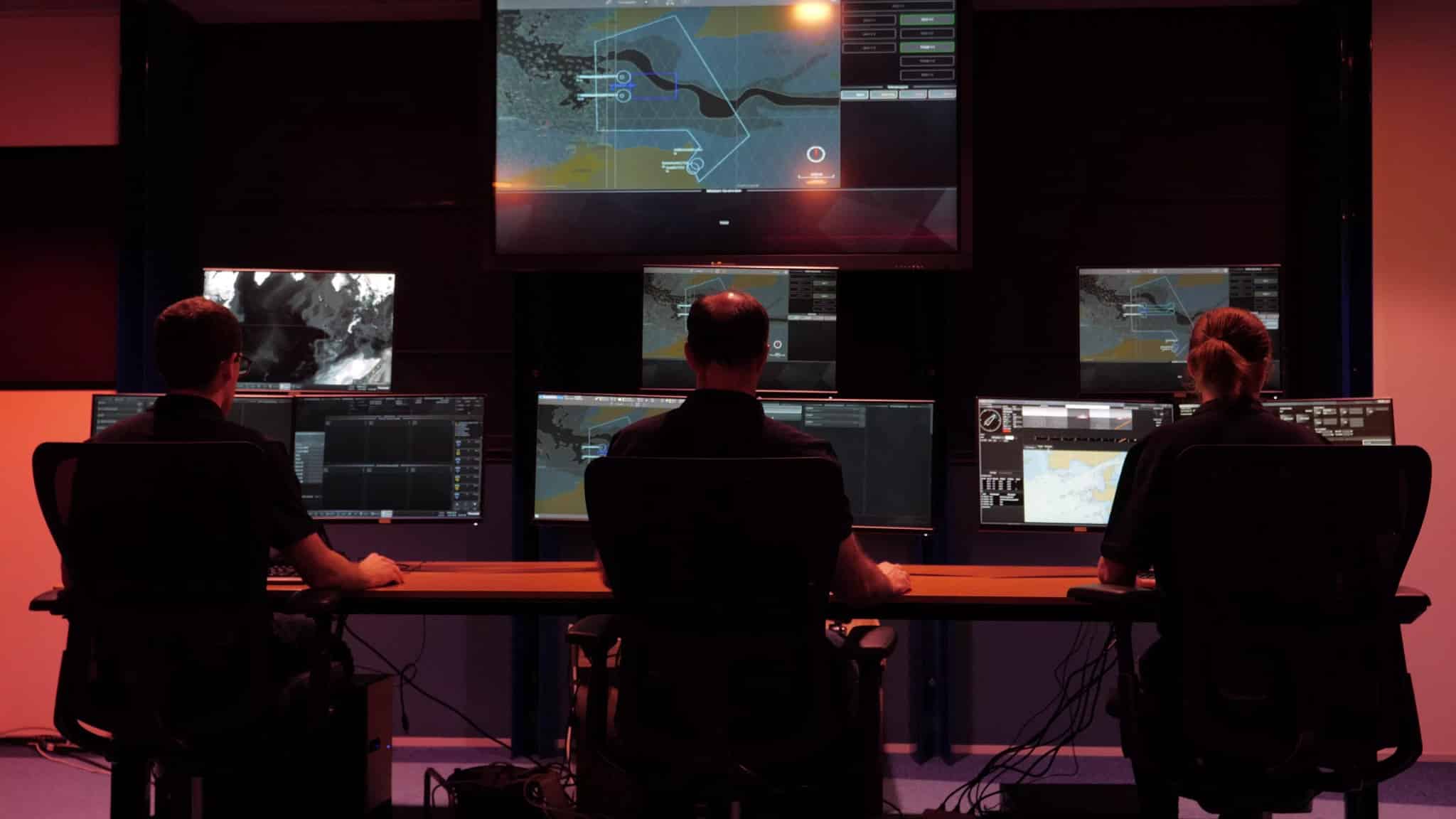
The UK Ministry of Defense (MoD) has contracted Thales to design, develop and deliver a portable remote command center (RCC) to support the transformation of the Royal Navy's (RN) mine-hunting capabilities (MHC) and wider undersea warfare capabilities through enhanced use of autonomous systems.
The contract, issued by the MoD's Defense Equipment and Support (DE&S) acquisition organization, is worth up to £100m, has a contract period of three and a half years (with extension options) and will deliver up to eight containerized RCC units. Thales said in a Dec. 29 statement that this includes the supply of hardware, software, training and technical advice to support the deployment and integration of RCC and a wide range of MHC equipment. The initial phase of the overall contract, which covers the completion of the RCC design and establishment of core management of the program by late 2026, is valued at £10 million.
“The requirements are [is] Integrating currently disparate and individually controlled major MHC platforms and autonomous capabilities into the Thales Maritime Mine Countermeasures (MMCM) RCC to provide a single unified RCC enables integrated command, control (C2) and operations of the full range of MHC platforms, systems and subsystems. ” David Hankin, director of mine warfare strategy at Thales UK, said: navy news.
among them June 2025 Strategic Defense Review (SDR), the Ministry of Defense noted that the rapid evolution of the RN's MMCM capabilities through the utilization of autonomous platforms will be central to the Navy's transformation into a “hybrid navy”.
In a statement, Thales explained the overall impact of the M-Cube mission management software, Mi-Map database and cortAIx artificial intelligence (AI) applications that are at the heart of the RCC concept. M-Cube is already in service with multiple navies, providing planning, execution, and evaluation options for traditional autonomous MMCM missions, bringing maritime situational awareness (MSA) from the task force to the unit level. Mi-Map and cortAIx are combined as other components, and Mi-Map builds a database of raw data. This, when filtered with cortAIx, provides more accurate and streamlined information more quickly to support MHC through (for example) automatic target recognition.
The integrated software and enabling hardware package is deployed onboard or ashore as a containerized, modular solution that connects platforms, systems, and subsystems. This will enable RN operators to coordinate multi-domain fleets of autonomous and remotely operated unmanned systems.

concept of ability
Autonomous capabilities to deliver MMCM and other undersea warfare effects are essential to enabling the RN and its NATO naval allies to deter threats to freedom of navigation in waters that are currently highly contested throughout NATO's area of operations. Freedom of navigation includes having access to maritime choke points, coasts and ports, as well as unimpeded passage through the open sea. These seas are lined with strategic maritime communication routes, including critical undersea infrastructure such as data cables.
The ability to deter threats to freedom of navigation can be enhanced by using unmanned systems to create more efficient and effective systems for sensing presence and mass. The MMCM RCC concept's intent to routinely integrate maritime unmanned systems with manned system operations provides mass enhancement while providing a more rapid and adaptive operational response.
The combination of platforms (crewed/unmanned), sensors, and effectors to provide operational outputs represents a “system of systems” approach. In this context, the MMCM RCC acts as an integrated C2 “hub” style command center for various unmanned systems.
The RCC's modular hardware structure and software architecture also supports the Department of Defense's rapid capability induction and spiral acquisition requirements, enabling upgrades based on operator feedback and technology advances, and providing adaptability to future mission requirements.
Hankin said the RCC concept is based on portable and adaptable containers, with internal configurations designed for maximum flexibility. “This allows the RN to be tailored to the specific requirements of each deployment. A modular design approach allows the solution to easily accommodate a variety of payloads and support current and evolving operational needs. ” he added.
The use of M-Cube at the core of the RCC concept, especially the integration of various unmanned vehicles, reflects its inherent modularity and versatility as a mission management system needed to deliver C2 for a variety of platforms (manned/unmanned), systems, capabilities, and effects.
“The focus of the development was to ensure that the system can easily interface and work seamlessly with external partner systems, which is essential for joint operations and future proofing.” said Funkin. “This flexibility allows RNs to easily integrate both new and legacy systems as requirements and technology evolve. Whether RNs choose traditional manned platforms or new unmanned/autonomous vehicles, the integrated approach enables rapid adaptation, interoperability, and expansion of capabilities.”
“M-Cube’s open, modular architecture allows for seamless integration with a variety of unmanned systems currently in service and anticipated in the future, providing RNs with the flexibility to adapt to evolving operational requirements.” Funkin added.
A variety of unmanned systems are available from different suppliers. Funkin said. navy news Thales works with experienced industry partners to bring together the best capabilities to ensure RN's solutions are flexible and future-proof.
The RCC concept and capabilities are the first step in the RN's transformation toward enhancing the contribution of unmanned systems to MMCM operations and developing a broader “hybrid” manned/unmanned naval architecture (as defined in the SDR). “We are generating important lessons that will inform broader transformation across the fleet.” Funkin explained. “In the initial phase, current Mine Countermeasures Vessels (MCMVs) will continue to operate in parallel with autonomous systems, ensuring continued operational efficiency while enabling an informed and smooth transition.”
navy news comment
The RCC concept, which integrates C2 of manned and unmanned systems, sensors and effectors into a portable and deployable structure, highlights the RN and wider NATO Navy's focus on building multi-domain and distributed operational capabilities at sea. Such containerized and distributed capabilities enhance rapid response. This, for example, proved to be something NATO particularly needed last year, given the urgent need to deploy sensing capabilities and packages of C2 to respond to threats to critical underwater infrastructure (CUI). Unmanned systems (remotely operated and autonomous) used for MMCM provide significant sensing and effect capabilities to counter CUI risks.


