
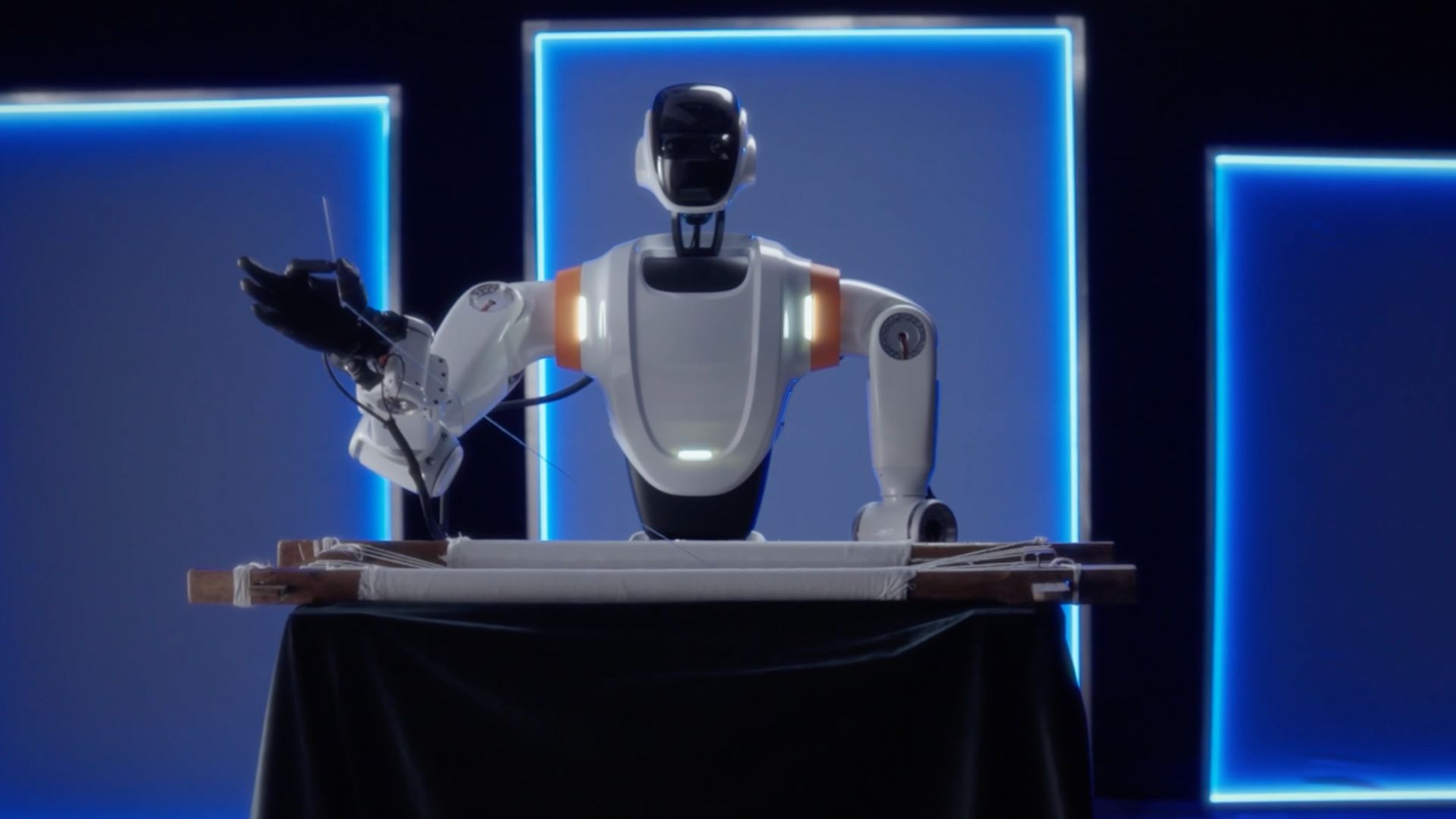
On December 22, China's TARS Robotics unveiled a hand-embroidered humanoid robot at a live event, achieving a milestone in embodied artificial intelligence.
The robot used both hands to perform tasks that required highly precise and stable control, such as threading a needle and sewing in a logo.
The demonstration showed how the robot handles soft, flexible materials with sub-millimeter precision. Until now, this type of long, delicate, and coordinated manual work was widely considered to be beyond the scope of automation.
Ultra-fine manipulation has long been a feature lacking in industrial robots, limiting the automation of complex wire harness assembly and other precision-sensitive processes.
By overcoming this barrier, the company has opened the door for robots to take on tasks previously performed by skilled human hands.
Eliminating long-standing barriers to automation
Hand embroidery may seem niche, but it represents one of the most difficult problems in robotics.
This work combines precise vision, adaptive force control, and coordinated movements of both hands while working with flexible materials that constantly change shape. A small error can cause the thread to break or the stitch to come off completely.
During the live demonstration, the humanoid robot completed the process smoothly and demonstrated its overall stability. This performance highlighted a level of embodied intelligence not previously shown in public spaces. The ability to perform such tasks reliably is considered the basis for broader industrial applications.
By mastering these movements, the same robotic system can be extended to other complex tasks. Tasks such as assembling complex electrical components and handling soft materials in manufacturing appear to be more achievable.
DATA AI PHYSICS collaboration
At the event, Dr. Chen Yilun, CEO of TARS Robotics, explained that this breakthrough comes from what he calls a DATA AI PHYSICS trinity approach. This framework connects real-world data, artificial intelligence models, and physical robotic systems into one continuous loop.
The robotics company uses the human-centric SenseHub platform to collect detailed operational data from real-world environments. This data is used to train the TARS AWE 2.0 AI World Engine. It is an embodied AI model designed to learn common physical skills rather than single tasks. These learned capabilities will be deployed directly to the company's T-series and A-series humanoid robots.
Chen emphasized that the robot is built to minimize the gap between digital and physical, meaning that what the AI learns in training can be reliably executed in the real world. He pointed out that this closed-loop system supports scalable development and follows the principles of scaling laws for AI systems.
Extend intelligence through data
Dr. Ding Wenchao, the company's principal investigator, highlighted how the scale of data is driving rapid progress across a variety of tasks.
“Leveraging the vast amount of data from SenseHub and based on the AWE 2.0 model, we have dramatically improved task success rates across multiple scenarios,” he said.
“As we continue to expand our data and evolve our model architecture, we anticipate new advances in robot intelligence and generalization capabilities, with the ultimate goal of bringing robots into every industry and home.”
It is important to emphasize this generalization. Rather than programming robots for specific jobs, the company aims to teach them adaptable skills that can be applied across environments and industries.
Rapid growth backed by large amounts of funding
TARS Robotics was founded on February 5, 2025 and has rapidly moved from concept to real-world deployment.
In less than a year, the company applied its core algorithms to a working robotic platform and achieved steady performance improvements.
The company's growth has been supported by the strong trust of investors. It raised $120 million in an Angel round from investors including Lanchi Ventures, followed by a $122 million Angel+ round.


