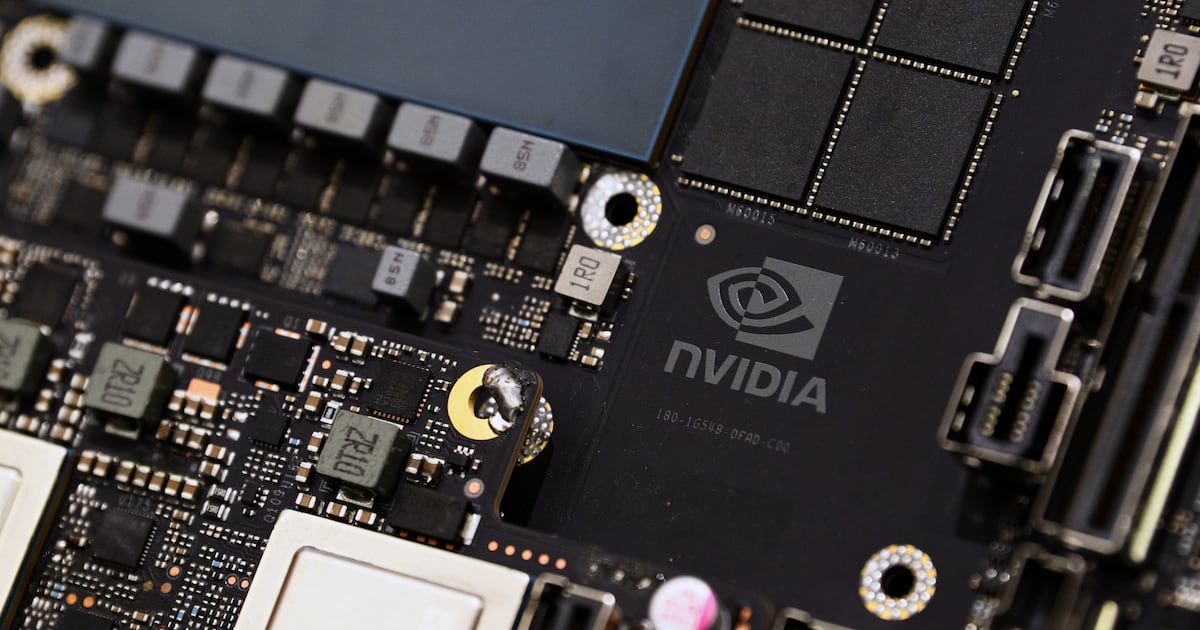
When everyone digs for gold, sell shovels. This old maxim captures the same logic as today’s artificial intelligence boom: the profits are flowing to those supplying the chips and infrastructure, not to the loss-making labs building the models.
Nvidia’s record earnings this past year, which pushed the chip maker’s market value past $5 trillion, show how profitable that trade has become.
But what if the world is selling the wrong kind of shovel? Analysts expect the global build-out of AI infrastructure – from data centres and chips to power and cooling – to cost several trillion dollars over the next few years. Much of that hardware is being built to run large language models (LLMs) such as OpenAI’s ChatGPT or Anthropic’s Claude.
But here’s the rub – if development moves towards smaller or more efficient AI, or if new technology reduces the demand for high-end chips or the large amounts of energy they require, much of that heavy infrastructure could end up underused, even uneconomic. The world is pouring trillions of dollars into one version of AI and risks hard-coding that choice into the global economy. It is, in effect, putting all of its eggs in one basket.
Evidence of that risk is emerging. Training the most advanced models is now astronomically expensive, yet recent generations have delivered smaller improvements for far greater cost. GPT-5, for instance, required hundreds of thousands of Nvidia chips, but delivered only modest gains in performance.
If the returns on scale keep flattening, the world risks locking itself into an AI system that may never earn back the cost of the hardware it depends on. Yet funding and research are increasingly concentrated on LLMS, which are built on the same underlying transformer architecture that powers most large language models.
Smaller models and alternative technology attract far less. So just when the field could benefit from diversity, it is narrowing instead. Research in areas such as liquid neural networks or neuro-symbolic AI may slow as funding and talent continue to flow towards transformer models.
History could be repeating itself. In the late 19th century, American railroads laid far more track than many could ever hope to fill. It was often more profitable to build new lines than to run them – a boom that ultimately ended in bust.
A century later, telecoms groups spent billions laying fibre-optic cables to meet forecasts for explosive internet growth – forecasts that proved far too optimistic. Much of that capacity sat idle for years, leading to bankruptcies.
Is the AI boom another classic case of speculative overbuilding? Some cracks are visible. When Google last month launched Gemini 3 – a chatbot widely seen as surpassing OpenAI’s – it trained the model on its own tensor processors rather than Nvidia’s chips, sending the company’s shares sharply lower.
It underlined how quickly assumptions behind AI infrastructure can change. Earlier this year, China’s DeepSeek achieved cutting-edge performance with its R1 model, using none of Nvidia’s costly, power-hungry processors.
If other companies move to different hardware or more efficient models, much of today’s AI infrastructure could prove uneconomic. Data centres, chip plants and power systems built for current LLMs would be hard to repurpose. The trillions invested might not disappear, but the returns could.
The risk is not just overbuilding, but letting too much power and money concentrate in too few companies. Since late 2022, the AI rally has pushed tech valuations to record highs – a run the European Central Bank says is now being fuelled by as much by “FOMO” as reality.
Those gains are highly concentrated. Eight of the 10 biggest stocks in the S&P 500 are tech companies, together worth more than a third of that entire US market. That leaves investors exposed to sharp losses if the market sours.
The risk is systemic. So much capital and market value are tied to a handful of companies – and to one model of AI – that any shock would reverberate through the global economy.
That dependence is clearest at OpenAI. The ChatGPT maker has lined up deals that could see it spend more than $1 trillion on computing power, financed largely by other big tech groups. Those partnerships are creating an insidious web of financial ties that risk locking the AI industry into one set of technologies and suppliers.
At some point, all this eye-popping spending will have to prove its worth. So far, the payoff remains uncertain. MIT research suggests 95 per cent of AI projects deliver no returns, yet money keeps pouring in; no company wants to be left out of what could be the next industrial revolution. But few have shown lasting productivity gains from generative AI and most are still experimenting, even as development costs climb.
The world needs to hedge its AI bets. Governments, investors and companies should avoid tying their AI strategies to the same few suppliers or technologies. The priority should be adaptable systems that can evolve as AI technology changes. Organisations may consider modular data centres that can be repurposed if demand for AI infrastructure declines. At the same time, it would be prudent to invest in other core technologies with long-term potential.
Investors, meanwhile, should look beyond the Magnificent 7 – Alphabet, Amazon, Apple, Meta, Microsoft, Nvidia and Tesla – and back smaller research labs developing different approaches. For one thing, open-source AI deserves far more attention. By sharing code and training data, these models help lower development costs, speed up innovation and widen access to generative tools.
China is backing open models that anyone can use or adapt, while Europe’s Mistral is a leader in open-weight systems. Yet this approach still needs far stronger support from governments, investors and the tech industry. Mistral, valued at nearly €12 billion ($14 billion), remains Europe’s best hope of challenging US rivals, but it still operates at a fraction of their scale.
For now, most of the money is still chasing the same few companies and the same type of infrastructure. In the rush to sell shovels for the AI gold rush, we may be building the wrong kind – and paving the way for another costly correction.
Amit Joshi is professor of AI, analytics and marketing strategy at IMD
Tuesday’s fixtures
Kyrgyzstan v Qatar, 5.45pm
((Disclaimer))
The Liechtensteinische Landesbank AG (“Bank”) assumes no liability or guarantee for the accuracy, balance, or completeness of the information in this publication. The content may change at any time due to given circumstances, and the Liechtensteinische Landesbank AG is under no obligation to update information once it has been published. This publication is intended for information purposes only and does not constitute an offer, a recommendation or an invitation by, or on behalf of, Liechtensteinische Landesbank (DIFC Branch), Liechtensteinische Landesbank AG, or any of its group affiliates to make any investments or obtain services. This publication has not been reviewed, disapproved or approved by the United Arab Emirates (“UAE”) Central Bank, Dubai Financial Services Authority (“DFSA”) or any other relevant licensing authorities in the UAE. It may not be relied upon by or distributed to retail clients. Liechtensteinische Landesbank (DIFC Branch) is regulated by the DFSA and this advertorial is intended for Professional Clients (as defined by the DFSA) who have sufficient financial experience and understanding of financial markets, products or transactions and any associated risks.
UPI facts
More than 2.2 million Indian tourists arrived in UAE in 2023
More than 3.5 million Indians reside in UAE
Indian tourists can make purchases in UAE using rupee accounts in India through QR-code-based UPI real-time payment systems
Indian residents in UAE can use their non-resident NRO and NRE accounts held in Indian banks linked to a UAE mobile number for UPI transactions
Global Fungi Facts
• Scientists estimate there could be as many as 3 million fungal species globally
• Only about 160,000 have been officially described leaving around 90% undiscovered
• Fungi account for roughly 90% of Earth’s unknown biodiversity
• Forest fungi help tackle climate change, absorbing up to 36% of global fossil fuel emissions annually and storing around 5 billion tonnes of carbon in the planet’s topsoil
Results:
CSIL 2-star 145cm One Round with Jump-Off
1. Alice Debany Clero (USA) on Amareusa S 38.83 seconds
2. Anikka Sande (NOR) For Cash 2 39.09
3. Georgia Tame (GBR) Cash Up 39.42
4. Nadia Taryam (UAE) Askaria 3 39.63
5. Miriam Schneider (GER) Fidelius G 47.74
The more serious side of specialty coffee
While the taste of beans and freshness of roast is paramount to the specialty coffee scene, so is sustainability and workers’ rights.
The bulk of genuine specialty coffee companies aim to improve on these elements in every stage of production via direct relationships with farmers. For instance, Mokha 1450 on Al Wasl Road strives to work predominantly with women-owned and -operated coffee organisations, including female farmers in the Sabree mountains of Yemen.
Because, as the boutique’s owner, Garfield Kerr, points out: “women represent over 90 per cent of the coffee value chain, but are woefully underrepresented in less than 10 per cent of ownership and management throughout the global coffee industry.”
One of the UAE’s largest suppliers of green (meaning not-yet-roasted) beans, Raw Coffee, is a founding member of the Partnership of Gender Equity, which aims to empower female coffee farmers and harvesters.
Also, globally, many companies have found the perfect way to recycle old coffee grounds: they create the perfect fertile soil in which to grow mushrooms.
How Filipinos in the UAE invest
A recent survey of 10,000 Filipino expatriates in the UAE found that 82 per cent have plans to invest, primarily in property. This is significantly higher than the 2014 poll showing only two out of 10 Filipinos planned to invest.
Fifty-five percent said they plan to invest in property, according to the poll conducted by the New Perspective Media Group, organiser of the Philippine Property and Investment Exhibition. Acquiring a franchised business or starting up a small business was preferred by 25 per cent and 15 per cent said they will invest in mutual funds. The rest said they are keen to invest in insurance (3 per cent) and gold (2 per cent).
Of the 5,500 respondents who preferred property as their primary investment, 54 per cent said they plan to make the purchase within the next year. Manila was the top location, preferred by 53 per cent.
How to keep control of your emotions
If your investment decisions are being dictated by emotions such as fear, greed, hope, frustration and boredom, it is time for a rethink, Chris Beauchamp, chief market analyst at online trading platform IG, says.
Greed
Greedy investors trade beyond their means, open more positions than usual or hold on to positions too long to chase an even greater gain. “All too often, they incur a heavy loss and may even wipe out the profit already made.
Tip: Ignore the short-term hype, noise and froth and invest for the long-term plan, based on sound fundamentals.
Fear
The risk of making a loss can cloud decision-making. “This can cause you to close out a position too early, or miss out on a profit by being too afraid to open a trade,” he says.
Tip: Start with a plan, and stick to it. For added security, consider placing stops to reduce any losses and limits to lock in profits.
Hope
While all traders need hope to start trading, excessive optimism can backfire. Too many traders hold on to a losing trade because they believe that it will reverse its trend and become profitable.
Tip: Set realistic goals. Be happy with what you have earned, rather than frustrated by what you could have earned.
Frustration
Traders can get annoyed when the markets have behaved in unexpected ways and generates losses or fails to deliver anticipated gains.
Tip: Accept in advance that asset price movements are completely unpredictable and you will suffer losses at some point. These can be managed, say, by attaching stops and limits to your trades.
Boredom
Too many investors buy and sell because they want something to do. They are trading as entertainment, rather than in the hope of making money. As well as making bad decisions, the extra dealing charges eat into returns.
Tip: Open an online demo account and get your thrills without risking real money.
Major matches on Manic Monday
Andy Murray (GBR) v Benoit Paire (FRA)
Grigor Dimitrov (BGR) v Roger Federer (SUI)
Rafael Nadal (ESP) v Gilles Muller (LUX)
Adrian Mannarino (FRA) Novak Djokovic (SRB)
UAE currency: the story behind the money in your pockets
MATCH INFO
Quarter-finals
Saturday (all times UAE)
England v Australia, 11.15am
New Zealand v Ireland, 2.15pm
Sunday
Wales v France, 11.15am
Japan v South Africa, 2.15pm
How Beautiful this world is!
Fifa Club World Cup quarter-final
Kashima Antlers 3 (Nagaki 49’, Serginho 69’, Abe 84’)
Guadalajara 2 (Zaldivar 03’, Pulido 90′)