
Careers in biotech R&D and AI/ML
Two of the most exciting and promising career paths in today's rapidly evolving job market are biotechnology research and development (R&D) and artificial intelligence (AI)/machine learning (ML). The biotech R&D and AI/ML fields are at the forefront of innovation and deliver significant results. opportunitybut they differ widely in focus, skill requirements, working environment, and future outlook. For students, professionals, researchers, or career changers, choosing a career in biotechnology R&D or AI/ML can be a difficult decision.
This article takes a closer look at both career paths, comparing their nature, opportunities, challenges, and ideal candidates to help you decide whether a career in biotech R&D or an AI/ML career is right for you.
Understanding Biotechnology R&D Careers
What is biotechnology research and development?
Biotechnology research and development focuses on the use of biological systems, organisms, or derivatives to develop new products and technologies. This includes everything from drug discovery and genetic engineering to agricultural improvements and environmental solutions.
Biotechnology research and development professionals work in laboratories experimenting with DNA, proteins, cells, and microorganisms. They design and perform experiments, analyze data, and develop prototypes for new treatments, diagnostics, or biobased products. Its main focus is to transform research discoveries into concrete solutions that improve human health, agriculture, the pharmaceutical industry and the environment.
General role in biotechnology research and development
- Researcher: Conduct experiments to understand biological processes or develop new bioproducts.
- molecular biologist: Develop gene therapy and diagnostic tools primarily using DNA, RNA, and proteins.
- bioinformatics scientist: Use computational tools to analyze biological data such as genomes and proteomes.
- clinical researcher: Test new drugs and treatments in clinical trials.
- process development scientist: Designing scalable methods for producing biotechnology products in industry.
Skills needed for biotechnology research and development
- A strong foundation in biology, chemistry, and life science related fields.
- Experimental skills such as cell culture, PCR, and chromatography.
- Data analysis using software such as R, Python, or specialized bioinformatics tools.
- Critical thinking and problem solving skills.
- Experimental work that involves trial and error requires patience and perseverance.
Working environment and career advancement
Biotechnology research and development professionals often work in laboratories within pharmaceutical companies, academic institutions, government research centers, or biotechnology startups. Work is very hands-on and may require long hours to meet project deadlines and troubleshoot experiments.
Career growth typically involves a transition from a junior scientist role to a senior research position, project leadership, or management position, and sometimes to regulatory affairs, patent law, or science communication.
Understand Careers in Artificial Intelligence and Machine Learning
What is AI and machine learning?
Artificial intelligence and machine learning are fields of computer science that focus on creating systems that can learn from data to make decisions and predictions. Artificial intelligence covers a wide range of technologies, including natural language processing, computer vision, robotics, and expert systems. Machine learning specifically refers to algorithms that automatically improve through experience.
Artificial intelligence (AI) and machine learning (ML) are branches of computer science that focus on creating systems that can learn from data to make decisions and predictions. AI covers a wide range of technologies, including natural language processing, computer vision, robotics, and expert systems. Machine learning explicitly refers to algorithms that automatically improve through experience.
A career in AI/ML involves developing, training, and deploying models that enable computers to perform tasks such as speech recognition, image classification, recommendation systems, and autonomous driving.
Common roles in AI/ML
- data scientist: Analyze big data sets to extract insights and build predictive models.
- machine learning engineer: Design ML algorithms and implement them in production systems.
- AI researcher: Develop new algorithms and advance artificial intelligence theory.
- computer vision engineer: They work on image and video analysis using artificial intelligence.
- NLP engineer: Specializes in helping computers understand human language.
Skills required for AI/ML
- A strong foundation in mathematics, especially statistics, linear algebra, and calculus.
- Familiar with programming languages such as Python, R, Java, and C++.
- Familiarity with machine learning frameworks such as TensorFlow, PyTorch, and Scikit-learn.
- Understanding algorithms, data structures, and software engineering.
- Ability to preprocess and clean large datasets.
- Creativity to design new solutions and models.
Working environment and career advancement
AI/ML professionals work in technology companies, startups, finance, healthcare, automotive, and many other industries. They often collaborate with software engineers, product managers, and domain experts to integrate AI into products and services.
Career advancement includes roles such as senior machine learning engineer, artificial intelligence architect, data scientist, manager, and research scientist. Artificial intelligence and machine learning skills are highly transferable between industries and offer a wide range of job flexibility.
Comparing careers in biotechnology research and development and artificial intelligence and machine learning
Academic background and admission requirements
- Biotechnology and research and development Typically requires a degree in biology, biotechnology, biochemistry, or related field. Advanced roles often require a master's degree.
- Biotechnology research and development Typically requires a degree in biology, biotechnology, biochemistry, or related field. Advanced roles require specialized knowledge and lab skills and often require a master's or doctoral degree.
- AI/ML The career typically requires a background in computer science, mathematics, or engineering. Higher education, such as a master's degree or a Ph.D., is common, but not necessarily required, provided you have strong coding skills and work experience.
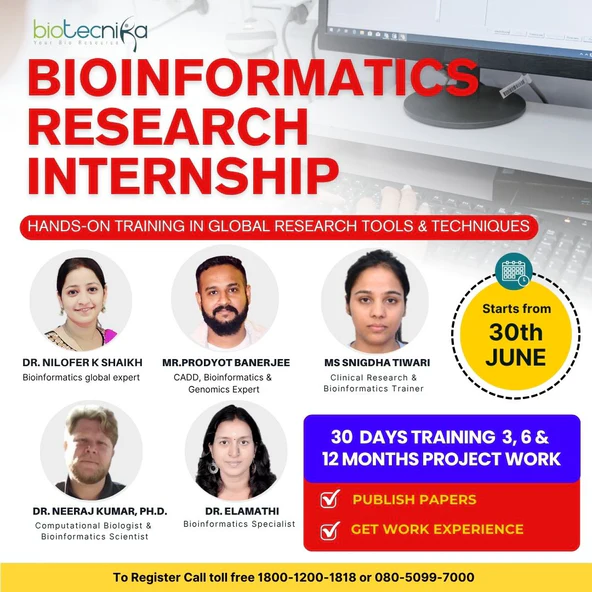
Learn Bioinformatics Global research tools and techniques Practical training with offline/online project work
Offline/Online | Get practical training | Work on a project | Publish a paper | Get a work experience letter
Options: 30 days, 3, 6, 12 month periods
Skill set and nature of work
- Biotechnology and research and development are largely experimental and laboratory-based, involving hands-on biological experiments and wet lab work.
- AI/ML is computer-based and involves programming, algorithm design, and data manipulation.
innovation and impact
- Innovations in biotechnology and research and development directly impact human health, agriculture, and the environment. Breakthroughs like new vaccines and gene therapies have the potential to save millions of lives.
- AI/ML innovations will impact a variety of fields, from medical diagnostics and self-driving cars to personalized marketing and fraud detection.
Job market and demand
- Biotechnology is a steadily growing industry, with strong demand in pharmaceutical, agricultural, and environmental biotechnology.
- AI/ML is one of the fastest growing fields in the world, with increasing demand in sectors such as technology, finance, and healthcare.
Salary and job security
- AI/ML roles typically have higher starting salaries, as the technology industry values programming and data skills.
- Biotechnology R&D salaries are competitive, but often vary by sector (academic vs. industry) and seniority.
- Both fields offer long-term job security due to the need for continuous innovation.
assignment
- Biotechnology research and development often involves long timelines, regulatory hurdles, and financial uncertainty.
- AI/ML professionals face rapidly evolving technology, intense competition, and the need for continuous upskilling.
Who should I choose?
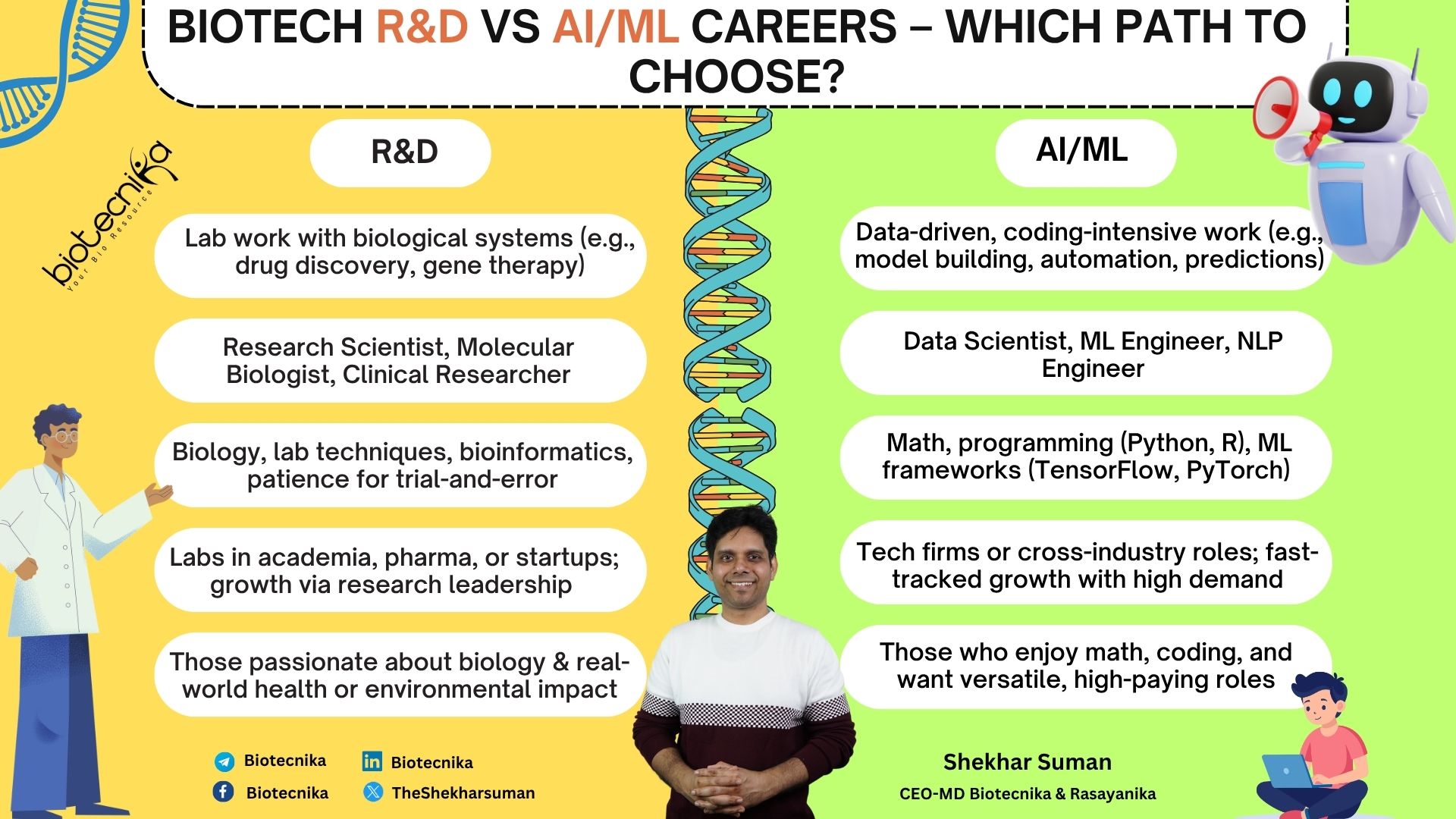
- If you love biology, love working in a lab, and want to make a long-term impact on health, agriculture, and the environment, choose biotechnology research and development.
- If you love math, coding, and working with data, and want a versatile career that thrives in a fast-paced technology environment and builds intelligent automated systems across industries, choose AI/ML.
Hybrid Opportunities: Where Biotech Meets AI/ML
The lines between biology and AI/ML careers are becoming increasingly blurred. Bioinformatics, computational biology, and AI-driven drug discovery are a combination of both fields. These hybrid roles require an understanding of biology and strong computational skills.
Examples include:
- Analyze genomic data for disease research using ML.
- AI algorithms for predicting protein structures.
- Machine learning models for personalized medicine.
- Automate lab experiments using robotics and AI.
If you are interested in both biology and AI, pursuing a career in computational biology or bioinformatics may be an ideal intermediate path.
Preparation steps for each career
For biotechnology research and development
- Earn a bachelor's degree in biology, biotechnology, or a related field.
- Gain hands-on lab experience through internships and research projects.
- Learn basic data analysis and programming skills (Python or R).
- Consider advanced degrees for research scientist roles.
- Stay up to date on biotech trends, regulatory standards, and new technologies.
For AI/ML
- Earn a degree in computer science, mathematics, or engineering.
- Master programming languages and ML frameworks.
- Work on a project or internship related to AI or data science.
- Build a portfolio of ML models or contribute to open source AI projects.
Continually learn new AI techniques and tools through online courses and certifications.
Bottom line: Which is right for you: a career in biotech R&D or AI/ML?
The choice between a biotech R&D or an AI/ML career largely depends on your personal interests, skills, and career goals.
- If you are interested in living organisms and would like to work in a traditional laboratory setting, designing experiments, analyzing biological data, developing new drugs, treatments, diagnostics, or environmental science, then biotechnology research and development is probably your calling.
- If you love programming, math, and building intelligent systems with a wide range of applications, AI/ML offers exciting opportunities and high demand.
- For those with a passion for both, exploring bioinformatics or computational biology can combine the best of both worlds.
Both R&D and AI/ML promise innovation, growth, and the opportunity to make meaningful contributions to society. It depends on your strengths. Consider internships and courses in both fields and choose the path that excites you most for a fulfilling career.



