
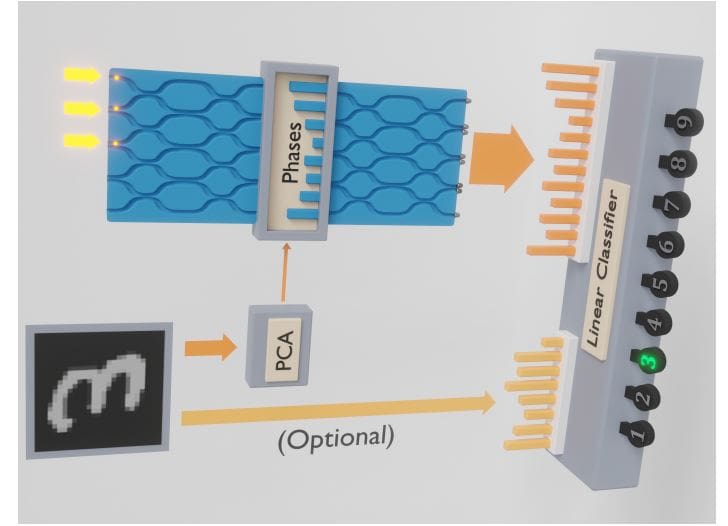
Machine learning is increasingly powering modern technology, but the full potential of quantum resources is currently not being exploited. Markus Rambach, Abhishek Roy and colleagues from the University of Queensland and Okinawa Institute of Science and Technology Graduate University, along with Alexei Gilchrist and colleagues from Macquarie University, have developed an optical quantum accelerator that uses boson sampling, a complex quantum interference process, to power reservoir computing. Their work shows that despite practical limitations such as incomplete photon sources and unbalanced datasets, machine learning performance can be significantly improved, successfully classifying handwritten digits and biomedical images with significantly less training data. Importantly, the team validates these benefits on a dedicated photonic processing unit, providing the first experimental evidence that boson sampling-enhanced machine learning yields measurable performance benefits on real quantum hardware.
Quantum reservoir computing for image classification
By integrating quantum-inspired techniques with classical reservoir computing, this research pioneers a new approach to machine learning and delivers improved performance on real hardware. Researchers have designed a system that takes advantage of boson sampling, a complex quantum interference process, to enhance the capabilities of reservoir computing for complex classification tasks. This included building accelerators for classical computations, leveraging boson sampling to generate high-dimensional fingerprints of the reservoir, and improving information processing power. To test this approach, the scientists implemented the system in a photon processing device and meticulously controlled the photon source to achieve varying degrees of indistinguishability.
We used a dataset of handwritten digits and biomedical images in our experiments, and intentionally introduced class imbalance to test the robustness of our method under realistic conditions. The team collected samples and encoded noise through non-ideal parameters to simulate real-world data imperfections. The results show that the model accuracy is significantly improved even when data is sparse, and the required training data is significantly reduced compared to traditional methods. In this study, the reproducibility of results was rigorously evaluated through Monte Carlo simulations and consistently high accuracy was demonstrated. The researchers systematically varied the parameters of the boson sampling network and confirmed the stability and reliability of their approach. Further analysis investigated the effect of increasing the number of photons and revealed that even a single photon can contribute to improved performance. The team also utilized macro F1 scores to ensure balanced evaluation across all classes and also evaluate performance on unbalanced datasets.
Photonic boson sampling for reservoir computing
This research demonstrates a new approach to machine learning by integrating quantum mechanical principles with classical computing techniques. Scientists have developed a way to leverage boson sampling, a process that exploits the unique properties of photons, to power reservoir computing, a type of machine learning that is particularly suited to processing complex data. Results show significant performance improvements across a variety of difficult scenarios such as noisy data, unbalanced datasets, and limited training examples. Importantly, the team experimentally validated this approach using photonic processing units and confirmed that boson sampling-enhanced reservoir computing yields tangible benefits in real hardware.
This research successfully demonstrated the potential of quantum-inspired techniques to accelerate machine learning tasks. The researchers maintained model accuracy and achieved robust performance improvements with significantly less training data than required by traditional methods. The team proposes extending this framework to time-series data and pattern recognition as a promising avenue for future research, while acknowledging that further development of both hardware and task diversity is required. Ultimately, this research represents an important step toward realizing practical quantum benefits in real-world machine learning applications.
Quantum computing improves image classification accuracy
Scientists have made significant advances in machine learning and demonstrated that by integrating quantum principles into classical computing frameworks, performance on image classification tasks can be significantly improved. This research focuses on a new approach called quantum-enhanced one-shot reservoir computing (QORC). This approach leverages boson sampling to create high-dimensional fingerprints for reservoir computing, a type of recurrent neural network. Experimental results reveal that QORC consistently outperforms traditional linear classifiers, improving test accuracy by up to 4.9% on the MNIST dataset.
The team measured the impact of QORC under a variety of difficult conditions, including an imperfect photon source and severe class imbalance. In particular, QORC required significantly less training data compared to traditional methods while maintaining model accuracy. The researchers validated the scalability of their scheme on photonic processing units, providing the first experimental evidence that quantum-enhanced reservoir computing yields real performance improvements on real hardware. Further analysis focused on the relationship between photon indistinguishability and classification accuracy and demonstrated a strong correlation, indicating that increasing quantum entanglement improves the information capability of the system.
Even for fully distinguishable photons, QORC remained advantageous due to first-order quantum coherence. In this study, we also investigated the performance of QORC on unbalanced datasets, which are common in real-world applications such as biomedical imaging, and achieved consistently higher macro F1 scores compared to traditional linear classifiers. On the MedMNISTv2 dataset, QORC significantly improved the classification F1 scores for various image types, demonstrating its versatility and potential for broader applications in medical image analysis.
Boson sampling improves reservoir computing performance
This research demonstrates a new approach to machine learning by integrating quantum mechanical principles with classical computing techniques. Scientists have developed a way to leverage boson sampling, a process that exploits the unique properties of photons, to power reservoir computing, a type of machine learning that is particularly suited to processing complex data. Results show significant performance improvements across a variety of difficult scenarios such as noisy data, unbalanced datasets, and limited training examples. Importantly, the team experimentally validated this approach using photonic processing units and confirmed that boson sampling-enhanced reservoir computing yields tangible benefits in real hardware.
This research successfully demonstrated the potential of quantum-inspired techniques to accelerate machine learning tasks. The researchers maintained model accuracy and achieved robust performance improvements with significantly less training data than required by traditional methods. The team proposes extending this framework to time-series data and pattern recognition as a promising avenue for future research, while acknowledging that further development of both hardware and task diversity is required. Ultimately, this research represents an important step toward realizing practical quantum benefits in real-world machine learning applications.


