
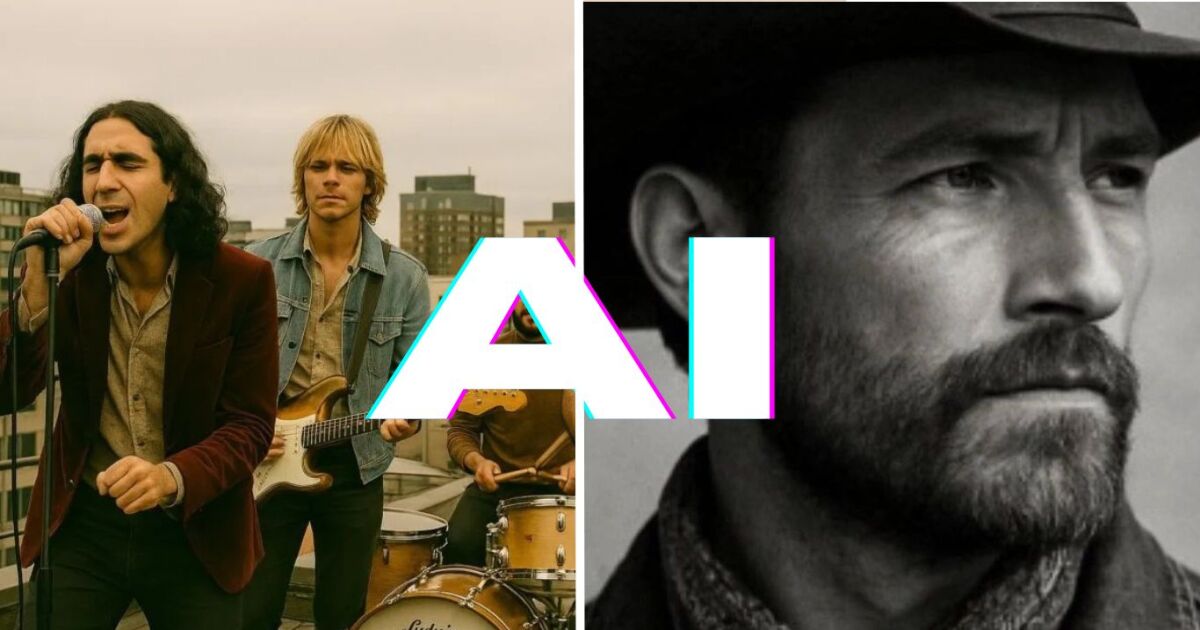
Music created by artificial intelligence (aka AI-generated music) is currently topping the record charts. Let that sink in for a moment.
In 2025, it's hard to escape the fact that AI appears to be everywhere. I bought a new washing machine and it has AI settings. Why do we need AI to wash clothes? I don't know.
As Iowa Public Radio's Josie Fishels reported, in the radio world, some stations are Frankensteining their AI DJs with the image and gender they want to hear and see. So when I heard that AI was topping certain music charts, I decided it was finally time to check it all out.
I listened to top AI-generated musicians perform, but you don't have to. However, I've also included a reference video in case you want to see it for yourself.
velvet sunset
This “group” went viral a few months ago after accumulating over 1 million plays on Spotify and fooling many listeners into thinking they were a real band. This “band” released three albums in a month before admitting that all of their music was entirely generated by AI.
Online reactions ranged from frustration to anger from both independent artists and industry professionals, particularly regarding the use of human artists' work as models to train AI without their permission.
With The Velvet Sundown, you can imagine the prompts used to create the track. I think it was probably programmed with phrases like “70s rock band sound,” “Led Zeppelin,” and “My Morning Jacket.”
The musical feel is a little off on these tracks. But strangely, if you have an untrained ear, or are listening to the song in the background, you won't be able to tell the difference. If the AI sounds so good that the average listener can't tell the difference acoustically, that's pretty alarming.
The band's name, The Velvet Sundown, is corny to say the least, and the lyrics are thankfully (and perhaps understandably) uninspiring. But then again, the reality is there are a lot of bands with corny names and lazy lyrics.
break the rust
Breaking Rust's “Walk my Walk” topped Billboard's Country Digital Song Sales for a week last month, sparking a flurry of entertainment news and shocking reactions online. In my opinion, this band sounds even worse than The Velvet Sundown, but people still seem to like this band even though they know it's AI. Perhaps AI could better imitate the nuances of country and Velvet Sundown's '70s rock sounds — at least for now.
The prompts fed into the AI to create Breaking Rust songs must be things like “Outlaw Country,” “Stomp/Clap,” “Cowboys,” and “Chris Stapleton Vocals.”
Musically, this “band” is just plain bad. The “instrumentation” here is all eerily similar, and the vocals have a strange, inhuman pulse to them.
Breaking Rust's lyrics are also very bland, often raising more questions than answers. For example, the band's song “Whiskey Don't Talk Back” includes the line, “The only thing that keeps me company is that Whiskey doesn't talk back,” which makes no sense no matter how you read it. To be clear, the AI cannot drink anything.
Zania Monet
This example is slightly different from the previous two examples. Zania Monet is not a real person and her music and voice are created by AI, but the lyrics from the song “How Was I should to Know?” are used. They are man-made and written by Terisha “Nicky” Jones. The atmosphere here is a mix of gospel and R&B, with a sprinkle of Mariah Carey.
Still, I'm not good at singing. Sure, the lyrics “Every kiss melts my daddy's wounds” were sung by an AI, but knowing it was written by a human was one of the stranger things I experienced while listening to all of these AI songs.
The song “Social Media Lies” has a specific phrase, “We celebrate things that aren't even real,” which quickly became very meta.
takeout
Simply put, AI-generated music represents the strange reality we currently live in. These are just a few examples of what's happening right now. Some commentators say this is just a tapering trend, but as AI gets better and better, real artists are using it to create chart-topping hits, like Zania Monet. Studio One favorite Teddy Swims says: “When used correctly, [AI] It can be a beautiful tool. ”
Does this mean that the role of the artist is changing to simply providing prompts to a generation software engine? When does something go from being a mere gimmick to an actual concern? What quality and ethical standards do we as music listeners and fans want the music industry to put on AI-generated music? Or do we even care? The future is unknown and no doubt full of more surprises than we think. It will be interesting to see what happens next.


