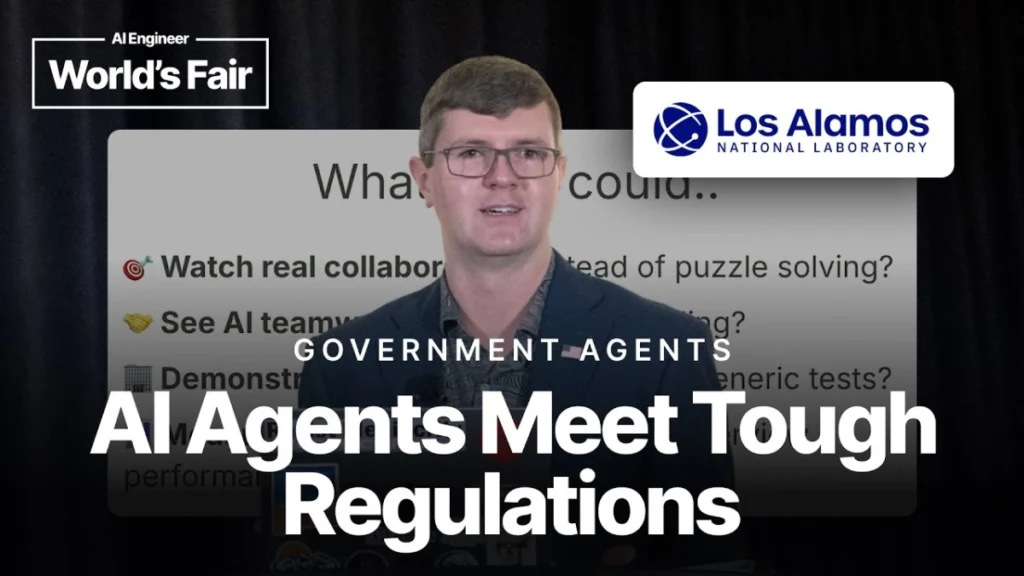
“If we get this wrong, people could die.” This stark statement by Mark Myshatyn, an enterprise AI architect at Los Alamos National Laboratory, at the 2025 AI Engineer World's Fair cuts through the hype surrounding artificial intelligence and reveals the grave responsibility inherent in government applications. His light talk provided a rare glimpse into how a venerable institution like Los Alamos is not only embracing, but actively shaping the future of AI, especially in the high-stakes field of national security.
Mishatin's presentation to an audience of founders, venture capitalists and AI experts highlighted Los Alamos' deep and often overlooked history in this space. Far from being new to AI, “Los Alamos has been part of the AI/ML world for 69 years,” he said, showing a black-and-white photo of scientists competing against early supercomputers in 1956. This rich heritage in applied statistics and machine learning now provides a unique foundation as the lab navigates the complexities of modern AI agents.
The heart of Los Alamos' current AI push lies in its “AI Scientist Model,” an agent workflow designed to accelerate scientific discovery. Myshatyn demonstrated an AI system tasked with designing an inertial confinement fusion (ICF) capsule for our sister lab, Livermore. Agents interact by reading scientific papers, searching the web, generating and critiquing ideas, proposing designs, and, importantly, running 1D simulations on high-performance computing assets. This iterative process allows AI to evaluate failures, develop new designs, and optimize for maximum yield. The entire design and simulation process, which would normally take significantly longer to perform by a human, was completed in just two hours without human intervention. This capability exemplifies how AI agents can act as powerful force multipliers, compressing the scientific discovery cycle and enabling previously unimaginable breakthroughs. “What we can inform the model is the changes that actually happened here,” Myshatyn said, highlighting the paradigm shift from the model simply knowing to actively exploring and iterating.
The National Security AI (NSAI) Office at Los Alamos operates with a clear mission to push the boundaries of AI science for national security, build strong relationships with commercial and academic partners, and support the right tools for science and operations. The scope of their work is immense, spanning 40 square miles of research and testing grounds, including 13 nuclear facilities. This vast ecosystem requires AI not only for scientific advancement but also for critical operational tasks such as payroll, procurement, and cybersecurity.
Introducing AI into such a critical environment poses a clear set of challenges, particularly around trust and responsibility. Unlike commercial applications where errors can lead to economic losses, government AI has a direct impact on national security and human lives. These two imperatives are central: accelerating innovation while preventing catastrophic failure.
The regulatory landscape for government AI is rapidly evolving, presenting both obstacles and opportunities. Mr. Mishatyn highlighted recent Office of Management and Budget (OMB) memorandums (M-25-21 and M-25-22) that encourage federal agencies to more deeply integrate AI into their operations, while also emphasizing the protection of civil rights, liberties, and security. The framework is still in its early stages of development and serves as a “blank slate” for government agencies to define their AI strategies. Existing compliance frameworks such as FedRAMP and the Department of Defense Cloud Computing Security Requirements Guide (CCSRG) are extensive, with over 1,000 controls in some cases, and have historically been slow to adapt. However, new initiatives like FedRAMP 20x aim to streamline and automate compliance.
Related books
Myshatyn outlined important architectural considerations for commercial partners looking to work with federal agencies, including building with explainability, separability, and governance in mind. Explainability is important for auditing decisions and ensuring accountability. This is particularly important when “AI is considered high-impact if its output serves as the primary basis for decisions or actions that have a legal, material, binding, or significant impact on rights or security.” Isolation is essential to deter potential breaches in sensitive environments, where national security is non-negotiable. Governance, including robust open source dependency management and patching plans, ensures the integrity and reliability of your AI systems. Finally, maintaining speed is most important. Federal agencies cannot afford to fall behind in AI development.
Los Alamos actively seeks partnerships with commercial and academic organizations to address problems that are extremely difficult or impossible within the commercial industry due to their scale, sensitivity, and specialized nature. They possess petabytes of data that have never been touched by the Internet and will never be touched, and unparalleled subject matter expertise in a variety of scientific fields. This unique environment provides fertile ground for collaboration, and as Los Alamos has demonstrated throughout its history, math and science, applied correctly, can really change the world. The opportunity to help shape the future of safe, reliable, and impactful AI for national security is enormous, and the Lab is inviting everyone who wants to build that future with us.