December 5, 2025
Singapore – Imagine having a professor in your pocket, a research assistant working behind the scenes, and a debate partner waiting right next to you.
Chatbots and other artificial intelligence (AI) tools are rapidly becoming part of campus life, coaching and quizzing students during class.
As the AI boom hits universities, students are experimenting with technology to hone their skills, get instant feedback, and personalize their learning.
Students told The Straits Times that while AI felt like learning was becoming too convenient, they were also checking their work and making sure they were doing “basic thinking” themselves.
“There is a risk of making learners lazy, but if used properly they can make the learning process much faster,” said Selene Chong, a law student at the National University of Singapore (NUS).
Dr Ranganath Vallabhajohra, senior lecturer in anatomy at Nanyang Technological University (NTU), admitted that finding a balance between overusing AI and true learning is “difficult”.
“One of the strategies is to rely on AI for basic level learning and then gradually… apply AI to learn more advanced concepts,” he said, adding that the onus remains on students to take control of their learning.
“We need to use AI more ergonomically and wisely,” Dr. Ranganath said, adding that it is important to identify where AI adds value and plan its use in a way that supports rather than replaces critical thinking.
NUS law students use chatbots to practice cross-examination during their trial advocacy course.
The bot, which was piloted in March, simulates scenarios from distressed and evasive witnesses to strict judges who demand accuracy, giving students practice in questioning and courtroom etiquette.
After reviewing case documents, they act as defense attorneys who cross-examine their “clients” while virtual judges and prosecutors respond in real time.
Third-year law students Emmanuel Wong, 23, and Chong, 21, said the chatbot has kept them on track. Wong said when they ask leading questions, “judges” overrule them and correct them, but their colleagues may not yet be trained to see through that.
Chong said it relieves “psychological pressure” because he can practice at his own pace and regain his composure.
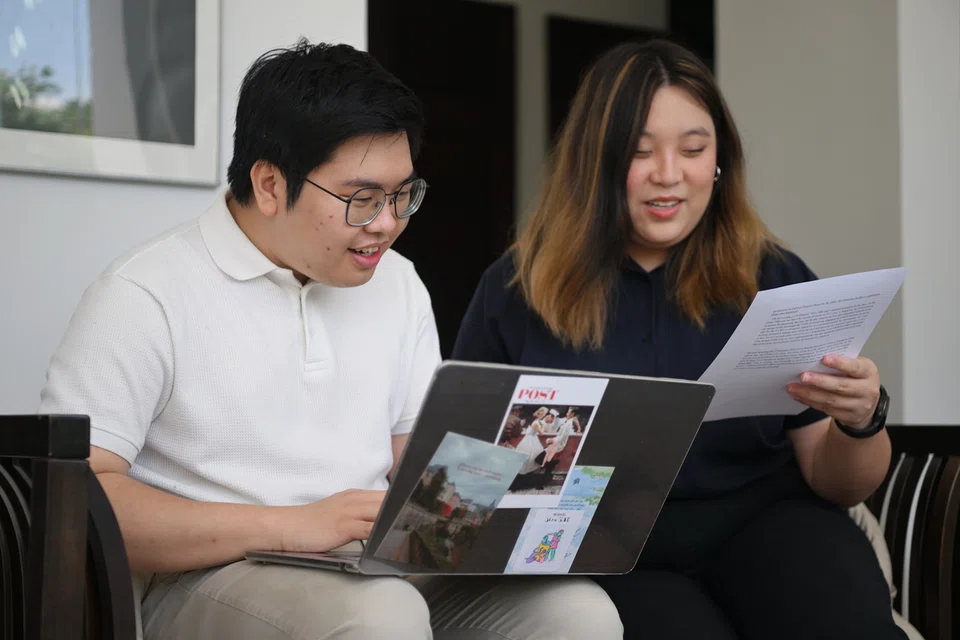
Third-year law students Emmanuel Wong (left), 23, and Chong, 21, said the chatbot has kept them on track. Photo: Straits Times
Wong added that the bot helped him ask precise questions and deal with noncompliant witnesses and unwarranted objections.
While in-person training is still essential, bots allow for more personalized practice, testing students’ grasp of concepts before tutorials and acting as a measure of understanding, said Associate Professor Marvin Chong, who leveraged his experience with real-life cases to develop the chatbot’s hypothetical facts and scenarios.
Approximately 126 students used this tool.

Exhibiting a chatbot demonstration. Photo: Straits Times
“When you suddenly go into in-person practice when there’s so much attention on you, it’s hard to overcome the anxiety,” he says. “But if we do it in our own space, we have time to think and respond accordingly.”
At Singapore Management University, design thinking bots play the role of stakeholders as students negotiate and interact with clients.
It was rolled out in January 2024 and has been used so far by approximately 400 students in the School of Computing and Information Systems.
Fourth-year computing student Ong Swee Long, 25, used the bot in her sustainability course. In this course, his group was tasked with proposing solutions to address food waste on campus.
While he was initially drawn to a technology-driven approach, he said AI has forced him to slow down and consider different perspectives.
For example, as the bot guides students through the steps of design thinking, students are encouraged to engage with “stakeholders.”
In Ong’s case, these included students, school principals, stall owners and cleaners.
Conversations with virtual “stakeholders” led the group to speak directly to Kofu City’s cleaning companies, revealing real-world constraints and perspectives that purely technical solutions would miss.
“It’s not a substitute for talking to a real person, but it can help you prepare some questions you want to ask in advance,” Ong said.
Bots can generate prompts, problem statements, prototyping options, and even ideas that students can use or adapt.
Kiruthika Ramanathan, a senior lecturer in information systems who helped develop the tool, said the goal of the tool is for computer science students to consider human needs beyond technical fixes.
Through AI-guided exploration, the team ultimately designed a centralized push cart with scales, cameras, and buckets to integrate food waste tracking, replacing the 16 carts that cleaners were using to collect food from various stalls.
“In addition to saving time and having everything in one place, AI encourages students to go through the entire process before jumping right to a solution,” Ong said.
Students also treat AI like companions they can study with 24 hours a day.
Some at the Singapore University of Technology and Design (SUTD) are taking their learning even further by building their own bots to suit their learning styles.
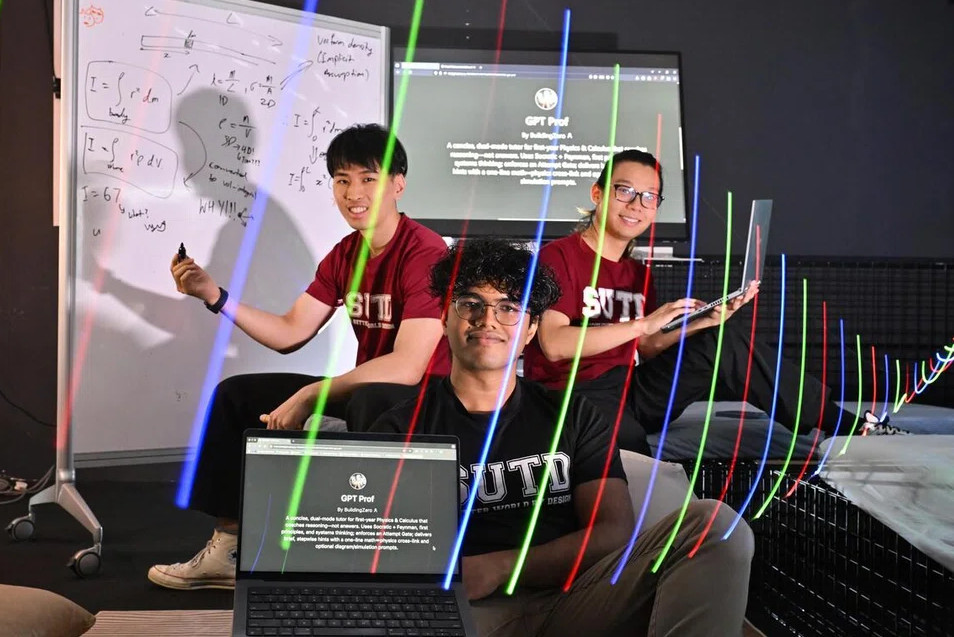
Anieyrudh R. from the School of Engineering Product Development created GPTBernie, an AI tutor modeled after Professor Bernard Yee’s teaching style, the day before her math finals.
“Within minutes, you feel like you’re in your professor’s office,” said the 22-year-old, who has reduced the number of emails he sends to professors by 70%. It was introduced in April to small groups of students.
The bot helps him solve more basic questions on his own, freeing up his face time with his professor for deeper, more complex conversations.
It also raises questions about his understanding, Anieldo said.

Anieyrudh R. from the School of Engineering Product Development created GPTBernie, an AI tutor modeled after a math professor. The professor’s teaching methods and explanations are included. Photo: Straits Times
He is leading a team of students who have developed similar bots to share with each other out of their own interests, and are expanding GPTBernie into a library of “GPTProfs” to help with administrative tasks, project design, and educational support.
At NTU’s Lee Kong Chian School of Medicine, Anatbuddy, an AI anatomy chatbot, helps first- and second-year students apply their clinical knowledge.
Ranganath, who helped develop the chatbot, said learning anatomy in a traditional environment is usually monotonous. Introduced in November 2024, Anatbuddy changes the game by encouraging students to think deeper.
Instead of simply naming parts, students are encouraged to consider clinical “what if” questions.
“They start thinking, ‘Where is it? What does it do? What happens if it gets damaged?'” Dr. Ranganath said, adding that this reflects deeper engagement and stronger conceptual understanding.
Students also arrive better prepared and able to ask more substantive questions of professors, he said.
Singapore University of Social Sciences has an AI learning companion called iSmartGuide that offers bite-sized lessons, flashcards, and quizzes.
Since its launch in June 2025, the platform has served more than 22,000 students.
ClassAId, Singapore Institute of Technology’s (SIT) in-house platform, allows instructors to create custom bots for any subject, from AI tutors to role-play partners. As students interact with these bots, instructors gain real-time insights into their learning, allowing for more targeted feedback.
Another SIT innovation, CommunicAId, works like a personal communication coach that helps students rehearse professional scenarios, navigate difficult conversations, and get instant feedback on assignments.
Another area where AI is proving useful is research.
NTU medical students have been using Rileybot since January, which helps collect information from databases.
Senior medical librarian Rebecca David said students are often confused or intimidated by the different interfaces of traditional databases.
RileyBot guides precise literature searches and is more accurate than regular bots like ChatGPT, she said, adding that knowing how to perform error-free searches is an essential skill for high-level research.
Over 500 students have used Rileybot and Anatbuddy so far.
“One is about technology and the other is about medical knowledge such as anatomy and research,” Dr. Ranganath said.
“When you combine the two and incorporate them into your regular learning life, your students will feel more confident and engaged in their learning.”
Correction note: This story has been edited for clarity.