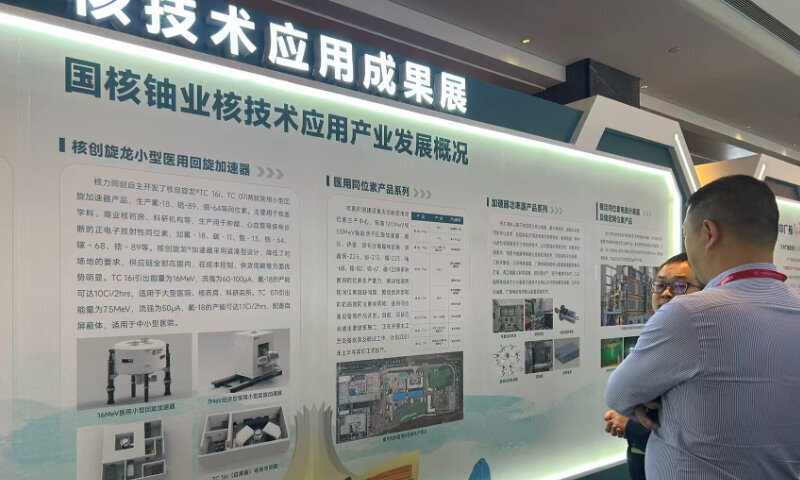
BEIJING, China, November 30, 2025 (Globe Newswire) — The 2nd Nuclear Technology Application Industrial Chain Joint Chain Action Conference was held on Thursday in Nanning City, Guangxi Zhuang Autonomous Region in southern China, where China’s first nuclear technology application industrial chain integrated action plan and a series of other achievements were announced, marking a new stage in systematic chain building efforts to drive quality growth. During the event, executives briefed Global Times on nuclear technology that integrates innovations in nuclear medicine and AI, highlighting how nuclear technology is increasingly powering a wide range of industries in the country.
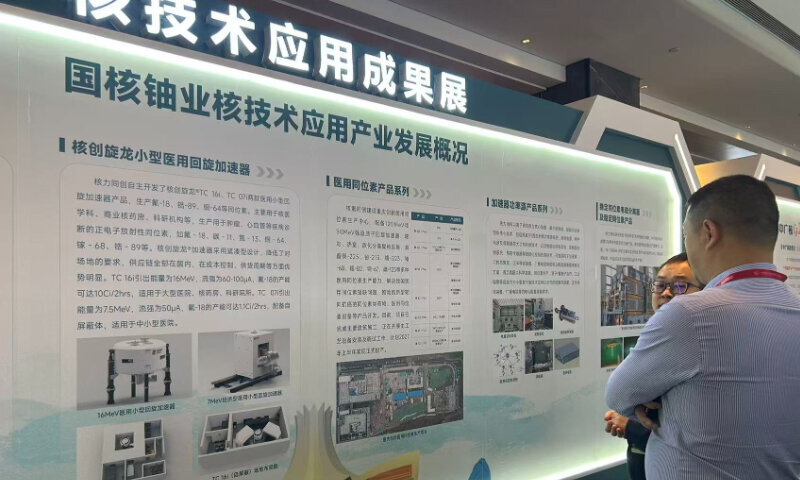
Visitors tour an exhibition of industrial innovation achievements at the 2nd Nuclear Technology Application Industrial Chain and Co-chain Action Conference held in Nanning, Guangxi Zhuang Autonomous Region, southern China, on November 27, 2025. Photo: Liang Rui/GT
In a video address at the conference, Najat Mokhtar, Deputy Director-General of the International Atomic Energy Agency (IAEA), praised China’s achievements in nuclear technology development and expressed hopes for deepening cooperation in the future.
Experts from China’s major nuclear research institutes, social organizations, and major industrial enterprises attended and gave remarks at the event. Experts from the China Atomic Energy Administration said that as China’s nuclear energy sector flourishes and the requirements for governance capacity increase, the upcoming enactment of the People’s Republic of China Atomic Energy Law will meet the essential need for high-quality development in this field. It also serves as a basis for improving the country’s nuclear governance system and strengthening its nuclear governance capacity. Experts provided further interpretations of the new law.
In addition, the “Nuclear Technology Application Industrial Chain Integrated Action Plan” is China’s first systematic industrial chain upgrading initiative jointly launched by industry organizations and with the joint participation of multiple stakeholders. According to the China Nuclear Corporation (CNNC), one of the conference organizers, the goal is to strengthen national security protection measures for nuclear technology application industries, gradually overcome bottlenecks in key areas, and lay the foundation for an autonomous, safe and controllable industrial chain.
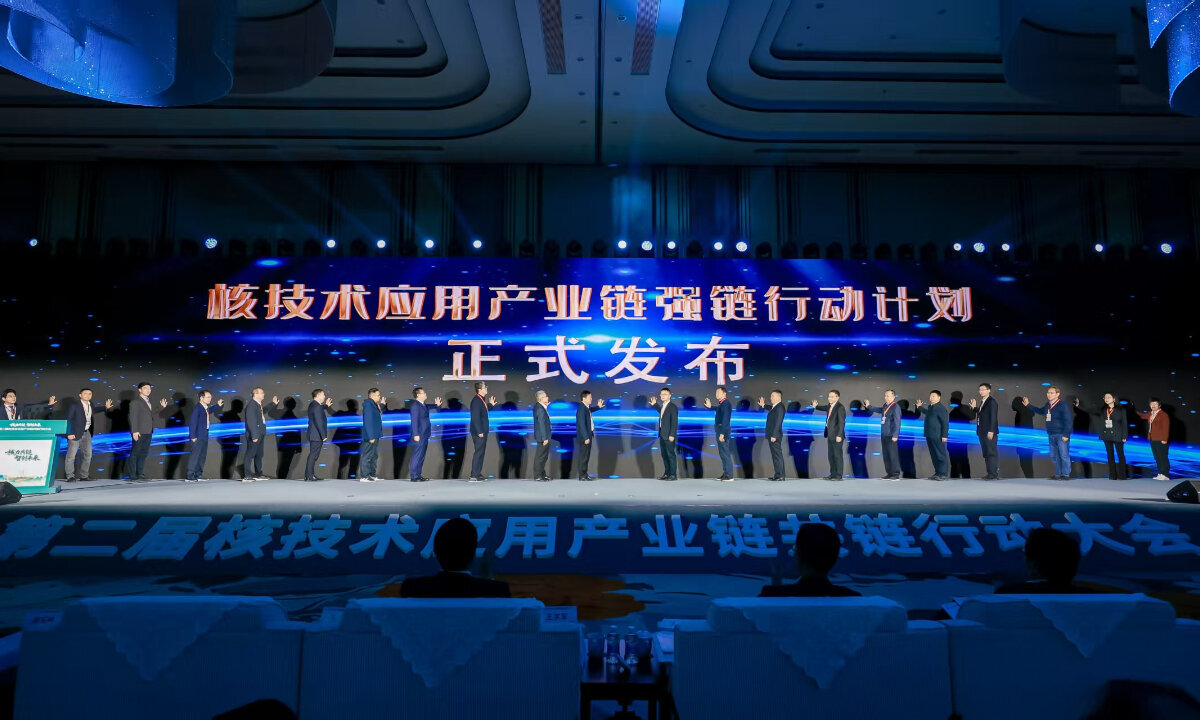
At the conference, the inauguration ceremony of the Nuclear Technology Application Industrial Chain Integrated Action Plan was held. Photo: Provided by CNNC
The conference also launched an integrated media campaign and held four parallel sessions covering “Nuclear Medicine”, “Radiation Modified New Materials”, “AI and Nuclear Technology”, and “Smart Nuclear Energy”, alongside the exhibition of industry innovation achievements.
Nuclear technology, also known as isotope and radiation technology, primarily refers to non-electrical civil nuclear applications. According to CNNC, related industries, which are the main components of modern science and technology, are defined by the characteristics of high technology, high efficiency and high quality, making them prime examples of new high-quality production forces.
The IAEA once assessed that nuclear technology directly contributes to nine of the United Nations’ 17 Sustainable Development Goals, according to an explanation provided by the China Isotope Radiation Association. CNNC said nuclear technology powers a variety of industries with unprecedented breadth and depth.
At present, China’s nuclear technology application industry has formed a multi-layer, multi-chain coordinated development system. Several major subsectors have achieved large-scale industrialization, and the sector as a whole follows a pattern of “mature chains leading and emerging areas being nurtured.”
In the medical field, nuclear medicine is a cutting-edge technology to target and destroy cancer cells and is also a major direction for future drug innovation. The Qinshan Nuclear Power Plant, a multi-unit nuclear power plant located in Jiaxing City, Zhejiang Province, in eastern China, is enabled by the country’s only commercial heavy water reactor and has become an “isotope dream factory” that supports stable mass production of multiple nuclear medicines and realizes autonomy in raw materials, technological innovation, and domestic substitutes.
“By late June 2025, the lutetium-177 isotope produced in Qinshan has been officially launched into the market. After pharmaceutical purification, it can be used for targeted treatment of prostate cancer and neuroendocrine tumors. Its annual production capacity is sufficient to meet domestic demand,” Li Shisheng, deputy chief engineer of Qinshan Nuclear Power Plant, told the Global Times at the conference. This represents a significant advance in China’s independent and controllable medical isotope production.
Regarding the integration of AI and nuclear technology, Peng Hua, vice president of China’s partly state-run security inspection products company Nuctech, told the Global Times at the conference that current achievements are mainly focused on industrial applications. The combination of AI and CT technology enabled automatic durian grading, lithium battery defect detection, and optimization of security inspection workflows, significantly increasing efficiency and safety while improving the user experience.
China’s AI-powered nuclear technology is now one of the most advanced in the world. For example, in customs inspections, our technology has already entered enforcement procedures and is being steadily deployed, particularly in the field of image recognition. This progress is supported by China’s vast market and high-quality data resources. I am very confident in the future development of this field, Peng added.
According to the three-year action plan for the quality development of nuclear technology application industry (2024-2026) released in 2024, by 2026, the independent innovation capacity of China’s nuclear technology application industry will be significantly strengthened and the industrial field will be further expanded.
In the next three years, breakthroughs will be achieved in many key technologies, many innovation platforms will be built, and new enterprises will be nurtured, focusing on the application of nuclear technology in fields such as medical diagnosis and treatment, agricultural breeding, food processing, safety and security, the three-year action plan added.
Source: Global Times:
Company name: Global Times
Contact person: Anna Lee
Email: editor@globaltimes.com.cn
Website: https://globaltimes.cn
City: Beijing
Disclaimer: This press release may contain forward-looking statements. Forward-looking statements describe future expectations, plans, results or strategies (including product offerings, regulatory plans and business plans) and are subject to change without notice. You are cautioned that such statements are subject to a number of risks and uncertainties that could cause future circumstances, events or results to differ materially from those anticipated in the forward-looking statements, including risks that could cause actual results to differ materially from those projected in the forward-looking statements.