
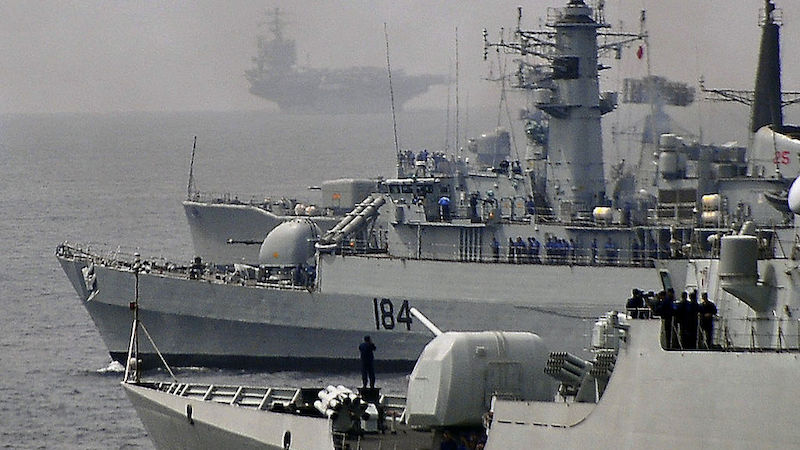
Modern naval power has always been powered by hardware: tonnage, sensors, missile range, and the ability to maintain a presence at sea. But Pakistan’s maritime signals are undergoing an extraordinary transformation, with forecasts of naval power increasingly relying less on ships and operations and more on something more fluid: doctored video, composite footage, and AI-generated narratives. Although the Pakistan Navy faces persistent constraints in fleet readiness and operational range, it continues to persist in the information domain through a growing ecosystem of fabricated anti-ship ballistic missile (ASBM) footage and deepfake operations.
This change marks a decisive shift in South Asia’s maritime intelligence battlefield. This shows that capability is no longer measured only by the movement of ships across the Arabian Sea, but also by the manipulation of pixels across social networks.
Missile tests and a flood of fabrications
Pakistan’s latest P-282 ship-launched anti-ship ballistic missile test was itself supposed to serve as a modest demonstration of a short-range strike system. The official footage released by Pakistan’s military was short and toned down, showing a tightly framed launch sequence followed by spray flying far out at sea. The ship was not identified, no telemetry was shared, and no details such as seeker type, trajectory, or range were provided.
But almost immediately, a parallel universe of visuals began circulating across Pakistan’s defense networks and social media platforms. These versions of the ASBM test were much more dramatic. The warship exploded in a digital fireball. The “hypersonic” missile flew in an arc through the artificially enhanced sky. An Indian aircraft carrier was shown being destroyed by a synthetic shock wave. Much of this content had obvious signs of manipulation. They include replay footage from unrelated tests, AI-generated device explosions, CGI overlays that create the illusion of piloting a target, and firing shots stitched together from different contexts.
Independent fact checkers and digital forensic analysts have repeatedly identified these circulating ASBM clips as tampered with, digitally modified, or AI-assisted. There is no such thing as officially released flimsy footage. The contrast is striking. Actual missile tests at limited ranges are overshadowed by virtual renditions designed to suggest technological breakthroughs that do not exist.
Deepfake targeting Indian Navy leadership
The overall maritime story does not end with weapons. It extends to even more critical targets: India’s naval and military leadership. Critics say a recently widely circulated video attempts to portray Indian Chief of Naval Staff Admiral Dinesh K. Tripathi
It blamed the Indian government and acknowledged the supposed naval losses. Forensic analysis by India’s Deepfake Analysis Unit (DAU) revealed that only the first few seconds were authentic. The rest of the video includes AI-generated audio overlaid with real footage, created to simulate dissent within the Indian Navy.
This was not an isolated episode. Other deepfakes have targeted former Indian Army Chief General Malik and several senior commanders through digitally altered interviews and synthetic statements. These efforts reflect the intensification of information warfare, where adversaries are no longer merely distorting events, but are also attempting to invent leaders themselves.
Operation Sindur: When Pakistan Navy stayed in port, its AI navy fought online
The disconnect between Pakistan’s physical and overall naval posture was most evident after the Pahalgam attack and after India launched Operation Sindur and deployed extensive maritime forces, including the Indian Navy’s Vikrant aircraft carrier group, to the Arabian Sea. Pakistan Navy vessels faced widely reported availability and propulsion issues and remained largely confined to coastal waters.
But online, Pakistan appeared to have won the broader maritime dispute. An AI-generated video showed the Indian ship being destroyed. Repurposed footage from a completely different war has emerged as a ‘breaking news’ of a Pakistani missile attack. Digitally produced radar screens claimed intercepts that the Pakistan Navy never conducted. In this virtual maritime world, Pakistan won easily, not because of its naval power, but because of the power of its narrative.
This spectacle splits the structure of a new form of maritime duality, with navies having a limited scope of operations at sea but expanding across information channels.
Incentives behind integrated marine power
Several factors explain Pakistan’s shift to doctored ASBM footage and AI-generated naval narratives. The maritime asymmetry with India has become even clearer. India’s surveillance network, carrier operations, and submarine capabilities far exceed Pakistan’s. Pakistan’s fleet continues to face maintenance constraints that limit long-term deployments.
When physical parity cannot be achieved, digital operations offer a low-cost means to remain competitive. Social media further amplifies that incentive. Artificial visuals spread faster, reach a wider audience, and evoke stronger emotional responses than official footage or technical briefings. Synthetic media provides a dangerous but powerful tool for states seeking to reassure domestic audiences or project deterrence abroad.
Emerging maritime risks: Escalation through fabrication
The rise of Pakistan’s AI-led navy has implications far beyond public perception. Manipulated ASBM footage and deepfake naval messaging pose new risks to crisis scenarios. A fabricated video showing an Indian warship destroyed could stir up public sentiment and distort decision-making. Deepfakes of military leaders can cause chaos at critical moments. Synthetic ASBM “attacks” can mislead viewers into thinking that escalation has already occurred.
In this environment, strategic stability depends not only on naval deployment, but also on the reliability of the information itself. Countries must now prepare for a crisis in which the first destabilizing act may not be a missile launch but a manipulated video.
New battlefields and new challenges in the Indo-Pacific
Pakistan’s AI-driven naval narrative will not change the material balance of the Indian Ocean. India’s operational capabilities remain strong, and Pakistan’s actual ASBM program remains tied to limited-range systems, with an unproven ability to attack naval groups moving over long distances.
But Pakistan has innovated in other areas. By relying on doctored ASBM videos, synthetic missile footage, and deepfakes of Indian officers, they have created a virtual navy that exists independently of real maritime constraints. It is a force that fights not in physical space but in cognitive space, a fleet of algorithms made for perception rather than projection.
The challenge for India and the broader Indo-Pacific security community is to recognize that the next big change in naval warfare may emerge not from shipyards but from digital studios. Maritime power is now as hotly contested in the information realm as it is in the open ocean. Countering the synthetic naval narrative will require new tools, new doctrine, and the understanding that even navies can now be manufactured digitally.


