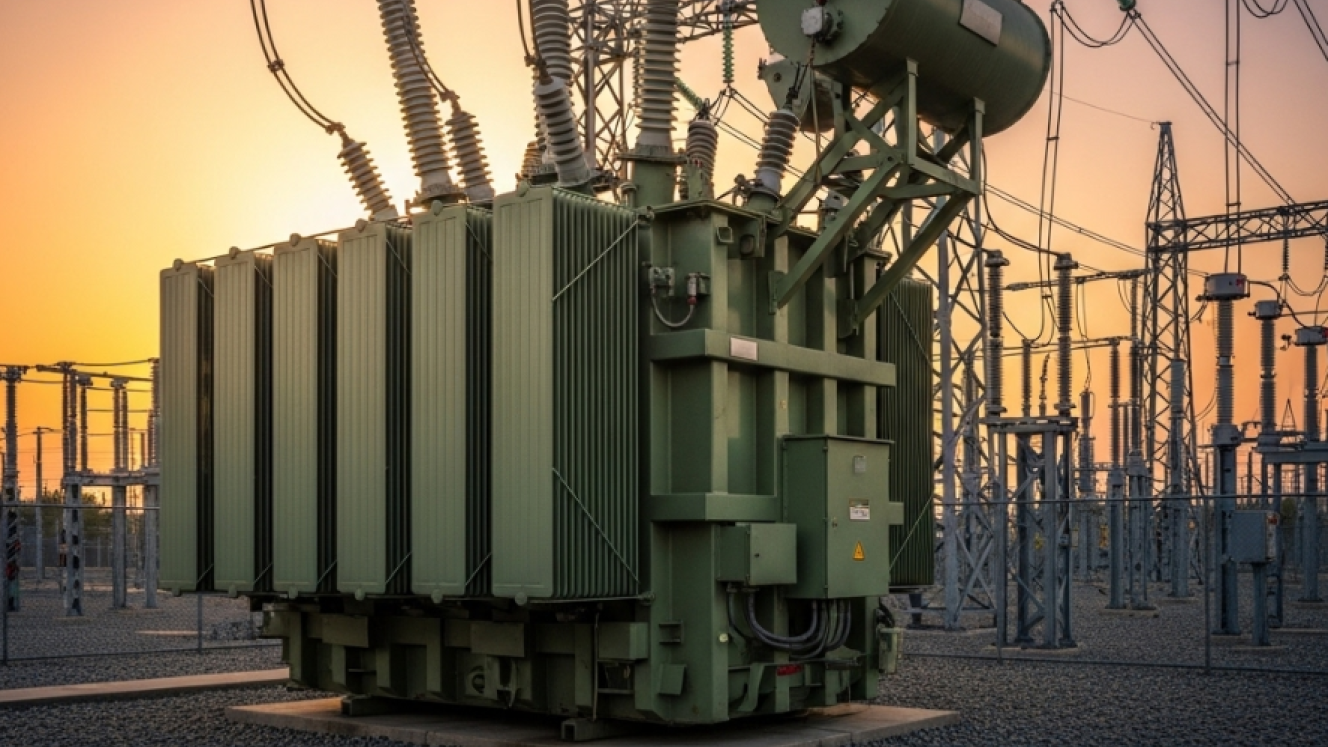
New research from ACTOM High Voltage Equipment demonstrates that machine learning techniques can significantly improve the identification of lightning impulse failure modes in power transformers, a process that is traditionally time-consuming, destructive, and dependent on expert experience. Research results presented by ACTOM engineers Bafana Nyandeni At CIGRE Southern Africa 2025 on October 15, multiple algorithms will be compared to determine which provides the most accurate and practical diagnostic support during transformer impulse testing.
Lightning impulse testing is used to check whether a transformer’s insulation can withstand transient overvoltages by applying a full-wave impulse at a defined basic insulation level (BIL). The resulting waveform includes parameters such as front time, tail time, peak voltage, chop, and time to overshoot. When a fault occurs, these unsteady, time-varying waveforms must be interpreted to identify the fault within the complex winding structure. This work typically relies on specialized analysts and, in some cases, destructive testing.
Nyandeni’s research investigates whether machine learning models can more systematically interpret these waveform characteristics. A comparative evaluation considered artificial neural networks (ANN), decision trees (DT), and support vector machines (SVM). We found that the ANN-based model is sensitive to the mismatch between the training and fault samples, while the DT model loses accuracy as the depth and imbalance of the tree structure increases with additional samples.
To overcome these limitations, this study developed a hybrid method that combines discrete wavelet transform (DWT) for feature extraction and SVM for classification. DWT was used to decompose the impulse waveform into detailed approximation coefficients, allowing extraction of feature sets such as wavelet energy, standard deviation, and mean value. These features were used to train an SVM classifier using test signals representing interwinding, interwinding, and ground faults over BIL levels ranging from 170 kV to 650 kV.
Model performance was evaluated using a confusion matrix across a combination of multiple datasets, with up to 98.3% accuracy for a given set of fault classifications. This study shows that organizing faults into series (interwinding/interturn) and shunt (line to ground) groups can stabilize SVM classification boundaries and minimize overfitting.
According to our findings, the DWT-SVM approach provides the most consistent method for differentiating between types of lightning impulse faults, reduces investigation time, reduces unnecessary disassembly, and offers the potential to identify potential fault zones early in the test cycle.