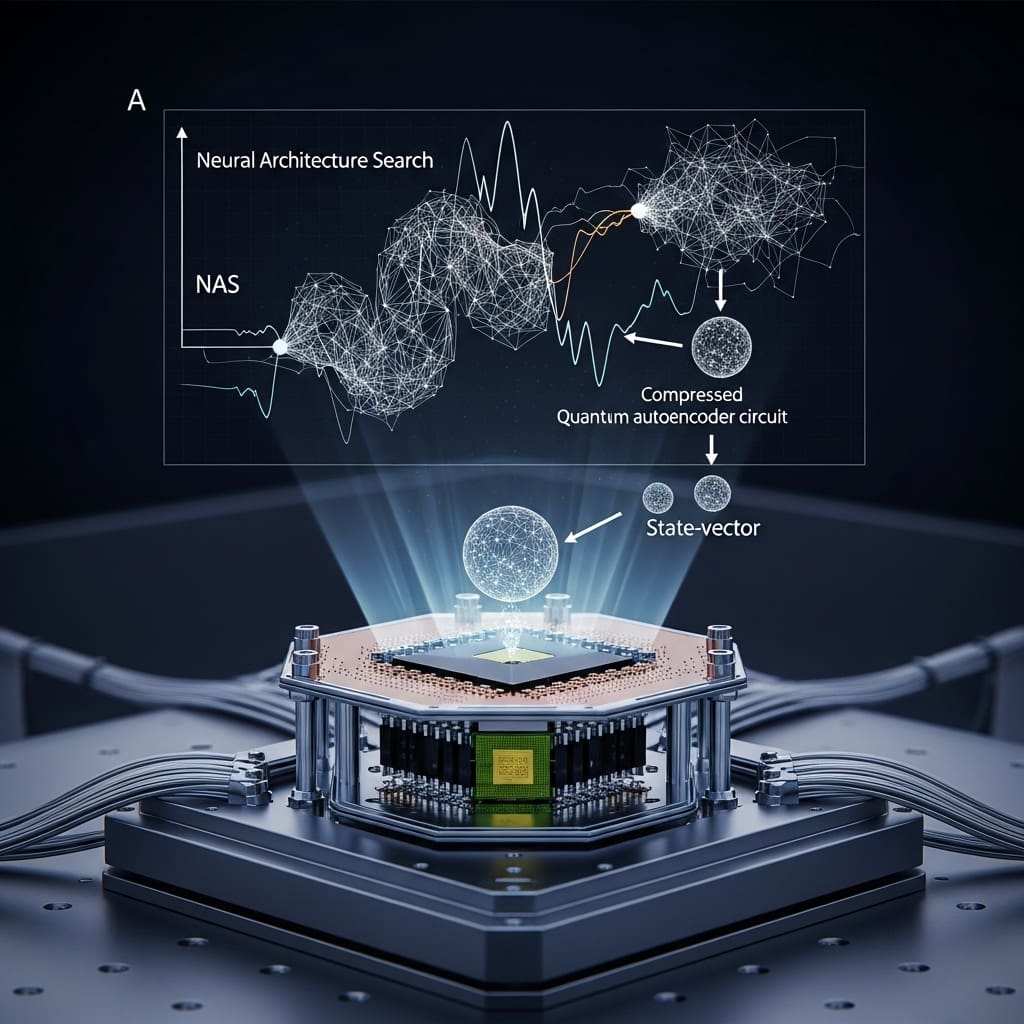
The quest to harness the power of quantum computing has increasingly focused on integrating quantum computing with established machine learning techniques, but designing effective quantum circuits remains a major hurdle. Hibah Agha of the New York Institute of Technology, Samuelyen-Chi Chen of Wells Fargo, and Huan-Hsin Tseng and Shinjae Yoo of Brookhaven National Laboratory are tackling this challenge by developing a new way to automatically design quantum autoencoders. Their work introduces a neural architecture search framework that uses genetic algorithms to systematically explore and optimize circuit configurations, overcoming the difficulties of manual design and the risk of suboptimal solutions. This automated approach demonstrates the ability to efficiently extract features from image data, paves the way for robust and adaptive quantum machine learning solutions suited to the limitations of current quantum hardware, and is expected to lead to advances in data compression and analysis.
Quantum autoencoder for noise reduction
This research focuses on quantum machine learning (QML), specifically autoencoders, reinforcement learning, and architectural search within the quantum domain. Research is investigating quantum autoencoders for data compression, noise reduction, and feature extraction, which are important for improving the reliability of quantum computation. Researchers are also applying reinforcement learning to optimize quantum control, automate the design of quantum circuits, and explore efficient architectures for complex tasks. A recurring theme is reducing errors in noisy intermediate-scale quantum (NISQ) devices through a number of approaches that combine classical machine learning techniques with quantum computation.
Fundamental research in quantum machine learning and autoencoders provides the basis for current research, while recent work has demonstrated the potential of evolutionary algorithms and reinforcement learning for designing effective quantum circuits. The search for differentiable architectures has emerged as a promising technique to accelerate the design process. This study shows a focus on noise reduction and error mitigation, with an emphasis on practicality. Hybrid approaches that combine classical and quantum techniques are proving to be the most promising path forward. Evolutionary algorithms and reinforcement learning are important tools for automating circuit design, and the search for differentiable architectures is gaining momentum.
Evolution of quantum autoencoders using genetic algorithms
Scientists have developed a novel neural architecture search (NAS) framework to automate the design of quantum autoencoders and overcome the limitations of manual configuration. This work pioneers a method to systematically evolve variational quantum circuit (VQC) configurations using genetic algorithms (GA) and explores a high-performance hybrid quantum-classical autoencoder for data reconstruction. This approach avoids getting stuck in local minima during optimization and allows for a more robust exploration of the circuit design space. The researchers designed a system in which candidate quantum circuits are treated as individuals within a population and undergo a process that mirrors natural selection. The performance of each circuit on an image dataset determines its “fitness” and guides the selection of circuits for replication and mutation. Through iterative cycles of selection, crossover, and mutation, the GA gradually refines the population, favoring configurations that exhibit superior data reconstruction ability.
Designing high-fidelity quantum autoencoders using genetic algorithms
Scientists have developed a new framework for designing quantum autoencoders using genetic algorithms, enabling automatic circuit design without falling into suboptimal solutions. This study demonstrates a robust method for evolving variational quantum circuit configurations and identifies a high-performance hybrid quantum-classical autoencoder for data reconstruction. This approach takes advantage of the natural parallelism of genetic algorithms to evaluate large populations of quantum autoencoders and has the potential to adapt to different data and hardware constraints. The team built an autoencoder consisting of encoder and decoder functions to achieve accurate data compression and reconstruction with minimal reconstruction loss across the dataset. The experiments focused on minimizing the difference between the original data and the reconstructed output, demonstrating the effectiveness of the hybrid quantum-classical approach in mitigating errors caused by noise. Measurements confirm that the developed autoencoder successfully compresses data into latent variables with reduced dimensionality, allowing efficient data representation.
Evolving quantum autoencoders for data reconstruction
In this study, we introduce a novel neural architecture search algorithm to automatically design quantum autoencoders for effective data reconstruction. Researchers have successfully evolved quantum circuit configurations by employing genetic algorithms, achieving enhanced feature learning while reducing computational overhead within a hybrid quantum-classical framework. Our results demonstrate that an optimized quantum autoencoder improves data reconstruction performance while promoting circuit design diversity and enabling principled exploration of quantum architectures. The researchers acknowledge that while carefully structured, highly intertwined circuits can still outperform baseline models, over-entanglement can sometimes hinder performance.
They observed that changes in circuit gates can cause both improvements and mild degradations in performance, highlighting the sensitivity of these systems to specific configurations. Future research will focus on extending this framework to larger datasets, incorporating adaptive mutation strategies within genetic algorithms, and investigating the ability of these evolved architectures to generalize across different machine learning tasks and hardware constraints. This research lays the foundation for automated design of quantum models and paves the way for more efficient and expressive quantum machine learning algorithms.