Quasars, which act as powerful gravitational lenses, are among the most unusual discoveries in astronomy. Of the approximately 300,000 quasars registered in the Sloan Digital Sky Survey, only 12 were identified as candidates and only three were confirmed. These systems are extremely valuable because they allow astronomers to accurately measure the mass of a quasar’s host galaxy. This is usually impossible, given that the overwhelming brightness of the quasar itself drowns out its surroundings.
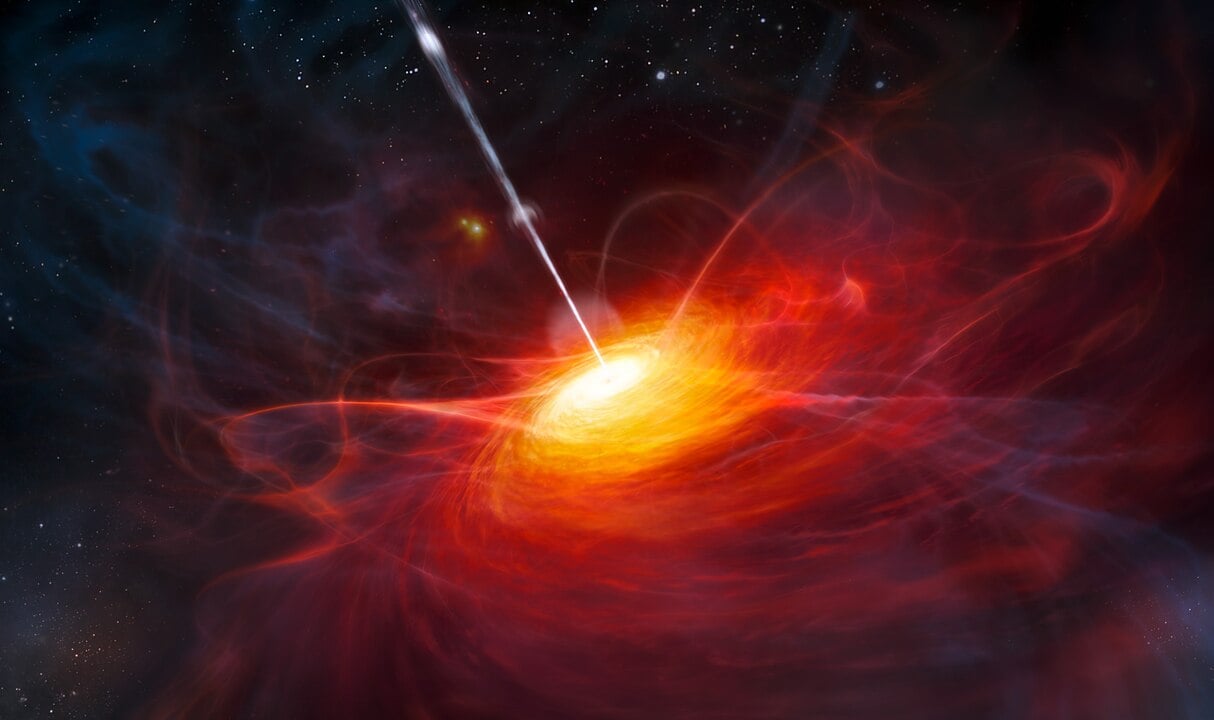 Artist’s rendering of the accretion disk of ULAS J1120+0641, a very distant quasar containing a supermassive black hole with a mass 2 billion times that of the Sun (Credit: ESO/M. Kornmesser)
Now, researchers led by Everett MacArthur have dramatically expanded this small sample using innovative machine learning approaches and data from dark energy spectroscopy instruments. Their study examined more than 812,000 quasars and identified seven new high-quality candidates. This is more than twice as many known samples in a single search.
The challenge lies in detecting subtle features in background galaxies whose light is gravitationally bent by the quasar’s host galaxy in the foreground. When more distant galaxies sit behind a quasar in almost perfect alignment, the massive gravity of the quasar’s host galaxy acts as a lens, bending the light of background galaxies around it. This produces multiple distorted images of background light sources, which are typically too faint and small to be resolved from the ground, given the quasar’s brilliant glow.
Spectroscopy offers another method of detection. When the background galaxy’s light passes through the same spectrometer fiber as the foreground quasar, its emission line appears at a different wavelength due to its higher redshift. The researchers trained a neural network to find these telltale features buried in the quasar’s spectrum.
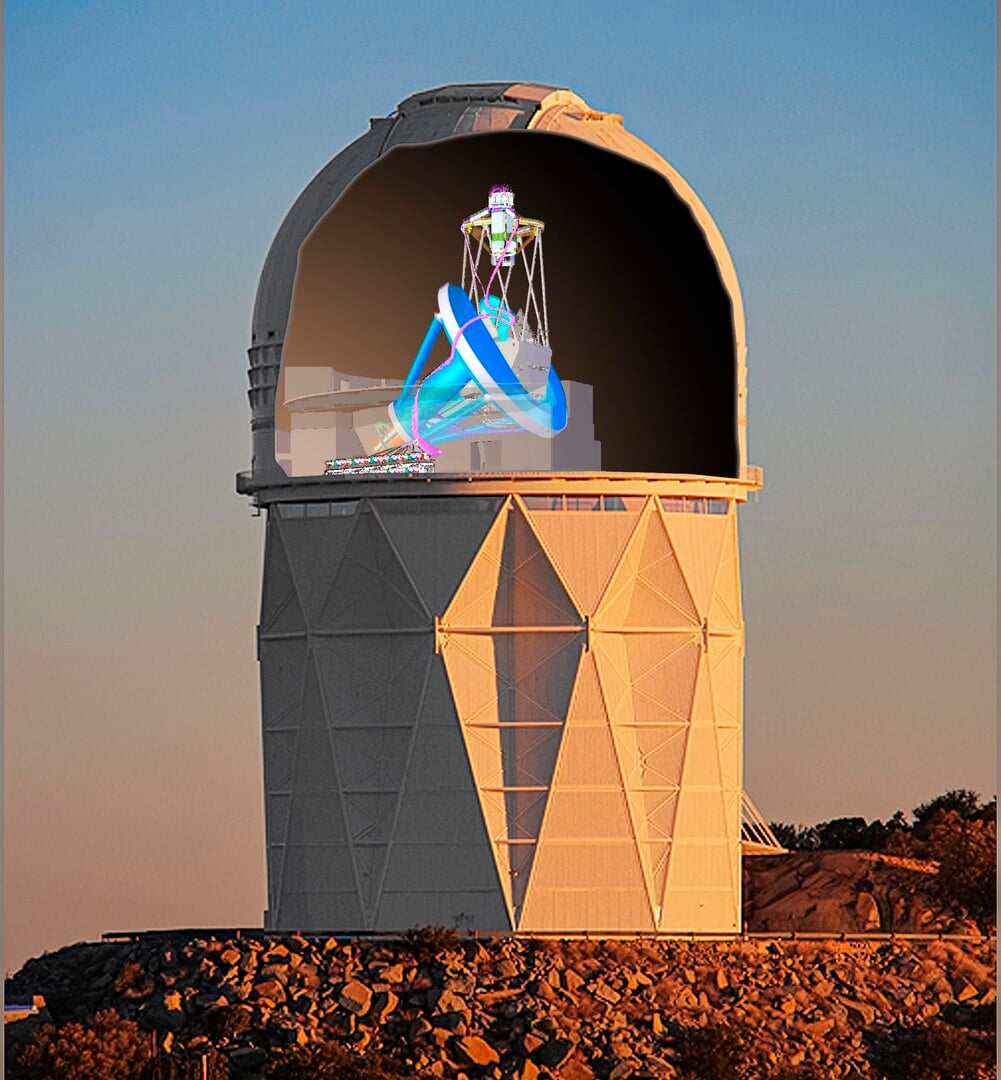 DESI in the dome of the Nicholas U. Mayall 4-meter Telescope at Kitt Peak National Observatory (Credit: Lawrence Berkeley National Lab/KPNO/NOIRLab/NSF/AURA – DESI)
Because real quasar lenses are so rare, the research team was unable to train their neural network on thousands of real-world examples. Instead, they constructed a realistic simulated lens by combining the actual DESI spectra of quasars with those of more redshift emission-line galaxies. They fed the spectra of about 3,000 synthetic lenses and 30,000 regular quasars into the network and taught it to distinguish the subtle emission line features of background galaxies from the complex spectral features of the quasars themselves. This network achieved very high accuracy classification performance with an area under the curve of 0.99.
Applying this approach to DESI’s first data release spanning quasars from redshift 0.03 to 1.8, seven grade A candidates were identified. Each shows a strong oxygen doublet emission line at a higher redshift than the foreground quasar, and four more show hydrogen beta and oxygen 3 emission from background galaxies. This method also successfully restored a single previously known quasar lens system within the DESI footprint.
Why is this important? Quasar lenses provide a powerful exploration of how supermassive black holes and their host galaxies have co-evolved over the history of the universe. The Einstein radius (the characteristic angular size of the image through the lens) directly reveals the mass of the host galaxy. Using traditional methods, it is nearly impossible to separate a quasar’s light from its host galaxy, but gravitational lenses make this measurement easier.
Source: Quasar acting as a strong lens found in DESI DR1