

Many writers, actors and other creatives are now experiencing a small wave of panic, with artificial intelligence (AI) taking over their jobs.
Generic AI (Genai) makes machine learning and creative work accessible to everyone. But for industry experts, the rise of generative AI can demonstrate the disruption of creative work.
However, a recent report by the World Economic Forum shows that AI will create more jobs than it will be expelled over the next five years.
We are four scholars from various creative industries who want to explore educational approaches to AI. We want to prepare the next generation to innovate within a collaborative framework with humans. To do this, we began consulting with other creative experts through online research.
What if AI can actually support human creativity and productivity? Can you use these technologies to your advantage? What can we expect in the future?
Creative experts believe that new technology can be utilized while supporting basic creative and ethical principles.
How AI is used in the creative sector
AI is deeply embedded in the operational workflows of the creative industry, from early concepts to integrated reality.
Media and creative workers are on strike to protest the use of AI, causing important conversations. For example, the Hollywood Screenwriters and Canadian Writers Coalition raised concerns and helped shape new policies about AI and creative work.
Within media production, large-scale language models (LLMS) promote rapid prototyping of narrative concepts, scripts and audiovisual materials, while automated editing platforms and AI-driven visual effects create large-scale efficiency gains in post-production. This technical integration allows creators to move their focus from tedious manual tasks to high-level creative refinement.
In graphic communication and packaging, AI and machine learning are recognized as the driving force behind change. AI can enhance processes from ideas to production logistics, from sorting and personalized web to printing platforms. In the realm of digital asset management, AI can help improve the discoverability and utility of assets through automated metadata tagging and sophisticated image recognition.
Journalism is also undergoing major changes. AI has been used for some time to analyze large datasets for research reports, but LLMS is now streamlining article summaries regularly. More advanced applications are here. The AI system is designed to identify news values and automatically generate articles from live events. Major news organizations like Financial Times and New York Times We have already deployed AI tools in our newsrooms.
Ethical Issues
AI integration is not without its significant challenges.
Generation of manufactured information and non-existent sources is a documented obstacle. These examples highlight important issues of accuracy and reliability.
Many people say they don't fully understand the extent to which AI is built into standard software. This disparity between deployment and user awareness highlights the subtle yet broad nature of AI integration. This illustrates the urgent need for improved transparency and digital literacy.
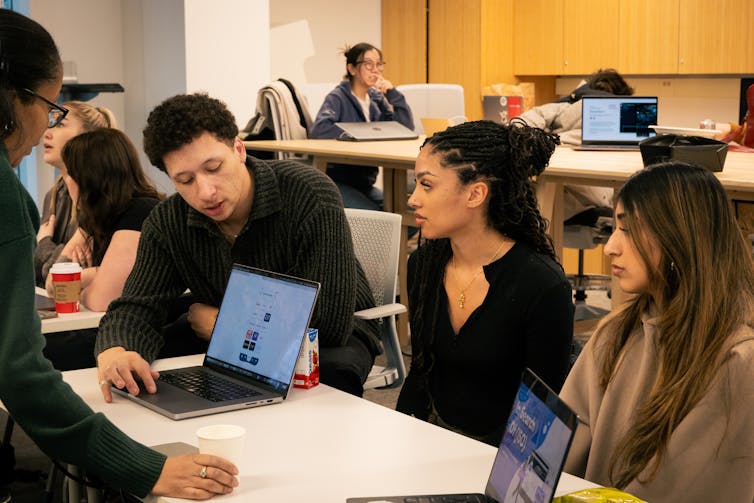
(YYZ Media/TMU), Provided by the author (no reuse)
Bias and Intellectual Property
Models trained with vast, uninstitutional internet data often replicate and amplify existing social biases. For example, studies have shown persistent issues such as anti-Muslim bias in LLMS.
Read more: Artificial intelligence can discriminate based on race and gender, age
At the same time, urgent ethical and legal issues with intellectual property emerged. LLM's training with no compensation copyrighted content has created considerable friction. For example, pending New York Times The lawsuit against Openai highlights the open issues of fair use and reward for creative work.
Conversely, Genai shows considerable potential to democratize creative production. By lowering technical barriers and automating complex processes, these tools can provide access to individuals and groups historically excluded from creative fields through resource and educational constraints.
Certain applications have already enhanced media accessibility, including AI-powered tools that automatically generate ALT text for images and subtitles for video content.
Navigating this dual usage landscape requires the adoption of a robust governance framework. Promoting industry-wide equity, diversity and innovation education is essential to mitigate risk while leveraging the possibilities of Genai, a comprehensive creative ecosystem.
Evolution of labor and skills
The technological revolution has catalyzed significant changes in the historically creative labor market, and Genai represents the latest disruptive force.
The surge in genai reshaped the creative industry and called for new professional capabilities.
Human creativity and intervention are essential and provide cultural and contextual accuracy. Humans also need to look at AI-generated content for quality and inclusiveness.
In response to this shift, higher education institutions need to readjust their curriculum from tool-specific training to fostering curiosity, ethical reasoning and AI literacy.


