

<写真1。ジェーシク・チョイ教授、カイスト・キム・ジェチュル大学院>
Recently, text-based image generation models can automatically create high-resolution, high-quality images from natural language descriptions alone. However, when the text “creative” is given to a typical example, such as a stable diffusion model, the ability to generate truly creative images remains limited. Kaist researchers have developed technologies that can increase the creativity of text-based image generation models such as stable diffusion without additional training, allowing AI to draw creative chair designs that are far from normal.
The research team of Jaesik Choi, AI at Kaist Kim Jaechul Graduate School, has worked with Naver AI Lab to develop the technology to enhance the creative generation of AI-generating models without the need for additional training.
<写真2。NAVERAILABの研究者、Gayoung Lee。 Dahee Kwon、Ph.D。 AIのKaist Kim Jaechul大学院の候補者。ジヨン・ハン博士AIのKaist Kim Jaechul大学院の候補者。 Junho Kim、Naver AI Lab>Researcher of
Professor Choi's research team has developed a technology that enhances creative generation by amplifying internal functional maps of text-based image generation models. They also found that shallow blocks in the model play an important role in creative generation. They confirmed that after converting feature maps to frequency domain, amplifying values in the high frequency region could lead to noise or fragmented color patterns. Therefore, the researchers have demonstrated that amplifying the low-frequency regions of shallow blocks can effectively enhance creative generation.
Taking into account originality and usefulness as two key factors defining creativity, the researchers proposed an algorithm that automatically selects the optimal amplification value for each block in the generative model.
Through the developed algorithms, proper amplification of internal functional maps of pre-trained stable diffusion models was able to enhance creative generation without additional classification data or training.
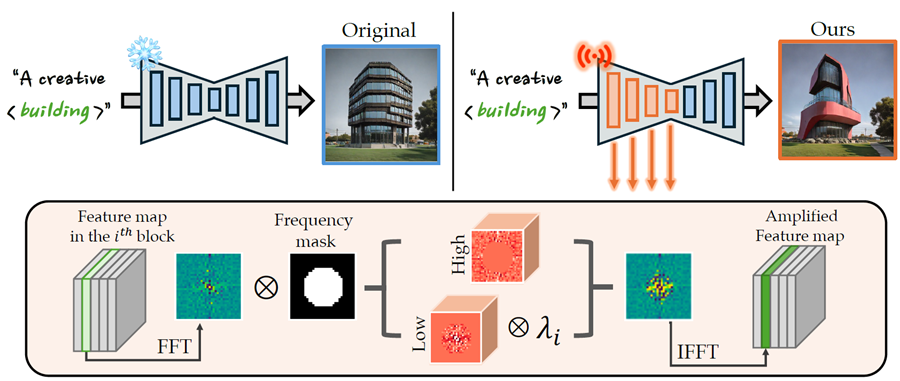
<図1。開発チームが研究した方法論の概要。事前に訓練された生成モデルの内部機能マップを高速フーリエ変換を介して周波数ドメインに変換した後、特徴マップの低周波領域が増幅され、逆高速フーリエ変換を介して機能空間に再変換されて画像を生成します。 >
Using a variety of metrics, the researchers quantitatively proved that the developed algorithms can generate images that are more innovative than those of existing models without significantly compromising their usefulness.
In particular, they observed an increase in image diversity by mitigating the mode collapse problem that occurs in SDXL turbo models, which were developed to significantly improve image generation speeds for stable diffusion XL (SDXL) models. Furthermore, user studies showed that human assessments showed significant improvements in novelty compared to utilities compared to existing methods.
Ji-young Han and Dr. Da-hee Kwon Kaist and candidates for the paper's co-first author said, “This is the first methodology to enhance the creative generation of generative models without new training or tweaking. We have shown that potential creativity within a trained AI generative model can be enhanced through functional map manipulation.”
They said, “This research allows for easy generation of creative images using only text from existing trained models. It is expected to provide new inspiration in a variety of fields, including creative product design, and contribute to practical and useful applications of AI models in the creative ecosystem.”
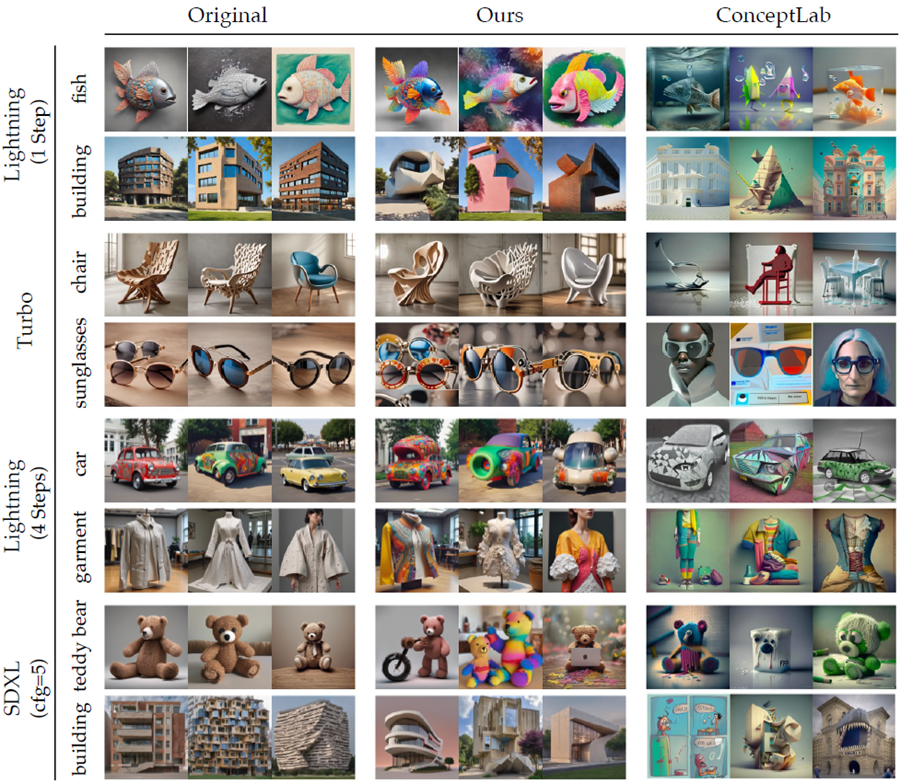
<図2。開発チームが研究した方法論のアプリケーション例。さまざまな安定した拡散モデルは、生成されたオブジェクトの意味を維持しながら、既存の世代と比較して新しい画像を生成します。 >
This research was co-authored by Ji-young Han and Dr. Da-hee Kwon. The candidates for the Graduate School of AI Kaist Kim Jaechul were presented at the International Conference on Computer Vision and Pattern Recognition (CVPR), the International Science Council of Japan.
*Paper Title: Enhance creative generation with a stable, diffusion-based model
* doi: https://doi.org/10.48550/arxiv.2503.23538
This research is supported by the KAIST-Nover Ultra Creative AI Research Center, the Innovation Growth Engine Project Exclupable AI, the AI Research Hub project, and research on flexible and evolving AI technology development in line with ethical policies funded through the Ministry of Science and ICT for the promotion of information and communication technologies. It was also conducted at the KAIST Future Defense AI Specialized Research Center with support from the KAIST AI Graduate Program and with support from the Defense Acquisition Program Management and Defense Development Agency.
/Public release. This material of the Organization of Origin/Author is a point-in-time nature and may be edited for clarity, style and length. Mirage.news does not take any institutional position or aspect, and all views, positions and conclusions expressed here are the views of the authors alone.


