
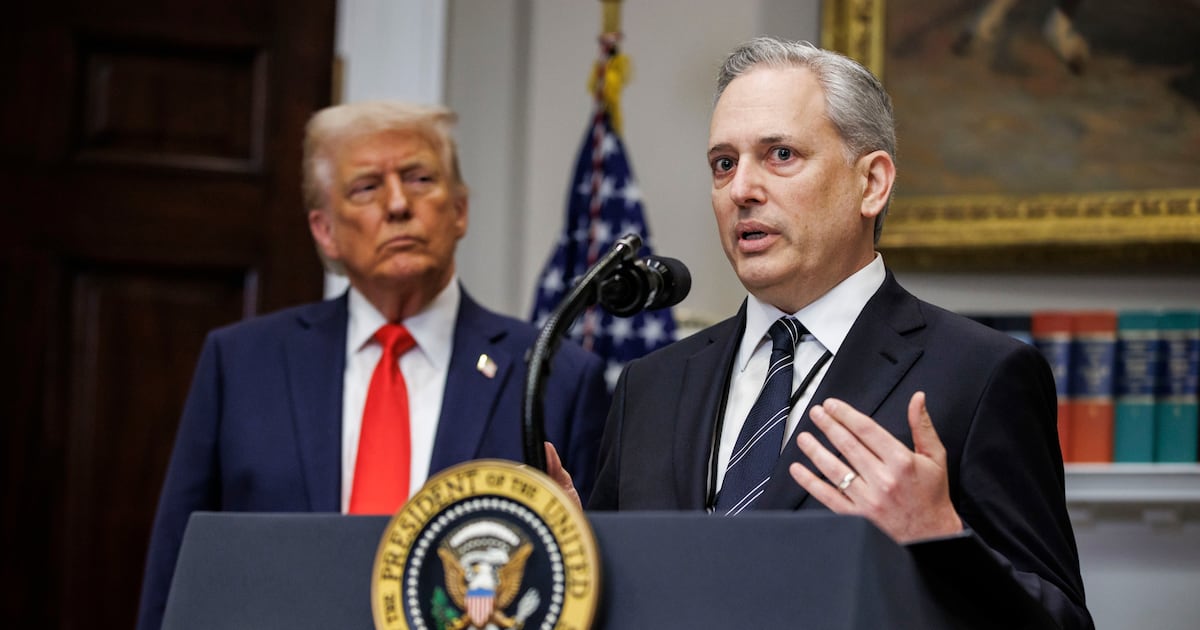
US President Donald Trump’s adviser on artificial intelligence said the decision to allow the UAE to make strong semiconductor purchases was a turning point in making US technology the dominant standard.
David Sachs, who also serves as the White House crypto czar, commented on the US and UAE efforts in AI at the Hill & Valley Forum conference in Washington. The forum describes itself as a “nonpartisan, private community of lawmakers and innovators committed to harnessing the power of technology.”
“The argument was made that somehow any chip sold to the UAE is like being sold to China, and any chip sold to you will be diverted,” he told a packed room in the Andrew W. Mellon Auditorium, a few blocks from the White House.
He called the concerns expressed by some “bullshit” and said current geopolitical events support this.
“If UAE data centers were serving China, I don’t think they would be bombed by Iran right now,” Sachs said.
On Monday, during a preview event at the Hill & Valley Forum, U.S. Under Secretary of State for Economic Affairs Jacob Helberg spoke about the Trump administration’s deepening technology partnership with the United States and the UAE.
He also said an Emirati delegation will meet with senior U.S. officials later this week to discuss furthering the AI acceleration partnership the two countries signed last year.
“The group’s work is even more meaningful in light of current events,” Helberg said in response to a question. The National. “We would like to reaffirm how much we value our bilateral relationship with the UAE and the courage they have shown during this incredibly difficult time.”
The UAE has been the target of thousands of Iranian drone and missile attacks since hostilities between the US and Israel began on February 28.
Yousef Al Otaiba, UAE Ambassador to the United States, said last week that trade, partnership and investment in the United States remains strong.
“The UAE’s $1.4 trillion investment and economic framework with the United States, announced last year, will remain on track with plans to accelerate deployment and financing,” Al Otaiba said in a letter to the U.S.-UAE Business Council. Several deals related to AI, energy, advanced manufacturing and critical infrastructure are underway, he added.
Over the past decade, the UAE has made great strides towards becoming a global leader in AI.
In 2019, the country announced the establishment of a university specializing in this technology, the Mohammed bin Zayed University of Artificial Intelligence.
Two years ago, the UAE was one of the first countries in the world to appoint an AI Minister, Omar Al Olama, who is currently Minister of State for AI, Digital Economy and Remote Work Applications.
A systematic effort to prioritize AI in the UAE culminated in a major announcement during Trump’s visit to the country in 2025, announcing plans for a 5GW UAE-US AI campus.
The UAE, along with various US-based technology companies such as Microsoft and Nvidia, have been urging the US to ease chip restrictions on friendly countries such as the Emirates.
These efforts have been largely successful, and security agreements play an important role in ensuring that U.S.-designed semiconductors are not used by nefarious groups or governments.
More broadly, there are concerns about semiconductor smuggling, which is occurring as the U.S. and China compete for AI supremacy.
Last week, the U.S. Department of Justice indicted Supermicrocomputer co-founder Wally Liau and two others for allegedly trying to divert U.S.-made AI chips to China.
“The defendants’ scheme became more brazen over time, resulting in the shipment of large numbers of servers containing controlled U.S. artificial intelligence technology to China,” the department said.
But Michael Crasios, director of the Trump administration’s Office of Science and Technology Policy, said in August that successfully implementing such a scenario would be much more difficult than many imagined.
“These are like huge racks that weigh tons of tons, and you can’t put them on a forklift or load them into a truck,” he said. The idea of chip smuggling “is probably going to get more airplay than it needs to,” he added.


